Author: helenlehndorf

  • Slow-Small Media for the Weekend #5

    (Above: My inspiration wall. Are you an inspiration wall / mood board kind of person?)

    Let’s start with poetry:  

    How are you doing?

    Every time I catch up with the news, I feel pretty bleak for a while afterwards so I’m making myself go in search of a poem to remind me of all the good in the world. This one from Ada Limon is very beautiful and helpful, ‘Instructions For Not Giving Up.’

    Do you spend time in NZ bush huts? Here’s a cool collaborative creative challenge… 

    Check out this wonderful call out for anthology submissions from creative powerhouse couple, Kemi and Niko

    Go to a favourite bush hut, respond to your surrounding in words and/or images, submit! 

    Dancing our work, dancing our meals

    I love this piece which was on Dark Mountain recently about a dancer in dance-training in Japan where the class danced every aspect of their lives. 

    They danced their garden work, they danced their food, they danced from place to place. 

    From the piece: ‘Ours was a dance that featured the odd, the twisted, the dark, the ugly, the sick, the old, the infirm. We danced as bodies coming from the earth, eating the earth, becoming the earth.… we were animal, human elemental, sometimes all at once.’

    I don’t entirely understand what is happening in this piece and I loved it. Sometimes good writing can have that effect, hey?

    It made me want to dance my chores….dance my sweeping, dance my cooking, dance with the weeds as I kneel on the ground. 

    A long and melancholy song

    After I posted about my recent discovery of Sun Kil Moon, a friend asked me if I knew of this song ‘Farewell Transmission’ – full of yearning and foreboding. 

    The song was recorded with the whole band playing it live after just learning the song’s bare bones. It has a potent energy that can only come from when musicians are in the moment together, riffing and  trusting, watchful and present. At first the song didn’t especially grab me…but then it traverses through some interesting territory and the spare and repeated refrain of ‘listen’ at the song’s end becomes really powerful. 

    I have been listening to the song on high rotate since my friend told me about it. 

    Of course I ended up researching the band and the song a bit, because: nerd, and found this moving article on Orion magazine about the song and the sad demise of the writer and vocalist, Jason Molina. Jason Molina died of alcoholism, as did his mother. One interpretation of the song is that it is like a warning from his mother about his potential trajectory…which he ultimately did not/could not heed because of his illness. This only adds to the song’s haunting quality. 

    (& you can find the slow-growing playlist of all of the Slow Small Media songs together here on Youtube.) 

    In the kitchen

    This weekend, I want to play with making beetroot lattes! A while ago I bought some beetroot powder on a whim because I couldn’t resist the colour. I’m yet to use it so I looked up some ideas of uses and was taken with the idea of a bright fuschia-coloured latte. 

    I will use this recipe as inspiration but will play around with various powders I have in the cupboard…medicinal mushrooms, maca, spices. If it goes well, I’ll report back. 

    Affordable Art

    This week’s affordable art is just $25 for an original, inky linoprint from MairangiAtelier! What an amazing price for something hand-cut and hand-printed.

    There are several native birds to choose between in this listing but I particularly like the hawk, the Kārearea. 

    I have a pair of Kārearea claws which I preserved in salt (saved from roadkill)l. I love to hold them and visualise the freedom of soaring high, high above the land as a hawk. 

    Music nerd fun

    Let’s round off with a fun one. I love to watch the iconic Amoeba Records series called ‘What’s in my bag’ where famous musicians (and others) share what they have just shopped from Amoeba. It’s always interesting learning about people’s obsessions and a great way to find new music, too. 

    Comedian Bill Hadar’s ‘What’s in my bag?’ is a nerdy delight (18 mins) I especially love that they didn’t actually invite him. He’s such a nerd for this series he emailed them and asked to appear on it. How very geeky and sweet. 

    *

    This weekend is my city’s iconic Red Cross Book Sale, three huge halls full of second hand books! It’s a joy for the bookish, a highlight of the local calendar and it goes allllll the long weekend. I usually go along at least twice. 

    I also have a friend’s 60th birthday party…because apparently I’m now of the age where friends are turning 60! Not sure how that happened. 

    I hope all is well in your world & I hope you enjoyed at least one thing from this week’s digest.

    I’m enjoying sharing the strange corners of the internet that I lurk on with you.
  • 52 and still stumbling over the ‘A’ word…

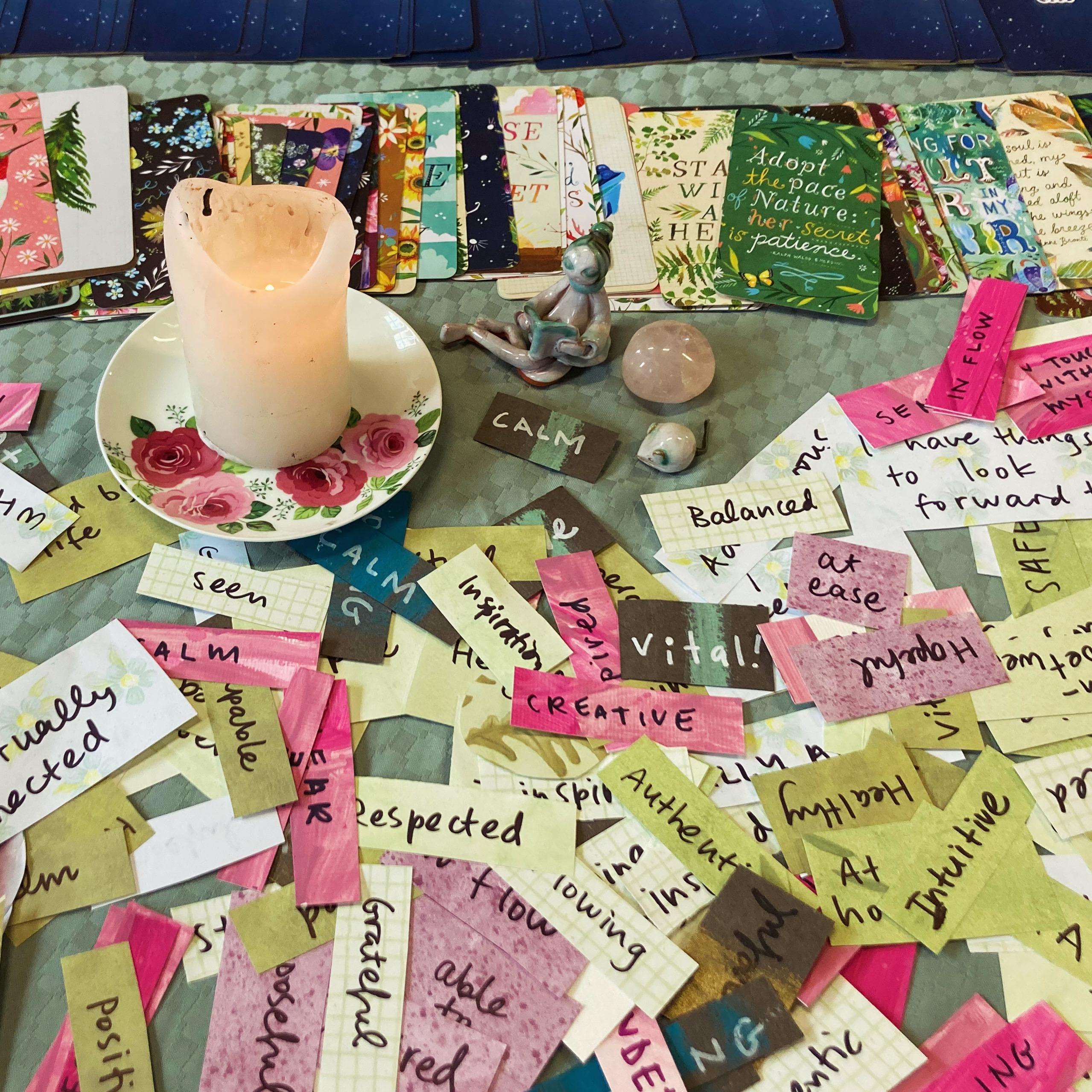
    (Above: journal word cards I make for my workshops.)

    Over the weekend, I was at a beach-side retreat for women so I was meeting some new people. I had just taught a journaling workshop (if you’re reading the blog because of foraging…you might not know my second book was about the practice of keeping a journal and I teach journal workshops) and a new acquaintance asked if I were an artist.

    I made some digressive, stumbling reply about how I loved to ‘mess about’ with art, had a visual element to my journal practice, love to play with art materials…mumble mumble… but ‘no, I am not a ‘proper’ artist.’

    My friend C, who was standing there, who is a visual artist, has been to art school, etc, interjected and said,

    ‘Helen, you are an artist. You are. You spend a lot of time doing art. You’re an artist!’

    I thanked her…the conversation moved on…but it left me reflecting.

    (Above: Mixed-media chamomile from a botanical sketchbook I’ve been working on.)

    I have taught creative writing for most of my working life (at university) and there I was, encouraging my undergrads to claim the ‘W’ word, ‘writer’ for themselves.

    ‘If you are passionate about writing, you spend your time writing, you are a writer!’ I said to them. I meant it, too. I felt there was power in the claiming of the word for themselves.

    And yet…and yet…here I am, old enough to know better, and still wiggling around doing the same thing for myself in another creative discipline. I studied creative writing at university and spend a great deal of time writing so it feels simple to claim ‘writer’ for myself. I still wobble around with claiming ‘artist’.

    Aren’t our brains fascinating, and odd, and annoying?

    (Above: Mixed-media red clover from a botanical sketchbook I’ve been working on.)

    I think part of it is where a passion intersects with an audience, or with capitalism. I find it easy to claim ‘writer’ because I have published things and had an audience respond to them. My words have earned me (a little!) money. I have been successful in selling books.

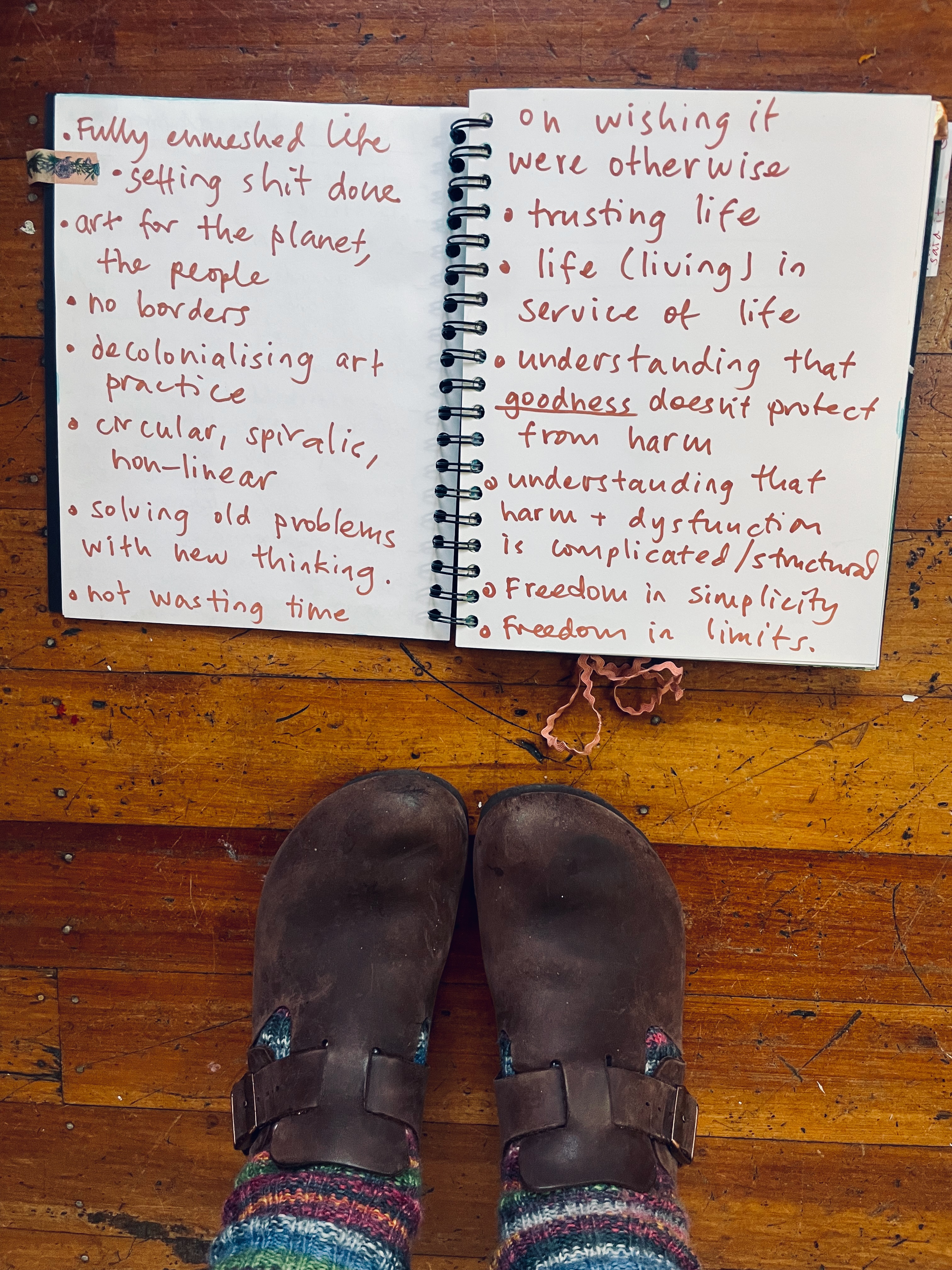
    (Above: art manifesto in the making. Sketchbook notes.)

    My art is mostly in the vein of play, experimentation and enjoyment of the creative process. I have exhibited art work and sold a few things. When my children were small, I supplemented my income with making self-designed and drafted textile crafts and paper goods. I love taking photographs. I feel I have a good visual eye.

    So how is it, I can, for years, have encouraged students to claim ‘writer’ for themselves and yet fail to take my own advice in another discipline?

    Do you have a creative practice noun -artist, writer, musician, singer, potter?-…..you yearn to claim and inhabit but struggle with? I’d love to hear about your blocks or advice for overcoming this odd phenomena.

    Love, Helen, (confident writer, tenuous artist.)

  • Slow-Small Media for the Weekend #4

    Somehow it’s the weekend again, friends. What even IS time lately?


    (Above: Black peach cake. We’ve been exploring butter-free baking due to butter now being mostly unaffordable in NZ. More about that below.)

    What does it mean to get older consciously

    At the start of this year, I started a Pinterest* board: ‘Conscious Ageing’. I wasn’t sure exactly what I wanted to fill it with. So far I have been stowing in there memes about integrating the past, looking after yourself well and any images of older women that I find inspiring. 

    I wrote a little in ‘A Forager’s Life’ about being on the threshold of ‘baby eldership’. I don’t want to get older before my time (I know 52 is not that old) but I do want to walk into my elderhood with open eyes and conscious integration along the way. 

    With these sorts of things in mind, I enjoy reading material written by people a little further along the path than me and I really enjoyed this article by Laurie Wagner about her observations of her changing self as she gets a little older. Honest and compelling writing. 

    (Beautiful artwork by Dee Nickerson.)

    Heartening writing on finding joy in spite of/amongst a heavy care load: 

    I really appreciated this article about the tensions of caregiving but/and joy in spite of it all. By Elizabeth Kleinfield.  

    This line from Elizabeth’s article:

    The worry is constant, a background hum beneath everyday life’

    really captures how life has felt for me as the parent of a kid with a disability. Even when I get an opportunity to ‘relax’ …I can never entirely relax. The hyper-vigilance of care is as deep in me as my bone marrow. 

    How to easily increase the yields from your garden harvests by reframing how you see vegetables: 

    Are you a vegetable gardener? Here’s a helpful and interesting video (11 mins)  from garden writer Huw Richards on how to get more from your harvests in the garden by considering all of the parts of a plant…it’s kind of like ‘nose to tail’ eating except for vegetables. Eat those flowers! & in some cases, eat those roots!

    A beautifully-written origin story: 

    I really enjoyed this article by New Zealand writer and reviewer Lucy Black about the origins of her ravenous reading habit (I know Lucy IRL and no one reads more books than Lucy!) I always appreciate articles which explore working class experience and Lucy’s article is buoying and beautiful. 

    Affordable art: Iko Iko’s Cavallini Posters

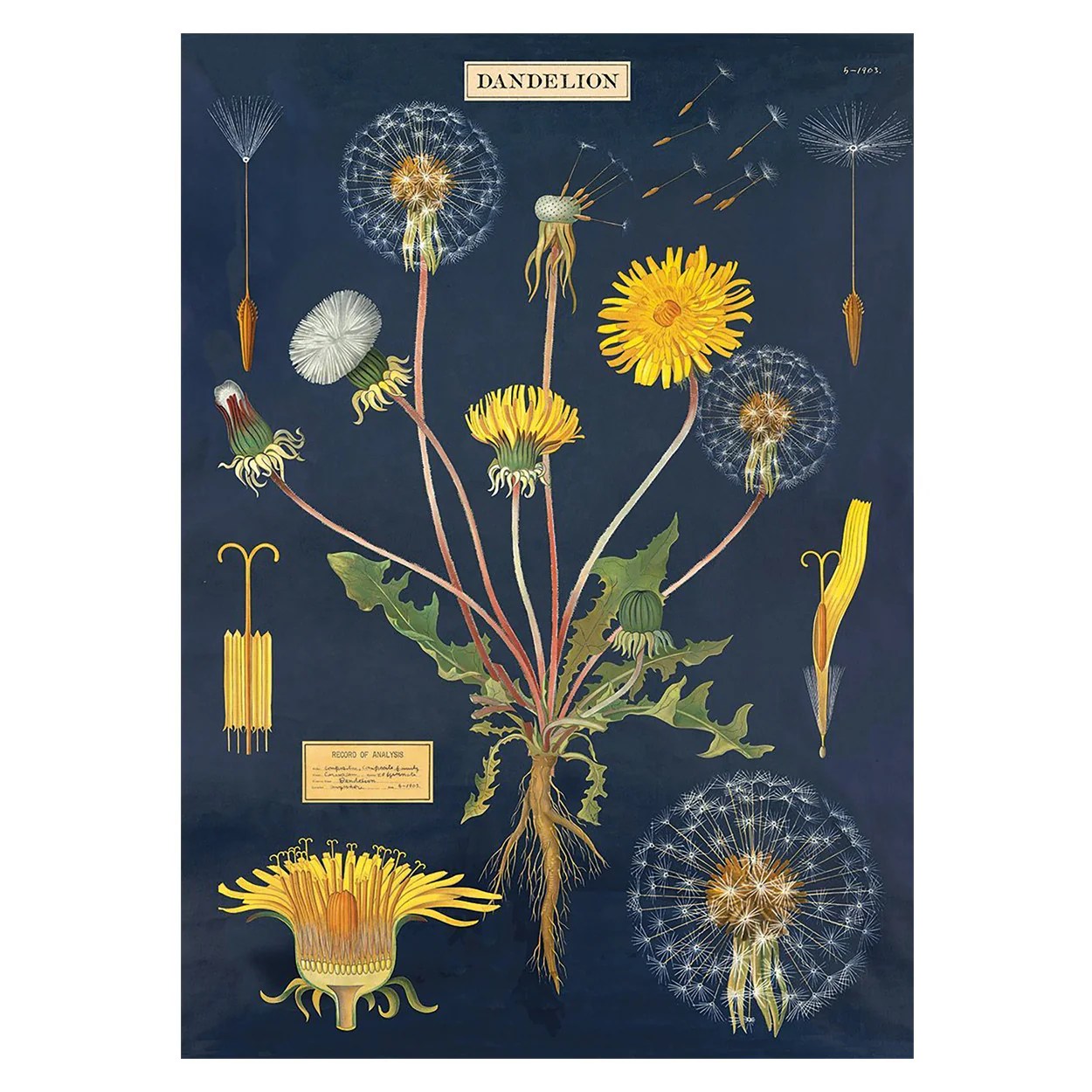
    I promised to find you affordable art under $50 NZD. This week’s is under $20! Iko Iko’s Cavallini Poster range of vintage-inspired posters are just $17 each.

    Predictably, I have this foraging one on the back of my front door. I also have this dandelion which I bought a few years ago. Most of them are so gorgeous…I’d love more but I don’t have much wall space left. Luckily my big dandelion still brings me joy every day. 

    A no-butter-needed tea loaf 

    In New Zealand, butter prices are rocketing. We can no longer afford to buy butter each time we grocery shop as we used to. 

    But my sons like to bake so I’ve been encouraging them to find recipes with little to no butter…which has cause a tea loaf revival in our house. Old-fashioned tea loaves are often dairy and egg free, yet still turn out moist and light. There are endless variations, date loaf, ginger loaf, here’s a nice dried fruit version we made this week. 

    Inspiring Creative Process videos

    Country Living UK has a Youtube channel and within it, they have a series of beautiful short films (around ten mins) about the creative process of artists who make work (from lots of different mediums)  inspired by nature.

    I’m slowly working my way through the playlist…but none so far have disappointed. 

    Calm, cosy and soothing viewing. 

    A beautiful song

    I love this sweet and poignant song by New Zealand artist Maisy Rika, called Reconnect. If you are not from NZ, the ‘Tui’ and ‘Huia’ mentioned in the opening are new zealand native birds. I love this repeated lament towards the song’s end…

    Change is inevitable, things don’t last forever…

    things don’t last forever, things don’t last forever

    (By the way, I have started gathering all the songs I’m sharing here into a slow-evolving playlist. You can find it here on Youtube. )

    Tell me in the comments what you’d like more of or less of for these Friday digests. 

    This weekend I am going to a wild west coast beach for a gathering of witches. *cackles manically* What are you up to? 

    (*Pinterest is the social media account I have the biggest following on. I have 16, 000 followers over there! I’m not quite sure how that happened…perhaps 15, 990 of them are bots?)

  • In the kitchen this week: an experiment with basil and a batch of Fire Cider

    (Above: the things I put in this batch of Fire Cider. Every batch is unique. It’s a real ‘use what you have’ medicine.)

    Kitchen-witchery is slow work.

    Sometimes things that end up the jars in my kitchen began months ago with literal seeds in the greenhouse or foraged finds from a season the opposite to now. If I count growing, harvesting and sometimes drying or macerating in to the recipe hours…I have to describe the recipe method in months rather than hours. This is why I love ‘slow food’ or the localising food movement…it operates on an entirely different time-scale to the deadening speed of supermarkets and fast food outlets.

    An example of this, I just conducted an kitchen experiment which began in back spring as seed…basil seed…grown by both me and my friend Bev of Kereru Natural Products. I had a modest basil harvest but Bev’s basil really flourished this summer and her basil patch was thigh high! I’d never seen such large basil plants. Whilst looking after her place for a weekend in summer, I harvested some and made a large batch of pesto; some for her, some for me. I’m used to making pesto without a recipe but for such a large batch, I googled a recipe to help me with proportions. I used this one which calls for 16 cups of chopped basil (!) to give you a sense of scale.

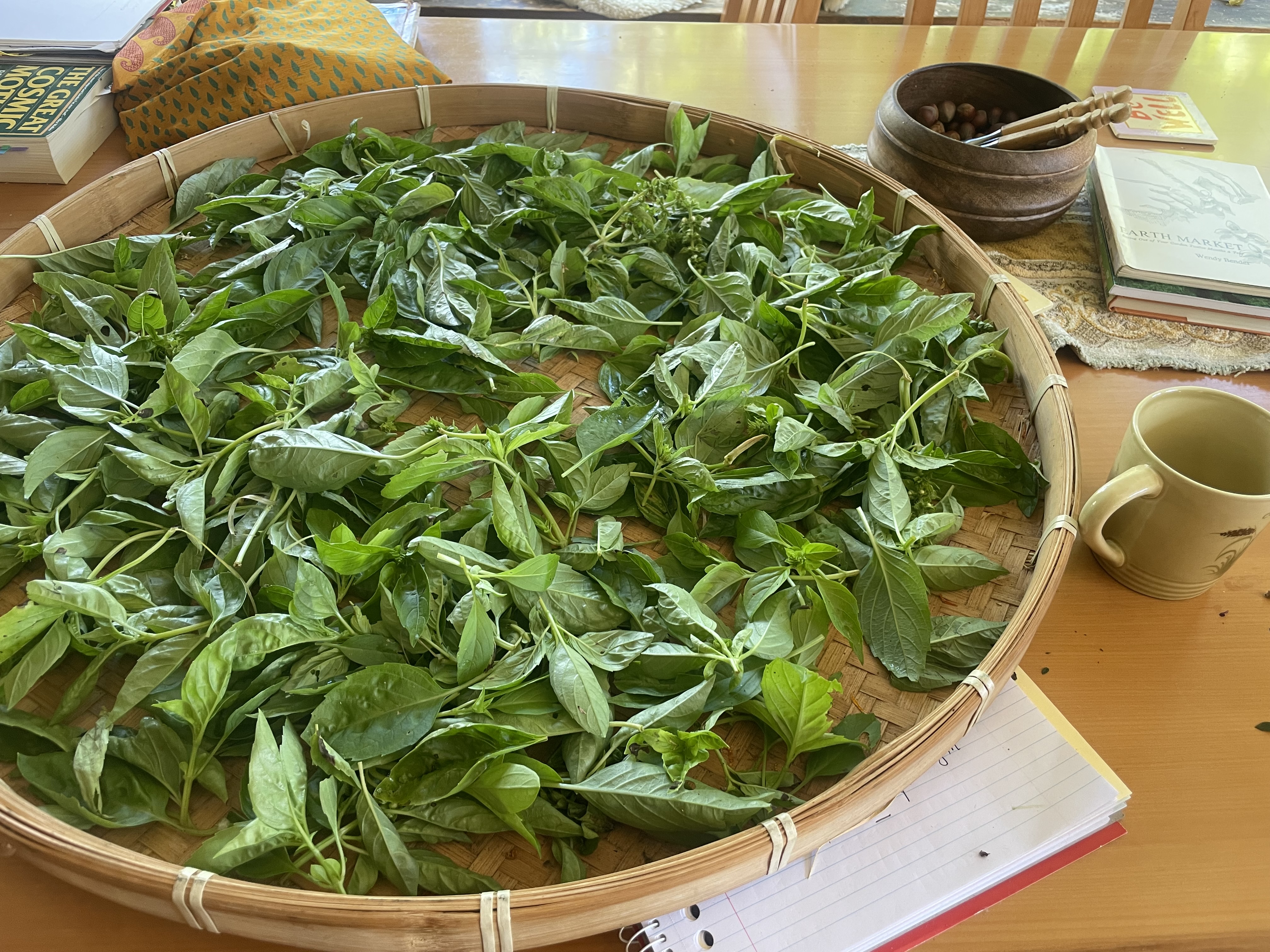
    (Above: basil, basil everywhere.)

    After the big basil-making session, the woody stalks were left behind. The stalks smelled so divinely peppery and aromatic, I felt loathe to compost them. So I tied the stalks from Bev’s basil and from my own in a bunch and hung them upside down in my greenhouse to dry.

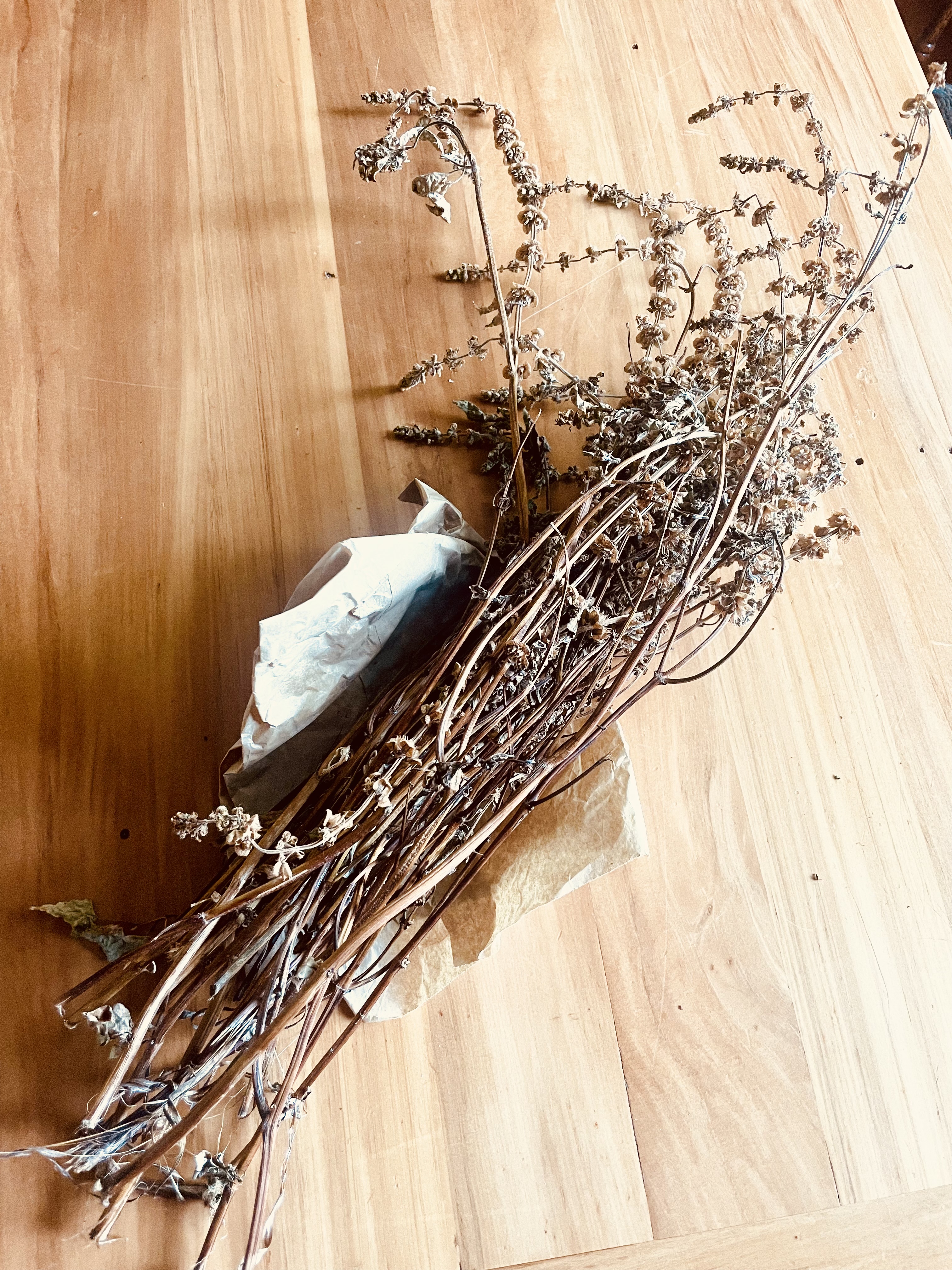
    (Above: one of the bunches of dried basil stalks and flowers.)

    Last weekend, with harvest season madness slowing down enough to get to some more peripheral tasks, I bought the dried basil stalks in and had a go at turning them into a basil salt by cutting them into small chunks and grinding them into NZ seasalt in my electric spice grinder.

    I had to use garden secateurs for this, as they were very woody once dried. My spice grinder juuuuust coped. It made a not-very-visually-appealing, khaki, fibrous salt. However, what the salt lacks in visual appeal in more than makes up for in flavour.

    (Above: ground basil stalk + NZ sea salt. It’s not pretty but it’s delicious.)

    It has that intense, almost licorice smell that the top notes of basil has. It tastes like ‘essence of basil’. It’s freakn’ delicious and while it’s not attractive enough to be the kind of salt you’d put in a cute dish on the table, it makes a great ‘deep notes’ salt. I will be adding it to things which slow cook, like soups, stews and using it more like a stock than a table salt. I think this experiment was a success although if you have any thoughts about how to make it look more attractive, let me know in the comments. (You have to scroll all the way to the bottom of each post to find the comments box, btw.)

    Another thing I made on the weekend, was a batch of Fire Cider as we’ve gotten through all of last year’s.

    Fire Cider is basically a brew of ingredients which stimulate the immune system, the digestive system and are anti-inflammatory, steeped in apple cider vinegar. The resulting fiery brew can be taken as shots with a little water through the winter to help stave off winter colds. I also use it in dressings to we are ‘eating’ our medicine through the winter as well.

    There’s a fascinating story about Fire Cider. In america, a natural goods company attempted to trademark ‘Fire Cider’…an insult to this commonly-known and used folk medicine! An angry and indignant group of ‘fiery’ herbalists fought in court against this attempt to trademark folk medicine and WON! Hoorah! A victory for the commons.

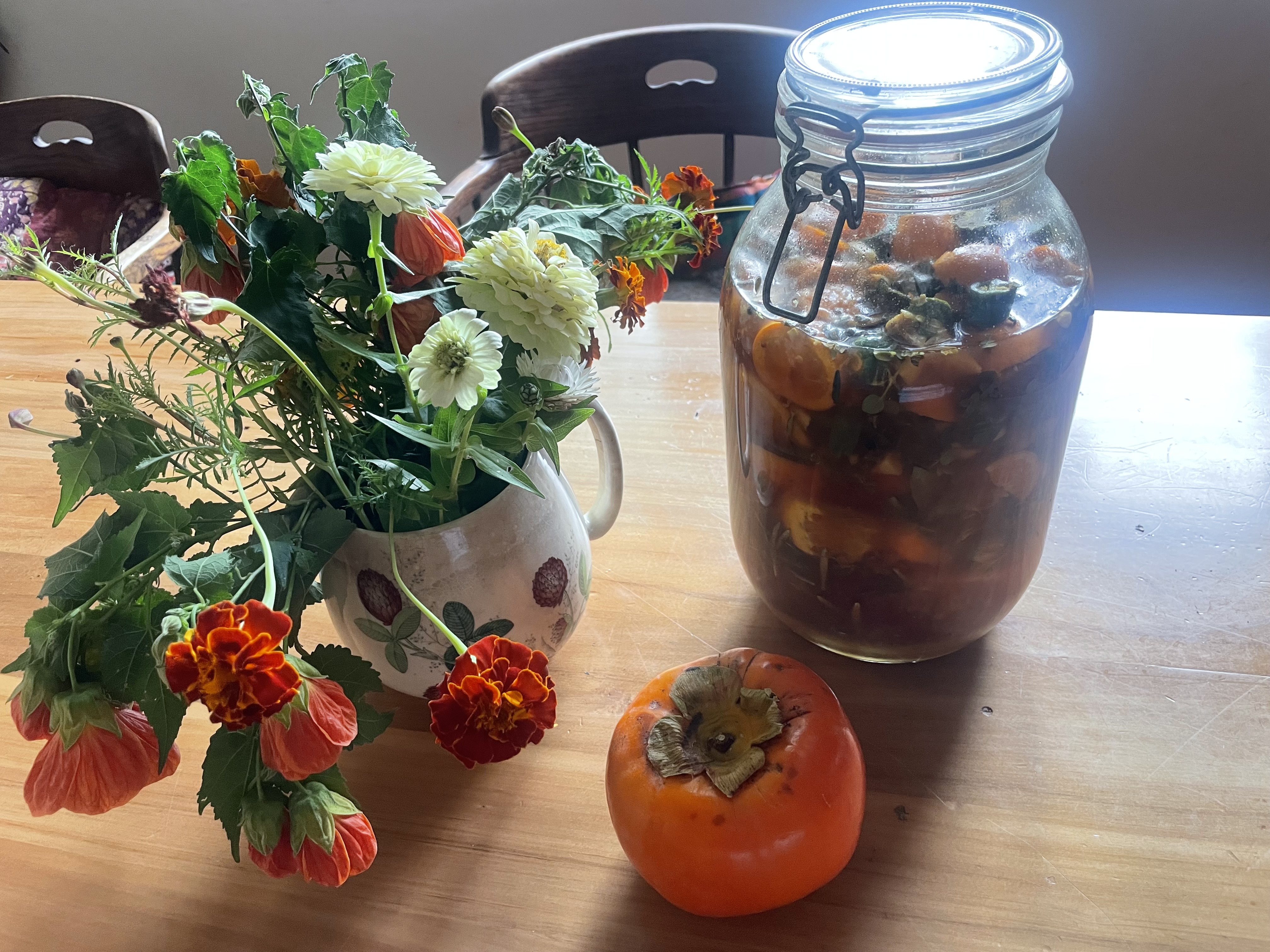
    There’s no real ‘recipe’ to Fire Cider. You use what you have and the ingredients you prefer. I don’t like white onion in mine but I do like the heat of chillies and garlic. I used some oranges for vitamin C. Rosemary, sage and thyme, calendula from the garden > all great for sore throats and coughs. Plus ginger and turmeric. by the way, I’d made the apple cider vinegar myself from our summer apple harvest. (See what I mean about slow food?)

    I find it a fun thing to make because it looks so pretty in the jar while it’s brewing. Our is currently sitting on the kitchen table…at least for a while.

    (Above: still life with garden blooms, fire cider brew and a huge persimmon my mother-in-law gave me.)

    Every late summer and autumn, I make various winter medicinals: oxymels, tinctures, vinegars, throat sprays…etc. I think everyone should be able to access simple herbal medicinals. They can be very expensive from the health store so I like to share what I make around with my friends and family.

    & that’s what’s been happening in Ahuru Kitchen this week. (Our house came with a name on the front: the Māori word, Ahuru, which means nest.)

    Do you make medicinal things in your kitchen as well as culinary things? Do you ever do strange experiments with odd ingredients? I’d love to hear about it in the comments.

    & May we all have robust health this winter! x

  • Slow-Small Media for the Weekend #3

    (Above: dawn in the Otaki Gorge…from a trip there recently.)

    Slow-Small Media for the Weekend #3

    Make a cup of tea, snuggle up with your laptop if you have one (for a nicer reading experience than squinting at your phone) and enjoy some nourishing longer reads and beautiful things. 

    In these digests, I am not looking for things to share that are new, fresh, hot off the press (although sometimes they might be)…I want them to feel like an antidote to the speed and brain-addling endless novelty of social media so I am slow-mooching around the internet looking for quality over novelty. 

    A remarkable interview with a beekeeper who turned a wall of her house into a natural beehive so she could live with her bees

    If you have any interest in bees, you must read this interview with beecharmer Susan Chernak. She turned part of a wall in her house into a natural bee hive! open to the outside so that she could live with her bees. 

    Living with her bees, she observed that bees sing to each other, they cry, they take naps. 

    Reading this made me love bees even more. 

    A Song

    This week’s song has been one of my favourites for many years now:  Riptide by Laura Viers. If you’ve ever been knocked sideways by life, you might find this song comforting. Laura is also a visual artist.

    In the lyrics the narrator gets dragged out to sea by a riptide, asks the stars for help to get back to shore…then kind of gives up and makes peace with her surroundings. A song about surrender, I guess. Gosh that sounds depressing…but it’s not. It’s a beautiful, gentle and soothing song. Here’s an excerpt from the lyrics. 

    ‘Left with essence

    Of the moon and stars and night

    There’s no other route

    I cannot take self to flight

    I’ll float here with the shrimp and brine

    And on my cheeks and hair

    The salt will always shine

    And with this phosphorescence map

    A sailor’s chart, a mermaid’s hand…

    Something I’ll find.’

    An affordable art work

    When I can’t quite afford a print or painting by an artist I admire, I often buy their greeting cards or postcards and just frame those. That’s what I did a few years back with these two works by Australian artist, Lucy Pierce when I desperately wanted some of Lucy’s art on my walls but was too skint to even buy a print.

    (Above: Two of Lucy’s framed greeting cards on my kitchen wall. The image above them of the golden offering hands is by my friend, artist and writer Carly Thomas.)

    Lucy’s work is of the earth, of ancestry, of deep time. I find it warm and nourishing work. I hope to buy one of her amazing clay terraphim for my altar…I just can’t decide which one calls to me loudest. Lucy also writes on Substack here.

    I find this mandala of women ‘Belonging’ to be an inspiring piece about deep time…time as a spiral.

    A solace poem 

    Kindness by Naomi Shihab Nye.

    These opening lines get straight to it:

    Before you know what kindness really is

    you must lose things,

    feel the future dissolve in a moment

    like salt in a weakened broth.’

    But please go and read the whole poem. 

    + Do you want to know a poet’s trick for absorbing the full beauty of a poem? 

    Read it out loud to yourself, slowly, with short pauses at the end of each line to let the words really sink in. Then, if you like the poem, read it out loud to someone else in the house. 

    A recipe…or two

    Now that the weather is getting colder, this Mushroom and Lentil Cottage Pie is a hearty and vegetable-dense vegetarian version of a cold-weather classic.

    & for dessert, here’s a simple dessert recipe that is a must-add-to-your-recipe-file. In my household, we make Melissa’s ‘Any Kind of Fruit Tart’ so often that there is a copy of the recipe stuck to the inside of the baking cupboard. If you’re bored of crumbles but feeling too lazy to cream butter and sugar to make something cake-y, this recipe is your friend. (I see that she originally posted the recipe in 2011. So I guess that means we’ve been cooking it for fourteen years!) 

    Melissa is one of my original blogging friends from back in the early 2000s. She never stopped blogging so has much delicious content to delve into if you feel like spending some time in her calm and mindful world. 

    A calm and inspiring short film

    (Above: Twig poet and forest rewilder, Maria Westerberg.)

    Do you ever rewatch things you enjoy? I do. If something gives me a wash of calm or soothes like a balm or boosts my creative energy …I will rewatch it over and over.

    I’ve done that with this short (twenty minute) film about a ‘A Twig Poet’s Rewilding Journey’. 

    I particularly like her ‘Face Books’. 

    What is a twig poet? 

    Watch and find out and immerse yourself in her mossy, quiet world. 

    A mini-meditation 

    This beautiful video of sunflowers unfurling is two minutes long, very compelling, very soothing. (Warning: it may send you down a Youtube wormhole of timelapse flower unfurling videos.) 

    *

    I hope you enjoyed some of that. This weekend I will be pulling out the very last summer stragglers: a long tenacious cherry tomato, the green beans have finally given up producing, a chilli plant is starting to look unhappy with the cold evenings. 

    & I have a list of people I want to send snail mail to…overdue replies to beautiful missives that came my way last year. Now somehow it is May already and I haven’t written back yet. This weekend I will finally get to that. Do you still write snail mail? 

    I hope your weekend is good…and if it’s a busy one, make sure you fit in a short nap at some point…because the busier you are, the more important it is to take a nap.

  • How I auditioned to play myself and got rejected

    (An occasional series where I write about things that happened around my book, ‘A Forager’s Life’.)

    (Above: The audiobook as a tangible object!

    In winter 2023,  a few months after ‘A Forager’s Life’ came out, I received the exciting news that the book was going to be made into an audiobook with Bolinda Audio.   

    (By the way, it’s also available as an e-book) 

    Bolinda told me that they would soon be casting a voice artist and it would be recorded in Australia. They also asked me if there was anything particular criteria I would like for the voice actor. I replied that I’d like a warm, friendly voice and that it was very important to me that the Māori words in the book be pronounced correctly. 

    After I sent that email, I got to thinking ‘hang on a minute, don’t some authors read their own audiobooks?’. Of course they do…although it’s more common with celebrity authors or for celebrity memoirs. But in 2020, I’d had a bit of a go at recording some of my original meditations for the meditation app, Insight Timer.  I’d really enjoyed doing this and I thought my voice sounded pretty good… calm, composed. 

    So then I did something I almost never do…I advocated for myself and asked them if it would be at all possible that I be cast as Helen Lehndorf for the narration of the audiobook?

    They were very gracious and replied, ok, although it was unusual for the author to narrate their own audiobook, I could send them an audition ‘tape’ (MP3)  of me reading a part of the book. 

    I duly locked myself in my office and spent a couple of hours getting a decent recording of about five minutes of one of the chapters which had a bit of dialogue in it so they could hear me doing multiple voices. Listening back to it, I thought it sounded pretty good. I sent it off feeling reasonably confident. 

    A few weeks passed…and then I got an email to say they were sorry, but they didn’t feel I was suitable. 

    In other words, I’d failed the audition to play myself.

    They told me they had cast a young Australian actor, Ayesha Gibson. Then, (possibly because they felt sorry for me?) they asked if I would like to record the book’s epilogue. It would involve a trip to Wellington and a few hours in a recording studio. By this stage I felt a bit embarrassed by my bid to read the book myself, however I thought it would be an interesting experience so I said yes

    (Above: A photograph Ayesha sent me of herself in the Melbourne recording studio.) 

    I was booked to record in the same week as Ayesha. She recorded the whole book over just a few days. (The audiobook version is around eight hours long.) On the day I travelled to Wellington to record my little bit, Ayesha and I were in Whatsapp conversation about the recording process. She was (very sweetly) giving me little updates on how it was all going and would occasionally send me a question about pronunciation or meaning. It felt surreal to be getting these messages as I travelled on the train southwards…knowing we were both recording bits of the book at the same time in two different countries, timezones, studios. 

    My recording session wasn’t until the late afternoon. I was so paranoid about wearing out my voice so bought throat lozenges, a lemon honey drink and tried not to talk as I mooched around Wellington waiting. 

    I turned up at The Armoury Studio trying to look nonchalant and no doubt failing. I had around 3000 words to record. 

    Friends, it was challenging. It was harder than I imagined. Now I understand why Bolinda prefers to hire professional actors. I had to do retake after retake because of all manner of things…throat-clearing, dropped words, flubbed bits, weird nervous breathing. 

    (Above: one of the lovely (and patient) sound engineers at Armoury on my recording day.

    I don’t mean to make it sound like I did a terrible job…I didn’t..but nor am I a professional voice actor. And the sound engineers were lovely and reassured me everything that was happening was totally normal and I was ‘doing great’. However, it was precise, intense work. After just a few hours in the studio, I was so tired. 

    On the train on the way home, I felt relieved I had failed the audition to narrate the whole thing myself. Ayesha did an amazing job and I feel so proud of the audiobook version. 

    A few months later, I got sent a few copies of the Audiobook as a tangible object … an MP3 CD! It’s also available on Audible and, if your local library uses the service, Borrowbox

    And that is the story of how I failed an audition to play myself. 

  • Slow-Small Media for the Weekend #2

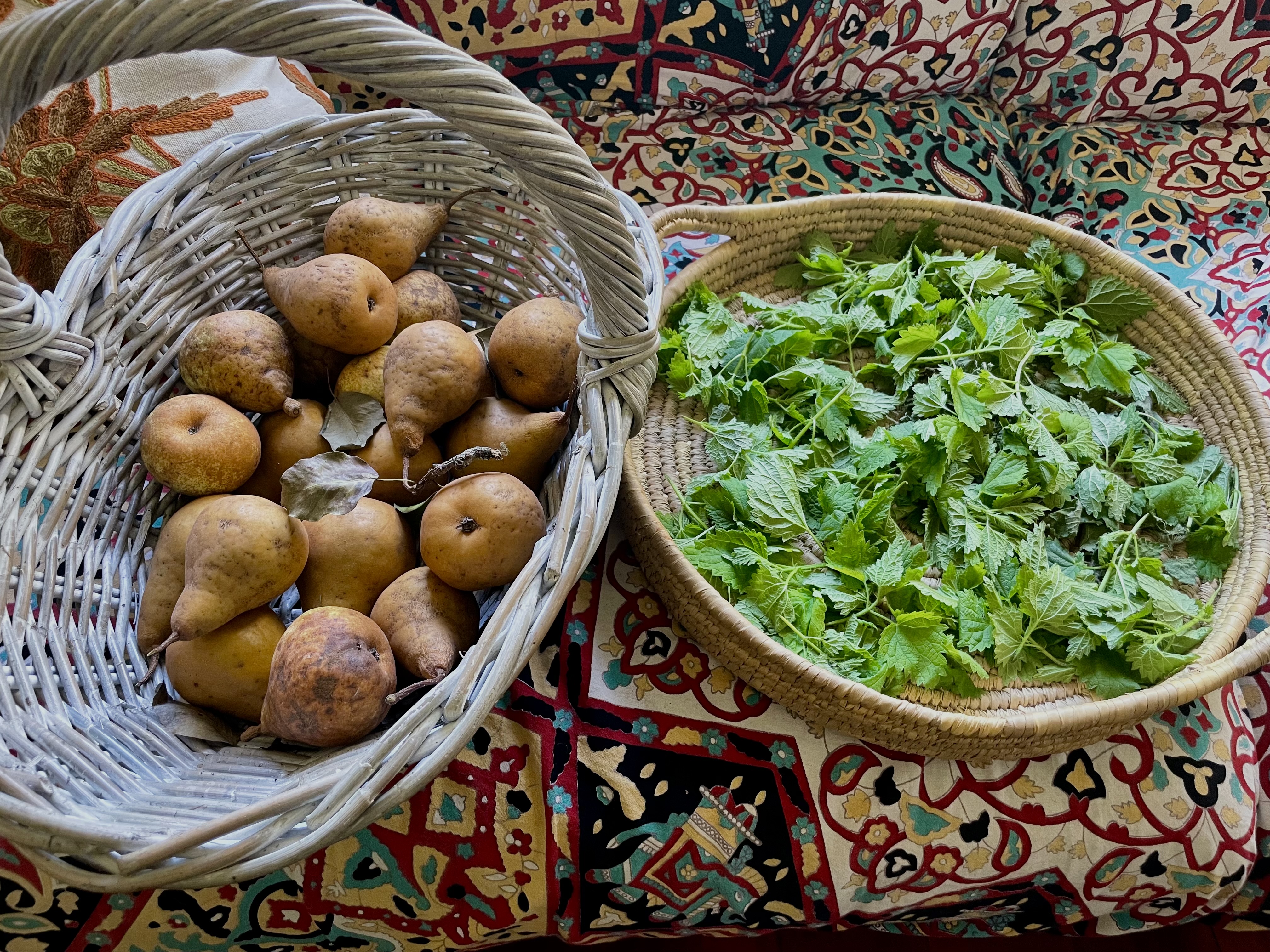
    (Above:These pears got turned into a pear/ginger/feijoa chutney. On the right are nettles drying. Autumn has been so warm…my nettle patch just keeps going and going.)

    When I posted the first ‘Slow-small Media for Weekend’ last week, I asked F if he got the wordplay in the title…? and he said, no, he didn’t–I can always count on him to be honest. I meant it as a play on ‘social media’…but the fact I’ve had to explain it means it doesn’t really scan, I guess. Never mind…I’m sticking with it.  

    A useful resource for reducing food waste in your kitchen

    F and I run a very low-waste, frugal (and yet abundant and colourful) kitchen. I feel I am pretty savvy about not wasting food however I learned things (or had my inspiration refreshed) from this great video by Immy Lucas. where she offers 100 ways to reduce food waste. 

    She has a practical and grounded approach that I really like. 

    & I appreciated that she included reading Braiding Sweetgrass by Robin Wall Kimmerer as one of the 100 things; a book that has opened many hearts and minds to being more grateful and reciprocal towards the earth. 

    An affordable artwork 

    I think everyone should be able to have beautiful art work on their walls and yet so much art is beyond the budget of many …so when I see beautiful art works available for purchase for under $50 New Zealand I will share them with you. Here’s one for this week:

    This graceful fern teatowel from New Zealand maker I feel Natty would make a lovely piece of affordable art, pinned up on a wall, I reckon. It has a calm-inducing quality about it.

    A (secular) prayer

    I immediately loved this earthy version of an ‘our lady’ by Sylvia Linsteadt and loved her invitation to add your own as things occur to you…to keep growing it as an ongoing appreciation of the earth. 

    & Here’s an addition to it from me: 

    Our lady of the slow autumn morning, the crackling fire, the bubbling porridge

    Our lady full of microscopic life, bringing the bubbles to our ferments

    Our lady of a friend’s handwriting on a homemade seed packet

    Our lady of the finch who sits in the open window, looks inside a moment then flits away

    (Above: the sweetest thing about garden/kitchen gifts from friends is their handwriting on the labels.)

    A song

    I’m new to this artist, Sun Kil Moon. Some of his songs sound like lost songs from Neil Young’s Harvest record. The music has a soft, dreamy, lugubrious style that is perfect for autumn/winter listening. 

    Another thing I really like about his work is that he often writes with careful specificity about geographical places, rivers, forests, cities. I guess because I’m a writer, I study and the appreciate lyrics as much as sounds of music. I’m particularly obsessed with this song ‘Carry me, Ohio’. 

    A commenter beneath the song remarked ‘This is the most depressing uplifting song in existence’ which made me laugh and is accurate. This song seems to be very gloomy, and yet it does something upwards to my heart. 

    There’s an apology in the lyrics, verses begin ‘sorry that…’. Is he apologising to a specific person? To a place? To his past self? It’s unclear…and that’s what makes the song so intriguing and beautiful. His music has a hypnotic quality, gloomy lullabies.

    An introduction to Eco-Dyeing

    I dabble in eco-dyeing. I’d like to get much better at it. Sometimes when I start something new I can be quite mean to myself about how janky my early attempts are.

    I have eco-dyed some papers for making cards and for using in my journal. I’ve eco-dyed some of my clothing, too. I didn’t get the lovely, clear leaf prints more experienced people do but still I was excited by the patterns the eucaplytus made on my linen tunic.

    Founder of eco-dyeing and one of my art-heroes, India Flint, writes evocatively about how eco-dyed fabrics take on on the scents of the plant materials and (if you do your dyeing over an outdoor fire, as I do) also woodsmoke. This is true! My eco-dyed tunic, despite many launders, still smells like eucalyptus and woodsmoke…both scents I love.

    If you’re new to eco-dying, here’s a simple introduction .

    & India Flint’s books are wonderful and inspirational. They can be hard to find but most libraries have them.

    I’ve decided to start a creative process journal for my eco-dyeing. I will share a bit of that along the way.

    A new Youtube channel

    I seem to watch more Youtube than any other subscription service these days. I have an endless appetite for watching people who have filmed themselves doing interesting things and sharing their quiet, fascinating lives. This year I’ve been paying for Youtube Premium and if you watch a lot of Youtube, I can’t stress enough how much it improves the experience to not have to deal with the ads. 

    I happened on Black Girl in the Woods somehow (thank you, algorithm) when she was just a couple of videos in. Now her channel is growing fast! 

    She has bought a small piece of land in the USA (mortgage-free) with a pond and some trees. Her videos are honest, gentle reflections on why she did that, her vision for her life and her little plot and some footage of projects on the go. I admire her courage and I appreciate her world-view. 

    A recipe (or two) 

    I’m in the middle of making this fermented hot sauce. It is fizzing away in my fermentation station and by the end of this week, I will bottle it. 

    Do you sometimes get in a rut with salad dressings? I do. Recently, I decided I want to use miso paste more in dressings because we’ve done that thing we’re we’ve triple-bought miso paste and now have too much. So I’ve been trying different miso-based dressings and I’ve been really enjoying the combination of miso with lime and ginger…these three ingredients really sing and zing together. 

    *

    I hope you’re enjoying these digests–let me know in the comments. 

    This weekend I am very excited to be going to see Marlon Williams

    & There’s a stamp and postcard convention happening in town. I’m not a stamp collector but I do have a passion for old postcards, particularly Victorian ones…so I will be going along to be that annoying person who flips slowly through boxes of postcards before musing over a large selection and then paring it down to a treasured handful to buy. 

    I am slow-hand-stitching a scarf with scraps of fabric my friend cyanotype-printed for me (I will show it to you when it’s finished) so I’m hoping there will be some time to sit down and work on that for a while. 

    Have a lovely weekend, beauties! 

  • fennel from the river

    (Above: My favourite selfie, out foraging beside the river.)

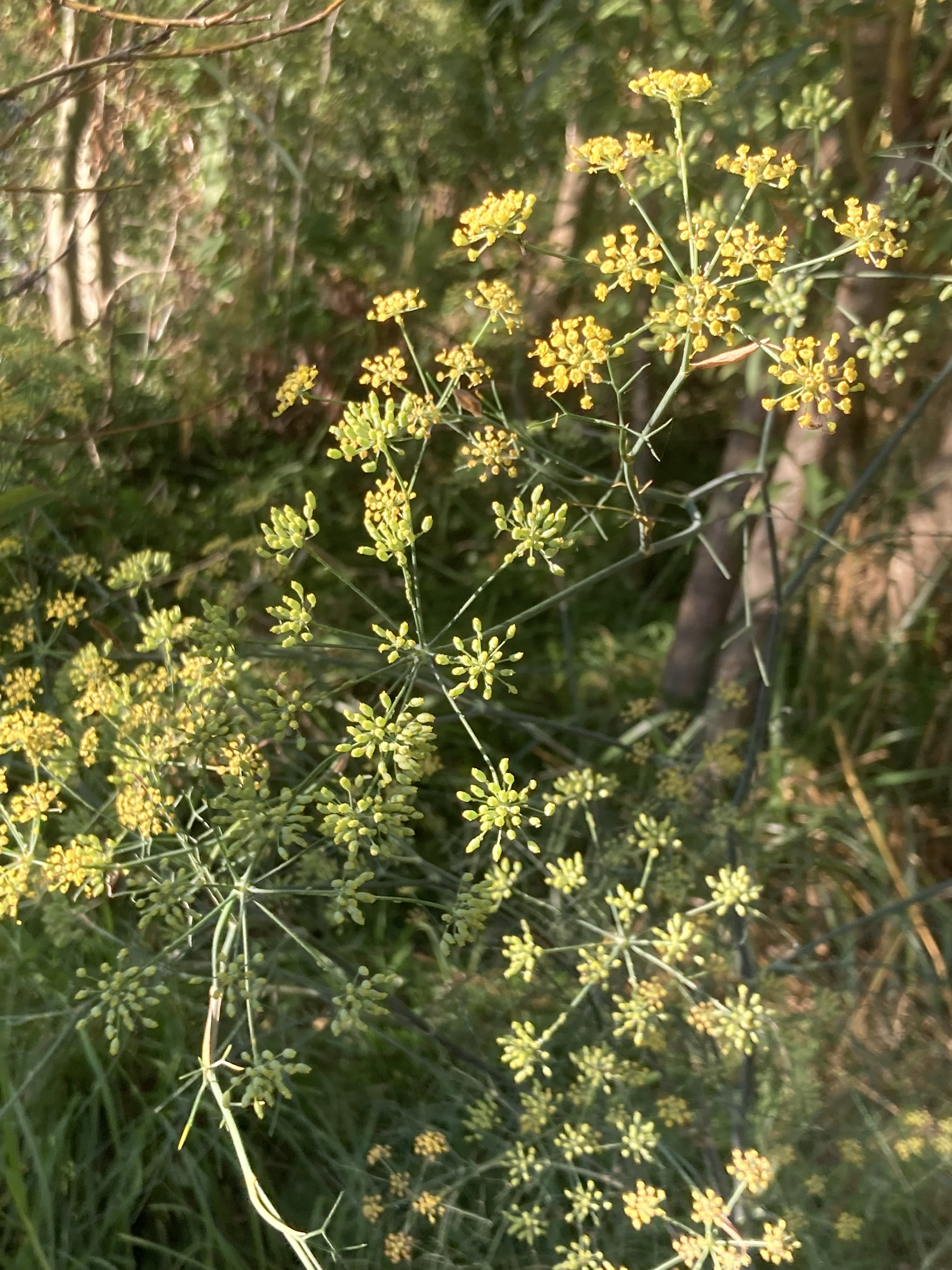
    In autumn, I forage for fennel seeds. Along the Manawatū river, the fennel plants are plentiful. This year, it’s been such a warm autumn, there is still fennel in flower as well as the older plants going to seed. I find fennel such a beautiful plant in all it’s stages: the bright green fronds of early spring, the sunny yellow umbels of summer…then the handsome dried seed heads of autumn.

    (Above: A ‘fennel tunnel, fennel tunnel, fennel tunnel’ < a little phrase from my foraging book.)

    Fennel is an enjoyable thing to forage for because each plant is so laden with seed heads that it’s easy to forage enough for the pantry in just a couple of walks. I fill up this 500ml jar and it lasts me a year of curries and pickles and tea.

    (Above: yellow fennel flowers going to seed.)

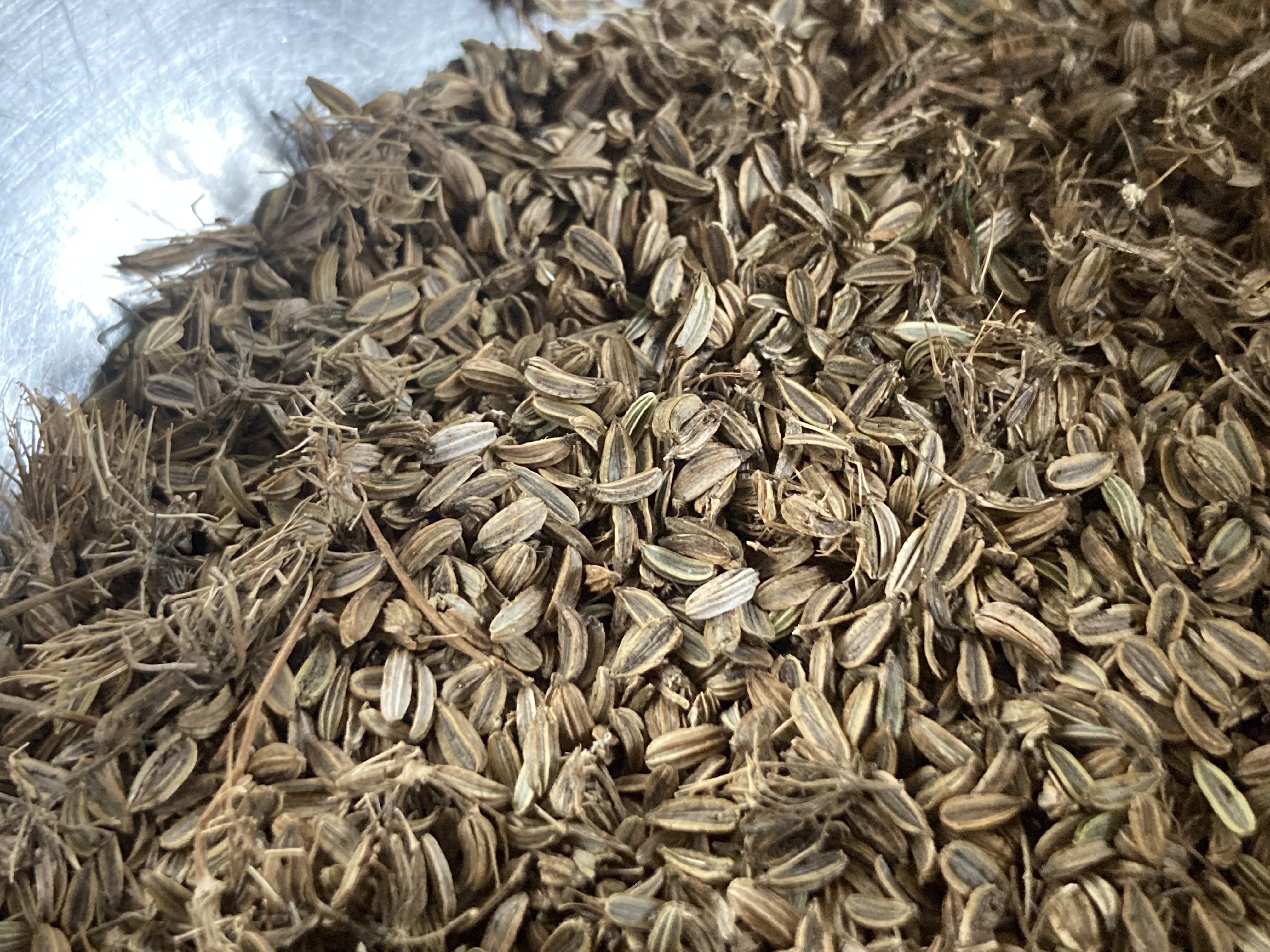
    I take secateurs with me and snip some of the seed heads that look grey and dry. Although they are probably dry enough off the plant, I leave them on a tray on my kitchen table to dry more…just to be sure they are totally dry. Then I rub the seeds off over a large bowl.

    (Above: the fennel seed heads drying a little longer at home.)

    I have an interest in Ayurveda. Fennel seed is highly-valued in Ayurveda for it’s digestive properties. In some Indian restaurants, they offer tea spoons full of tiny coloured sweets as a digestif after your meal. These are sugar-coated fennel seeds.

    (Above: The fennel seeds fresh off the seed heads before I sort through and get all the little bits of flower head out.)

    Here is a recipe (well, more a proportions guide) to a digestive tea I make with my foraged fennel seeds. I get the fenugreek from my local Indian supermarket and the licorice root powder from Pure Nature. Fenugreek has powerful digestive properties and can help regulate blood sugar, too. Licorice powder aids digestion and adds sweetness to the tea blend. Ginger helps with digestion also and tastes wonderful.

    Digestive Tea

    One part fennel seeds

    One part fenugreek, seeds or leaves

    One part licorice root powder

    One part ginger powder

    This tea is great to have first thing in the morning to awaken your digestive fire, or agni as it is called in Ayurveda. It’s also good to drink about an hour after a meal to calm the stomach, prevent flatulence, help with digestion.

    *

    I have an avid interest in folk herbalism so I tend to mostly make medicinal things with my foraged finds.

    Autumn is a lovely time for foraging…less chance of getting sunburn and so much to see everywhere! I’ve been enjoying looking at all the different fungi friends who emerge this time of year, picking up windfall eucalyptus leaves for eco-dyeing and harvesting mullein for making winter medicines with.

    What have you been foraging or harvesting?

  • Slow-Small Media for the Weekend

    Introducing … Slow-Small Media for the Weekend, a weekly digest of things which have caught my eye lately. My hope for these digests is that you can curl up with with a cup of tea over the weekend and enjoy these things as an antidote to the overstimulation of social media. 

    A read

    I’ve been enjoying Kirsten Bradley’s new art/writing project about moon literacy and garden tending.  If you like thoughtful writing about land tending and community care coupled with an art practice (cyanoptye) and folk herbalism…this is for you.

    Her article about progressive pickles and caring for her child particularly resonated with me. I, too, have had to let go of a lot of ideas about what loving family routines ‘should’ look like. I have a family member who dislikes eating with us. He eats his meals alone out on the porch.

    Kirsten writes: 

    ‘I have learned that insisting that we do things in the Family Way (…) was something I needed to let go of. (…) 

    Care can look like learning to pay close attention to what is actually doable for this kid, this day, rather than assuming I know better and pushing them too far.’ 

    Read the full essay here. 

    If you have time, read her other essays, too. All rich, contemplative stuff about nature and art and care. 

    A song

    When I find a song I love, I listen to it over and over and over. It feels like spending time with a friend. This has been my song of early autumn: ‘Time to Bide’ by New Zealand artist, Monty Bevins. It’s a whole journey in one song and a great example of song as storytelling.

    I love the spaciousness of the beginning. The song begins in Māori and then switches to English. Then just as you think you have a handle on what the song is going to be… changes pace. It is a song which demands close-listening. 

    + It’s a song that references cold weather and fires so it is a beautiful one to play loudly beside the fire. 

    Read more about Monty here. 

    A zine

    The Theme Zine is a project which brings together an international cohort of artists and writers to collaborate on zines based around set themes. Their latest issue’s theme is ‘Nature as Sanctuary. It’s beautiful short read (and best read on a laptop so you can enjoy the art). 

    An artist crush

    I love the work of American artist Chelsea Granger. I have her plant oracle deck The Dirt Gems and it is just stunning. Her work is so beautiful, humane, colourful, intimate. It feels like steeping into another world…a better one. If you tap the first tile on the top left, you can then view all her art as a slideshow. Trust me, it’s worth it. You’ll feel better about the world afterwards. 

    A watch 

    I found this short (12 minute) film about the ARK (Acts of Restorative Kindness)rewilding movement so soothing and nourishing for my nervous system, I’ve rewatched it four times over the last week.

    It’s got me thinking about where in my small garden I can intervene even less and ‘rewild’ small pockets for all the other creatures I share this little patch of land with. We (humans) like to try to be in charge of our gardens…it takes some real reprogramming (deprogramming?) to let go of control and let nature do what it is so good at, romping greenly. 

    Read more about the ARK movement.

    + I recommend Mary’s two books, also. I’ve read both and they are beautiful and inspiring. 

    A recipe

    If you were too busy in late summer to make a tomato kusundi, Nicola Galloway has a fantastic version made from feijoas.  If you like Indian flavours and haven’t tried kusundi before you will love this spicy, aromatic pickle. It’s a great thing to have around to liven up winter sandwiches. 

    Or if you are in the northern hemisphere, where spring weeds are springing…here’s a great recipe for wild weed pesto with a guide to some suitable weeds. 

    *

    This weekend I’m planning on sharing a morning tea with friends, making Nicola’s kusundi with our feijoa abundance, painting a new sign for the sharing shelf (the orange one in this post got stolen) and digging up some of my abundant strawberry and yarrow plants to share. 

    Tell me what you’re getting up to in the comments. Happy weekend, friends! 

  • ‘now we recognise ourselves less and less’

    (Above: plastic rubbish I picked out from my vegetable beds last week. I collect around this much rubbish each time I tend or harvest from my vegetable beds.)

    I enjoy the writing on The Dark Mountain Project. It’s an ongoing project (based in the UK) that publishes ‘uncivilised writing’, holds gatherings, creates a space for conversations about all manner of unsettling and challenging elements of living at this point of human history. There you will find writing beyond polite eco poetics or nature writing that merely holds nature in a human/nature binary of saccahrine reverence. I don’t always agree with what I read there and that is why I like it.

    Last week I read this piece by Amy Kennedy from the most recent issue with the theme of ‘bodies‘.

    At first it seems a deceptively simple piece of writing, Amy describes a group of parents at a childrens’ birthdday party. One of them brings up the subject of the finding of microplastics in human placentas. The piece explores plastic: our culpability and the unavoidable enormity of the tsunami of plastics in our lives.

    I have a fairly high threshold for ingesting media about climate collapse and environmental degradation. I don’t have my head in the sand.This is not because of courage but more that I am an anxious person who approaches life in a ‘forewarned is forearmed’ sort of way. I like to know something of what’s coming so I can consider in advance how I might respond. (I’d prefer not to be built this way but there is only so much you can do about your neurological wiring.)

    I was surprised by my visceral reaction to this piece with it’s blunt presentation of human culpability in terms of the use of plastics and refusal to look away from the idea of microplastics in human placentas, in human bodies. ‘Now we recognise ourselves less and less’, Amy writes. A familiar feeling for the eco-anxious amongst us and a statement that works on many levels.

    A few years back I wrote a poem in a similar vein about digging up the backyard of my crappy Wellington flat to grow food for my oldest son when he was a baby …only to years later find out that backyard had been a dumping ground for old car bodies and broken machinery and was no doubt full of petrol and lead and other toxins. In my youthful naiveté, I hadn’t considered the urban soil’s history.

    These human missteps we make in the name of love: a birthday cake served with a plastic fork, feeding a baby mashed carrots grown in polluted soil…the hell we plod towards on our road of good intentions.

    The depth to which I was triggered by Amy’s writing surprised me at first (I thought I was made of tougher stuff by now). But then when I thought about it, I realised it touched on a tender spot in my own gardening practice…a spot where I choose to put blinders on.

    I live in the centre of a city. Every time I weed or harvest from my front yard garden (tended so carefully with the best organic soil amendments and lovingly homemade compost) I fish bits of plastic out of my garden: plastic bag fragments, fruit stickers, junk food packaging, lollipop sticks. Some of it seems to get into our compost somehow, despite careful sorting at the kitchen end. The plastic in the vegetable beds seems to blow in from the street.

    (I wondered if this plastic trash were an urban problem but a friend who lives rurally said that there is just as much plastic trash out her way, in the road gutters, in streams, from the plastic packaging of hay bales and farm products.)

    I throw the bits of plastic into a colander that I have with me in my harvest basket then put them in the rubbish bin where they will travel in a plastic bag to the plastic afterlife, which is to say slowly deteriorating into microplastics in the city’s landfill.

    I dwell in a space of both knowing that I have my stubborn blind spots (the macro and micro plastics in my own food garden and in the soil I am creating in my compost) and also having no inclination to stop. I will carry on composting. I will carry on growing food in this microplastick-y soil I am making.

    I enjoyed this essay about composting by Scottish writer Fraser MacDonald (found via Pip Lincolne) He, too, is carrying on composting on despite tangible evidence of plastics in his compost. He writes:

    ‘I make my own compost so that I can convince myself that even when the world seems socially and ecologically broken there are still mechanisms for recovery: it shows that change is possible. Composting is a simple habit of composition or gathering together that integrates past fragments into a future whole, so that what matters is not the individual ingredients but the fertile new thing they can become.

    & that ‘fertile new thing’ possibly contains microplastics…yet still I persist in habits which put me squarely in the ‘doing’ space of the world, in flawed creative acts which give me a sense of agency and regenerate my spirit if nothing else.

    For that purpose alone I believe they are worthy.