Category: a foragers life

  • Winter is a great time for harvesting volunteer ‘microgreens’ from your garden (or local park)

    (Above: today’s bounty from a little wander around my own garden.)

    Do you buy sprouts, bags of mesclun mix or microgreens from the supermarket?

    Winter is a great time to find volunteer (‘weed’) microgreens, or young greens, around your garden or local park for FREE!

    Because of winter’s rain and damp, the young weeds will be beautifully bright green, healthy and not heat-stressed.

    To share some likely contenders with you, I took a walk around my small urban yard and here’s what I harvested.

    I took care to only harvest volunteers/weeds and nothing that I’d planted intentionally. (Violet grows like a weed in my yard.)

    The trick is to just harvest the young leaves, or the tips in the case of the dead nettle.

    These wild ‘microgreens’ can be used in a salad, or chopped and sprinkled on top of soup, or in sandwiches, or blended into a smoothie…the same as you would use supermarket or homegrown microgreens.

    I numbered the plants for ease of ID-ing them:

    1. Nasturtium leaves. These are peppery in flavour so great in salads and on sandwiches, not so great in smoothies.
    2. Dead Nettle tips. Great stand-in for lettuce.
    3. Young violet leaves and flowers. Use in salad or cook as your would spinach.
    4. Young ribwort plantain leaves. Important to pick the young ones as the older ones get stringy. The young leaves have a nutty flavour.
    5. Chickweed. Such an enthusiastic garden volunteer. Use the young growth and chop finely.
    6. Young dandelion leaves. These add a nice bitter element to a salad or sandwich. Not so great in smoothies.
    7. Oxalis (known in the UK as ‘wood sorrell’ and the USA as ‘sour grass’) Has a sour, lemony flavour similar to sorrell. Use just a little at a time as it contains oxalic acid. Treat it more like a herb than a main vegetable.
    8. Young mallow leaves. Mallow (also know as ‘Malva’) is a much-used vegetable in Middle-Eastern cuisine and parts of Italy. You can make dolmades with the leaves in place of grape leaves, making it useful during the winter when there are no grape leaves about. Young leaves are good in salad or cooked like spinach.

    & of course, these plants have medicinal properties as well, (most plant food does.

    I hope this inspires you to have a close look at what might be growing in your own back yard and save yourself a little money (or time) by eating some of the weeds around you.

    Let me know in the comments if you have any questions.

    Do you eat any of the weeds in your garden?

  • Sometimes reaching out to your heroes works out

    (Above: Morag Gamble + my book! *squeals with delight* Image borrowed from Morag’s website. I love this photograph. I look at it when I’m having low moments to do with writing stuff and it cheers me up.)

    Today I’m returning to an occasional series of sharing anecdotes from my experiences after publishing A Forager’s Life . This is a story about how I reached out to some writing or permaculture heroes, people I respect and look up to, and how it panned out.

    I have an amazing publicist at Harper Collins, Sandra Noakes, without whom I would not have had such good reach with the book or opportunities like feature articles in national publications, appearances at literary festivals and featuring on the bill at WOMAD.

    Any writer worth their salt, however, will do their best to get word out on their own steam as well. If you believe in your work enough to publish it…you have to keep backing it beyond publication. Publication isn’t the finish line. In some ways, it’s just the start line of phase two. Reaching out to people can be an excruciating experience. You have to steel yourself for plenty of ‘thanks but no thanks’ or, worse, silence. (*cue the sound of crickets chirping.*)

    Just after the book came out, I wrote to a dozen people (nature writers, permaculture heroes, eco-podcast hosts) introducing myself, explaining why I thought they might be interested in the book and offering to send them a copy. Out of that dozen – two said yes.

    Out of the two who said yes please to me sending a book…one worked out wonderfully well. The other person ghosted me. Being real with you, it’s hard not to take it personally…but for my mental health I’m choosing to believe that they were in a place of overwhelm with life and my book was one of the things that could fall off their ‘to-do’ list with minimal consequences …rather than: they just didn’t like the book.

    I share these details with you, not for sympathy, but to demonstrate how thick-skinned you have to be in the writing. business (and I’m not particularly…I bruise fairly easy). Take my recent lovely news about the Verb Home Based Writer’s Residency. I’m still so over the moon about this. What people don’t see, though, is the manifold rejections from other opportunities that I have thrown my hat in the ring for. The writing life takes tenacity…the amount of tenacity demanded can be wearing and I have definitely had fallow years where I just couldn’t find the grit to keep on trying. Or when the responsibilities of my life precluded space for creative pursuits.

    Anyway, this is a happy story, not a gloomy one!

    One of the permaculture heroes I approached was the indomitable, prolific, generous Morag Gamble. This name might not mean much to you if you aren’t active in the permaculture world but in permie-land, it means a lot.

    Morag is a permaculture teacher, mentor, writer who lives in Australia but works at a global scale. She has an excellent Youtube channel with dozens of helpful permaculture clips, she teaches permaculture teachers at the Permaculture Education Institute, and she runs a non-profit which gifts permaculture education to refugees in East Africa. She’s an incredible woman for whom I have a lot of admiration and respect.

    You can imagine my delight when she took me up on my offer to send her my book. I wrote a friendly letter and posted it off and then a while after that…she got back in touch to say that she’d read and really enjoyed the book (!!) and invited me to be a guest on her podcast! I was, and still am, thrilled.

    + Morag’s daughter also reviewed the book here.

    The podcast was conducted via Zoom. On the day, I was so nervous, my mouth kept going dry which is very annoying when you want to chat away and try to sound relaxed. I needn’t have worried, though, because Morag is just as warm and genuine as she seems in her videos and podcasts and talking to someone so aligned in values was an absolute dream.

    Here’s Morag’s description of our conversation: “As a published author of books like ‘A Forager’s Life‘, Helen has a beautiful way of emphasising humans’ reciprocal relationship with plants and the wisdom of plant tending. She also highlights the significance of hyperlocal food systems and the power of food commons and radical reciprocity.”

    You can listen to our conversation here.

    & while I didn’t have to tell you that I got the slot on Morag’s podcast because I chased it…I like to be honest about ‘behind the scenes’ things in the writing world in the hope it helps people get a sense of how things work and (maybe) to inspire you to keep going with whatever your dream is…even when things feel too huge or overwhelming.

    People will say no to you or they won’t respond at all…and that’s okay. Everyone is busy, often to the point of overwhelm, and I think one out of twelve is not too bad…especially given how delighted I was with the outcome. A more courageous writer than me would have sent out hundreds of emails…not just a dozen…but that was the maximum of what my nervous system could handle.

    I hope this story might have given you a little bit of inspiration to take the next step forward in working towards your aspirations. x

  • How I auditioned to play myself and got rejected

    (An occasional series where I write about things that happened around my book, ‘A Forager’s Life’.)

    (Above: The audiobook as a tangible object!

    In winter 2023,  a few months after ‘A Forager’s Life’ came out, I received the exciting news that the book was going to be made into an audiobook with Bolinda Audio.   

    (By the way, it’s also available as an e-book) 

    Bolinda told me that they would soon be casting a voice artist and it would be recorded in Australia. They also asked me if there was anything particular criteria I would like for the voice actor. I replied that I’d like a warm, friendly voice and that it was very important to me that the Māori words in the book be pronounced correctly. 

    After I sent that email, I got to thinking ‘hang on a minute, don’t some authors read their own audiobooks?’. Of course they do…although it’s more common with celebrity authors or for celebrity memoirs. But in 2020, I’d had a bit of a go at recording some of my original meditations for the meditation app, Insight Timer.  I’d really enjoyed doing this and I thought my voice sounded pretty good… calm, composed. 

    So then I did something I almost never do…I advocated for myself and asked them if it would be at all possible that I be cast as Helen Lehndorf for the narration of the audiobook?

    They were very gracious and replied, ok, although it was unusual for the author to narrate their own audiobook, I could send them an audition ‘tape’ (MP3)  of me reading a part of the book. 

    I duly locked myself in my office and spent a couple of hours getting a decent recording of about five minutes of one of the chapters which had a bit of dialogue in it so they could hear me doing multiple voices. Listening back to it, I thought it sounded pretty good. I sent it off feeling reasonably confident. 

    A few weeks passed…and then I got an email to say they were sorry, but they didn’t feel I was suitable. 

    In other words, I’d failed the audition to play myself.

    They told me they had cast a young Australian actor, Ayesha Gibson. Then, (possibly because they felt sorry for me?) they asked if I would like to record the book’s epilogue. It would involve a trip to Wellington and a few hours in a recording studio. By this stage I felt a bit embarrassed by my bid to read the book myself, however I thought it would be an interesting experience so I said yes

    (Above: A photograph Ayesha sent me of herself in the Melbourne recording studio.) 

    I was booked to record in the same week as Ayesha. She recorded the whole book over just a few days. (The audiobook version is around eight hours long.) On the day I travelled to Wellington to record my little bit, Ayesha and I were in Whatsapp conversation about the recording process. She was (very sweetly) giving me little updates on how it was all going and would occasionally send me a question about pronunciation or meaning. It felt surreal to be getting these messages as I travelled on the train southwards…knowing we were both recording bits of the book at the same time in two different countries, timezones, studios. 

    My recording session wasn’t until the late afternoon. I was so paranoid about wearing out my voice so bought throat lozenges, a lemon honey drink and tried not to talk as I mooched around Wellington waiting. 

    I turned up at The Armoury Studio trying to look nonchalant and no doubt failing. I had around 3000 words to record. 

    Friends, it was challenging. It was harder than I imagined. Now I understand why Bolinda prefers to hire professional actors. I had to do retake after retake because of all manner of things…throat-clearing, dropped words, flubbed bits, weird nervous breathing. 

    (Above: one of the lovely (and patient) sound engineers at Armoury on my recording day.

    I don’t mean to make it sound like I did a terrible job…I didn’t..but nor am I a professional voice actor. And the sound engineers were lovely and reassured me everything that was happening was totally normal and I was ‘doing great’. However, it was precise, intense work. After just a few hours in the studio, I was so tired. 

    On the train on the way home, I felt relieved I had failed the audition to narrate the whole thing myself. Ayesha did an amazing job and I feel so proud of the audiobook version. 

    A few months later, I got sent a few copies of the Audiobook as a tangible object … an MP3 CD! It’s also available on Audible and, if your local library uses the service, Borrowbox

    And that is the story of how I failed an audition to play myself. 

  • witch sticks & autumn harvests

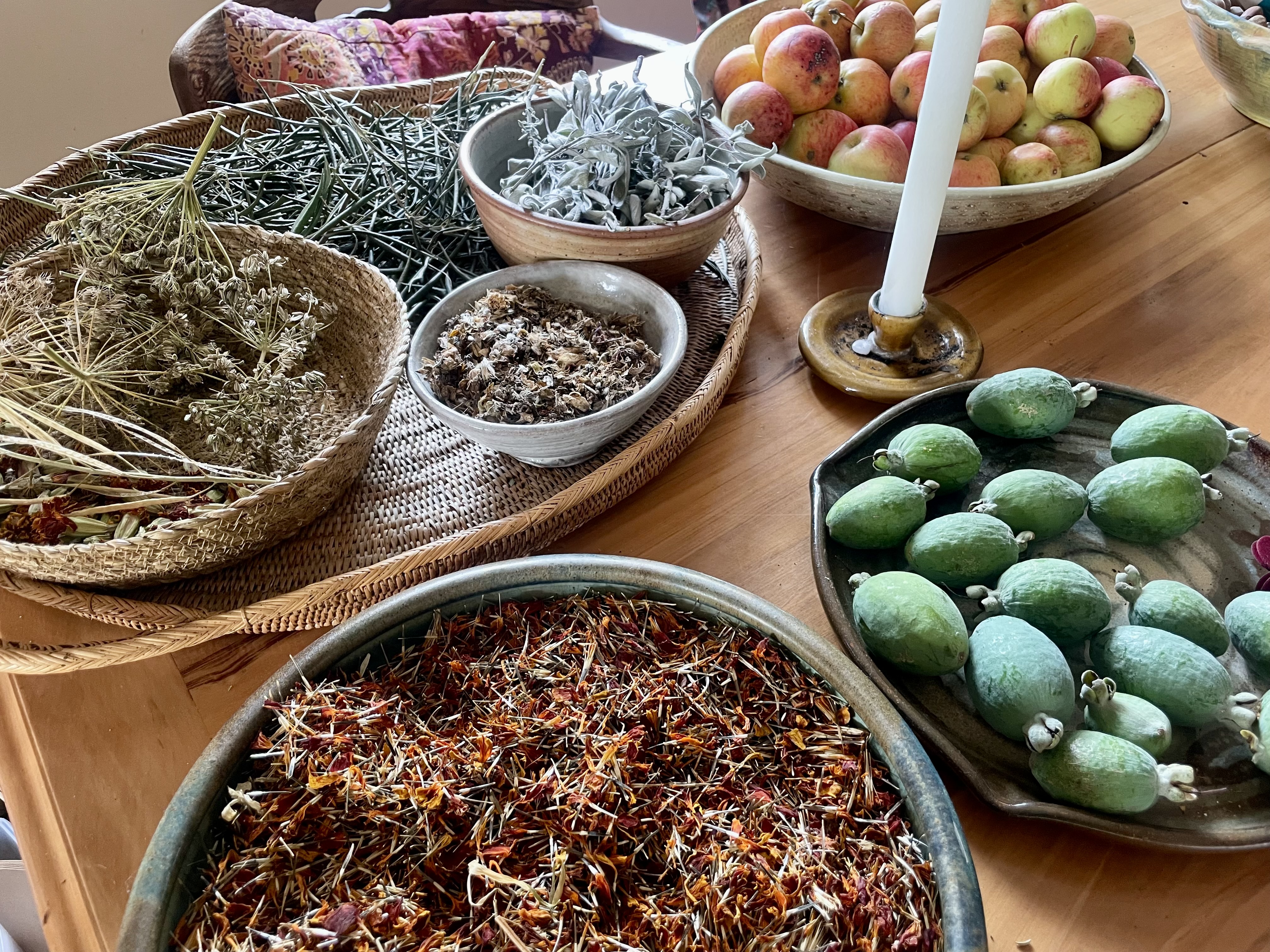
    (Above: Our kitchen table is a busy surface with often-changing bowls and baskets reflecting what is going on in the garden and the foraging season: things drying or waiting to be processed.)

    Autumn is my favourite season and, as a permaculture household, a busier season than summer with our labours to ‘capture and store’. There’s lots of picking and gathering and then kitchen work processing everything.

    (Above: Last sunday morning’s harvest chore was bottling a box of apples from our friend Bev’s orchard. These will turn into crumbles or top our porridge this winter.)

    Last week I gave my potted white sage plant a prune, ready to overwinter it in the greenhouse. White sage is a desert plant, native to the American southwest and Mexican northwest, so it doesn’t love the Manawatū winters.

    In the summer, I put it outside in full sun then prune it down to almost sticks at the end of summer and put it in the greenhouse where it sulks the winter away…but it (just) survives. Mine is about six years old now.

    (Above: white sage prunings, cotton thread. It’s on the sofa because I made the witch sticks while watching something in the evening. I do a lot of processing tasks (this, peeling fruit, cutting up herbs for tea, seed saving jobs) on the sofa…which might seem a bit odd…but I don’t see it as much different from knitting or hand-sewing in front of the TV. Does anyone else do this?)

    The prunings can be turned into what I call ‘witch sticks’ for burning by folding up the leaves on the stalk, weaving and rolling them longways and then tying with cotton thread. (Never use synthetic thread: it will melt and emit toxic smoke.) When the leaves have all burned down, you can burn the stalks, too.

    (White sage is a plant sacred to Indigenous people in USA and Mexico, so if you want some…have a go at growing it rather than buying imported sage. White sage is overharvested in the USA particularly. In ‘A Forager’s Life’, I write about alternative plants to white sage for making cleansing/burning sticks.)

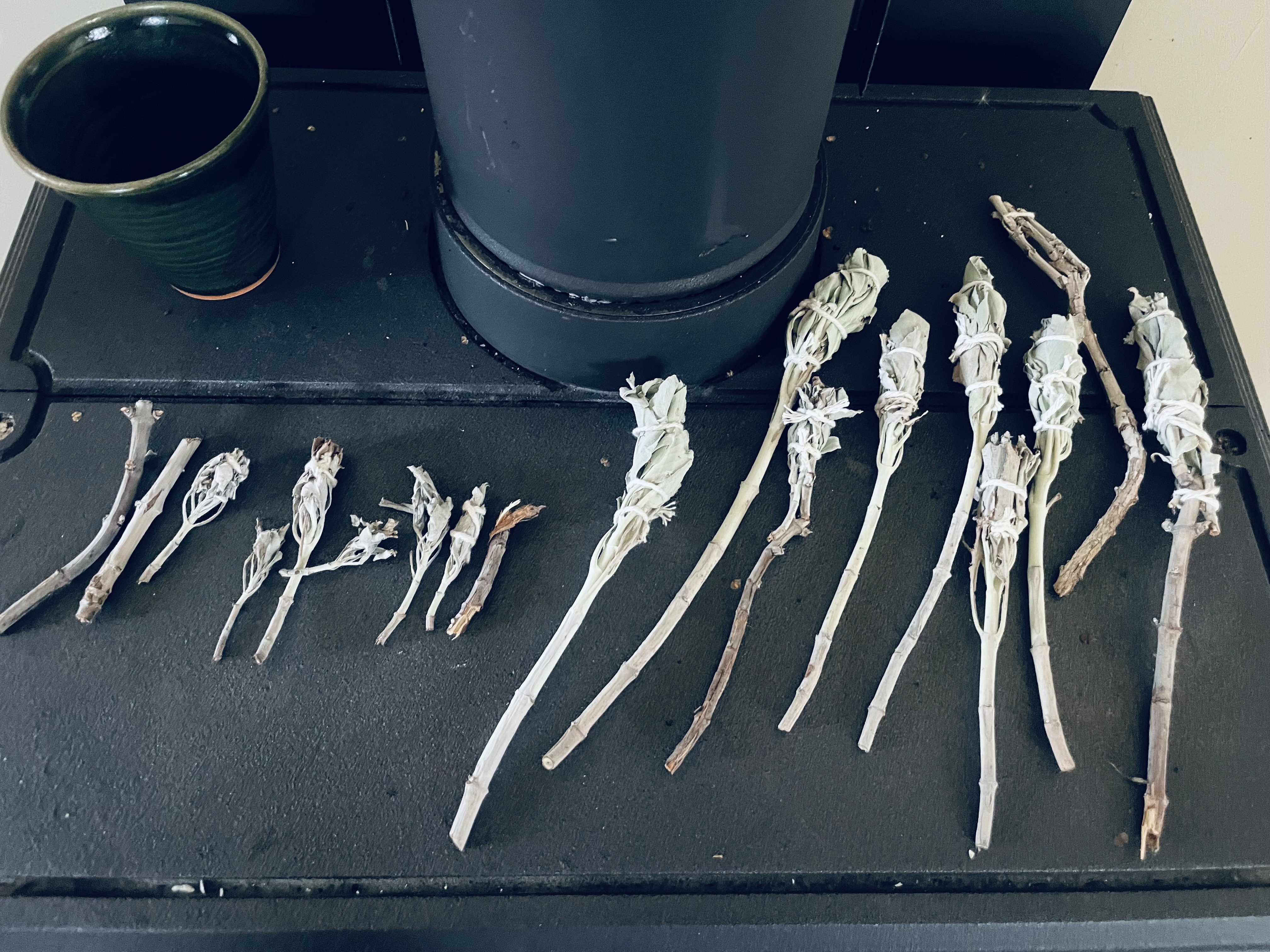
    (Above: I got eight decent witch sticks, plus some smaller bits and pieces of stalk…all of which can be burned. Here they are drying on my fire top.)

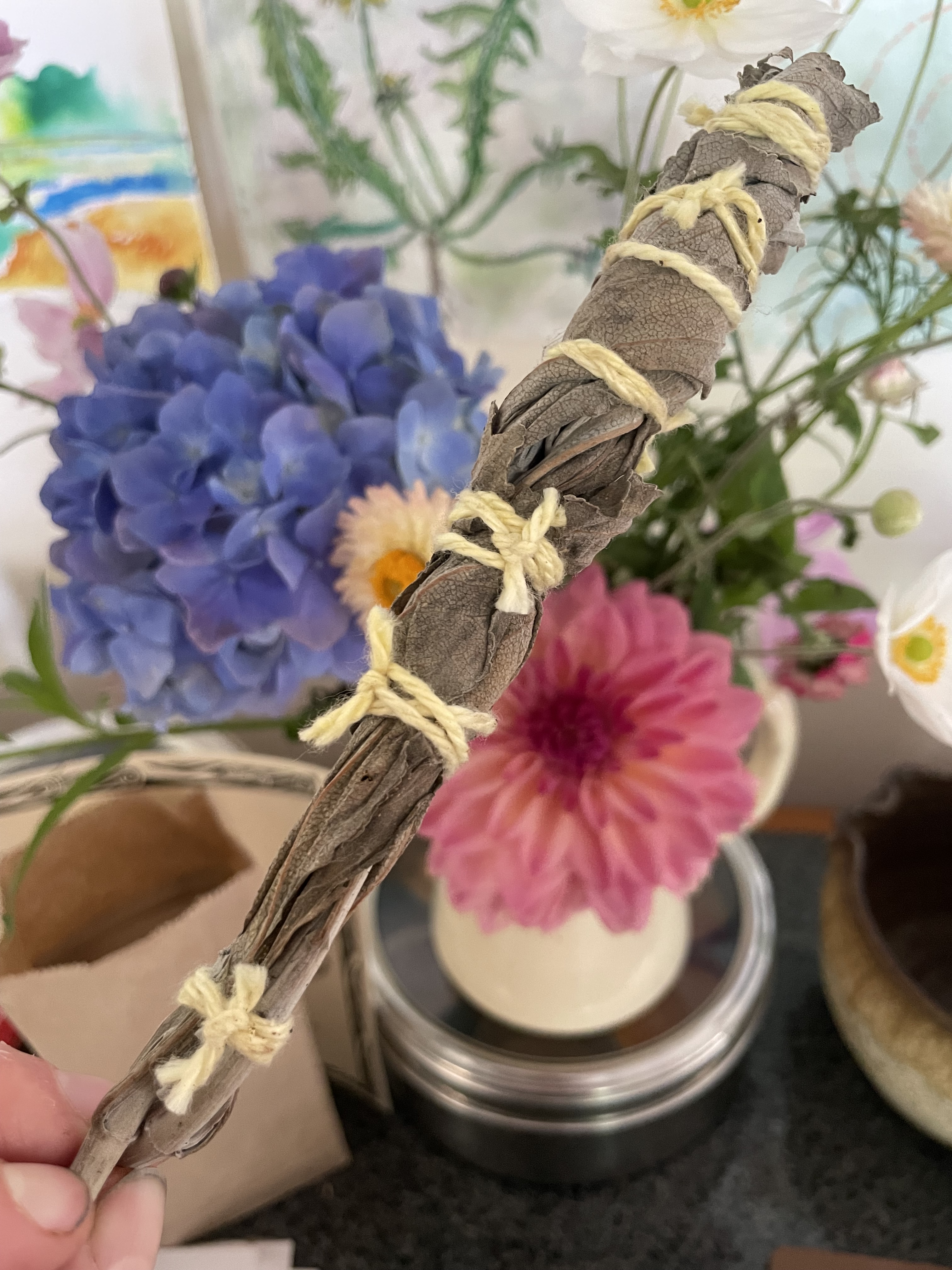
    I see a lot of ‘how-to’ articles about making cleansing/burning sticks around…but they often forget a detail which I think is important. For them to burn well and safely, don’t wind the string around and around the bundle, securing only at top and bottom. This will mean your stick will fall apart as the thread burns and you could have a higher risk of embers dropping off it. Instead, tie it tightly with small pieces of string at regular intervals, like in this photograph:

    (Above: please forgive my ‘dirt manicure’ as garden writer Gayla Trail calls it. I scrub* my nails regularly but folks who ‘touch soil’ (which is ilke ‘touching grass’ only more grubby) every day struggle to have photogenic hands. ((I have to buy a new nail brush every couple of months…so intent is my endless scrubbing.))

    Do you have a favourite season or are you one of those calm, rational people who loves them all equally?

    I’d love to hear what kitchen or garden chores you’ve been doing lately. Let me know below.

    “As long as autumn lasts, I shall not have hands, canvas or colours enough to paint the beautiful things I see.”

    -Vincent Van Gogh

  • somehow, ‘a forager’s life’ is two

    On March 18 my book ‘A Forager’s Life’ turned two!

    The two years since it emerged into the world have been, frankly, mad.

    I’m a person who enjoys a slow, simple life and lots of huge (for me, anyway) and exciting things happened with the book since it’s release. In this space, I’m going to share some of the things that happened…even though they are old news in terms of the pace of the online world. They are still very much with me.

    (Above: I threw a morning tea for the staff at my wonderful local bookshop, Bruce McKenzie Books on the day the books arrived in store, March 2023.)

    I was unkind to myself and, freaking out about money once my book manuscript was delivered, started a new job before the book even came out. At the same time, my younger son who has a disability was finishing high school and in a massive phase of transition into post-school life. I had underestimated how intense of this phase would be for him, resulting in a high-pressured time where I was trying to enjoy the opportunities the book bought my way, learn and hold down a new job and be there for the kid. Oof.

    It was all too much and, coupled with the NZ government’s slashes to disability support last year, I only lasted two years in the job before something had to give and I left it so I could adequately look after my boy.

    Now I’m out the other side of the intense part of the booky fizz, the job debacle, am still navigating the kid’s shaky steps into adulthood (I guess I always will be), plus I’m in the midst of the intense mind/body/spirit shake up that is menopause.

    I’m sitting here, a bit dishevelled, trying to put myself back together. It’s been a very strange time of immense, beautiful highs and difficult, fractious lows. (Then there’s everything going on in the world beyond my front door where the world appears to have gone completely mad.) Therefore, I’m hoping this winter is very boring and nesty so I can read mountains of books beside the fire and journal a lot (on paper and here) and let it all integrate into me at a pace I can cope with.

    So, interspersed with posts about other things, there will be the occasional retrospective post my experiences with ‘Forager’s’.

    I hope it’s interesting for you to read about such things from a writer’s perspective? As writers we are supposed to act very cool and nonchalant about the occasionally great things that can happen if you write something that people respond to…but I have never managed to be cool…I’m an awkward, nerdy, sensitive person who gets overwhelmed easily. I’m not at all nonchalant…I get very revved up about exciting things. In fact I get excited about non-exciting things, like the shape of a dried fennel seed head, finding a particularly niche-to-me second-hand book, or sampling from a pan of sun-ripened then slow roasted cherry tomatoes.

    & I know blogging is long dead but (see above point about not being very cool) however I’m hoping if I write here, the right people will find me, despite claims that blogging and personal websites have been made irrelevant by speedy old social media and peoples’ diminishing attention spans. ‘The right people’ are folks who like reading longer form than an Instagram caption and appreciate the reedy, faint voice of a shaky woman trying to lure kindred people into giving their precious attention to her personal website rather than further furnishing the pockets of tech billionaires.

    If that’s you, warmest of welcomes aboard.

    (Do leave comments if you feel moved to. I read everything and promise to respond.)