Recently, a new local friend, Kaydee gave me some beautiful small ripe lemons.
I’d been wanting to make some salted lemons so they seemed perfect for a smallish jar of those. Salted lemons are used a lot in both Middle Eastern and Indian cuisines.
On the weekend, I judged them ready. I was going to a social gathering that day so I took the lemons out, scraped away the flesh*, and put the preserved rinds through my blender to make a salted lemon paste.
(*some people use this part too…but it didn’t taste very good to me. I did use it to clean the inside of my sink before I put it in the compost.)
I know my friends are busy people and I figured the preserve was more likely to be used if they could just scrape out a bit with a spoon rather than having to take it a lemon, rinse it and finely slice it.
Even a small jar of preserved lemons makes a lot...too much for our household to get through in the six months they last. So it was helpful to me to have some people to share it with.
This is how it looked blended & before I labelled the lids.
Something I’ve learned from attending Crop Swaps is that making signs is super helpful. Then anyone interested can just take a photo of the sign and the gifter doesn’t have to answer the same questions many times.
So here’s the little note I made when I put the containers of lemon paste on the table to be shared:
I think he’s kind of a nature-writer’s writer, in that not many people seem to have heard of him yet his way of life and his nature writing (he only published one book in his lifetime, ‘Waterlog’ and two were published post-humously) are seminal in their influence on writing and eco-memoir, kind of like how people say about the Velvet Underground that they weren’t very big in their hey-day but they influenced thousands of people to become musicians. Nature writer Robert McFarlane remembers him here.
I’ve learned about the fascinating back story of Caspian Sea Yoghurt, because my friend Bev gave me some of her starter. It’s very easy to make, no heat needed, it ferments whilst just sitting out on the bench.
I’ve now made my first batch and it’s so good! It has a mild, sour flavour that is very satisfying. I’m a convert.
I op-shopped this vintage-looking (not sure if it is, though) cushion which I just love and have been enjoying gazing at.
If it IS handmade, the embroidery is so detailed and beautiful. Check out those french knots in the centre!
I’ve been making variations of this winter tonic each morning, but I often throw in a garlic clove (doesn’t taste great but excellent for gut health and immunity) and a kiwifruit as well.
I’ve been watching Wolf Hall and loving the costumes, the intensity of the wranglings of the court and Mark Rylance’s incredible, nuanced performance as the lead character.
This brief but darling song is so sweet and captivating. I confess I’ve been adding it to various playlists for years now, but I just don’t tire of it.
An exciting new resource for vintage imagery free of copyright
Public.Work is a very cool new resource for sourcing copyright-free vintage imagery which you can use for creative projects. It’s really nicely designed and fun to use.
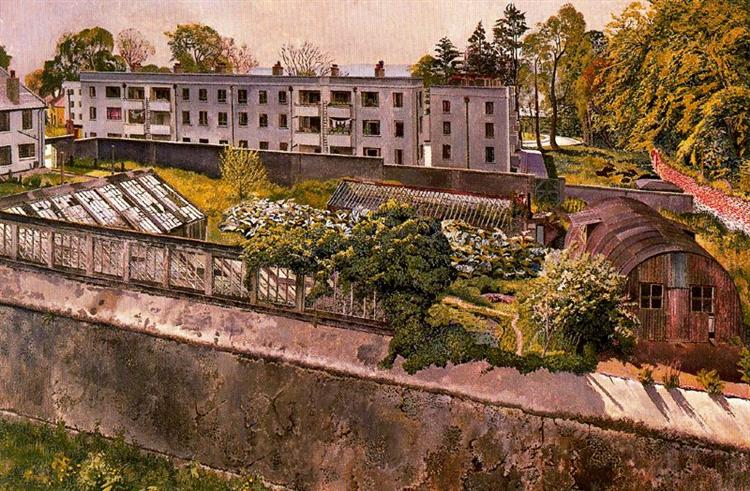
A painting which I saw in real life back in 2023 which has stayed with me
In 2023, I saw this painting, ‘Merville Garden Village near Belfast’, by English artist, Stanley Spencer, at the Dunedin Public Art Gallery when I was down there for an event at the Dunedin Readers and Writer’s festival for ‘A Forager’s Life’. (I wasn’t new to Stanley Spencer. I’ve read books about him and admire his work a lot so it was a real treat to see this IRL.)
I looked at it for a very long time. It’s even more beautiful in real life. It resonated for me as someone who likes to lurk around marginal spaces and does a lot of gazing over back fences and sideways vistas. On the Dunedin Public Library website they say of the painting,
‘Painted on-site while Stanley Spencer stayed with his elder brother Harold near Belfast, this painting compels us to emulate what this great British painter loved to do: climb up and peer over at ‘ungetatable’ places. (…) he brings the richness of the everyday to our attention. (…) The unpromising view is full of promise.’
That latter sentence captures so much of a forager’s approach to life!
Something to watch: a peaceful, inspiring tour of the Mahara Sculpture Garden in Coromandel
I’ve added it to the list of places I’d love to visit in the Coromandel. (Holidays are tricky for us with a disabled (now adult) kid who can’t cope with being away from home for more than a couple of nights…but I trust I will get there one day.)
A rebel 74-year old living off-grid in England
Speaking of potters, I enjoyed this article on World of Interiors about a potter, George Upwell, who was still living off-grid at age 74. I love the photographs of his simple, artful house and rebel spirit. (This article was first published in 2013.)
(Please comment below if you have any suggestions for the affordable art part of my digests. I’d love any leads from you.)
This simple and beautiful lino print of our native eel, by Carrie Dingwall is just $40.00. There’s only ten available, so if you share my love for eels, get in quick!
Today, my son Willoughby and I weeded, pruned, fed and mulched the raspberry patch. There’s something about doing tasks in deep winter that are about looking ahead to summer eating that make me feel so satisfied.
We also planted a weeping Kowhai and some more kawakawa…slowly trying to add more native plants to our small urban garden.
I hope your weekend is a pleasing mix of attending to tasks, resting and topping up your inspiration cup.
(Above: recent pot of echinacea flower tea. I love watching flowers and herbs steep through a glass tea pot.)
How was your wintery week?
Somewhat counter-intuitively, winter is the time to be planting fruit trees so that they have time to establish roots and resilience before the heat stressors of summer.
Do you have any spots in the garden (or in a large pot if you’re renting) that you could plant a fruiting tree?
Last weekend we planted an omega plum tree. It will (eventually) hang over our front fence in the hope that passers-by can enjoy some fruit also. In 2020 we planted a Luisa Plum in a similar spot.
To be honest, it’s meant that we haven’t had many plums off that one because people have picked most of the fruit within reach…but that’s okay…it’s why we planted it there. Eventually, the trees will be big enough that there will be plenty for us and everyone else.
An Australian man using YouTube to Plant a Forest
Speaking of planting trees, if you will oblige me by giving this video your attention (it’s just 12 minutes long), your ‘watch’ will contribute to backyard adventurer Beau Miles planting trees on both his own land and other farms in his area, in Australia.
I follow Beau on YouTube and when I first watched this video last week, it only had a few hundred views and at the time of writing this it is up to 237, 000 views!
(Like I said last week, I love random side-quests.)
Affordable Art: Studio Soph Tea Towels
(Above: image borrowe from the Tikitibu website.)
I love the bold wittygraphics of New Zealand artist and designer, Studio Soph.
Many of her products are outside the $50 cut-off for ‘affordable art’ but she has a fantastic range of tea towels which retail for just $25 each.
After all, what is a tea towel but a large rectangle printed surface? With the right presentation, a tea towel can be wall art! Either gun-staple it over a cheap canvas from the op shop, or sew hems to slide pieces of dowling into, or just pin it to the wall as is!
She has lots of great tea towel designs, but I particularly like this ‘Bird in Flight’ design, available at Tikitibu.
(If you’re new here, I hunt around the internet for affordable art. ‘Affordable’ means $50 NZD or less. I believe everyone should be able to access art and beautiful things for their home.)
Something inspiring for your eyes – a street artist paints bee swarms on urban walls to bring attention to the plight of the bees
What I enjoy about this poem is how a simple encounter with another person (and a potato!), a small exchange, becomes a deeply embedded sense-memory for this poet.
Here’s an excerpt:
‘I met a farmer who pointed the way—
Machu Picchu allá, he said.
He knew where I wanted to go.
From my pack I pulled out an orange.
It seemed to catch fire
in that high blue Andean sky.
I gave it to him.
He had been digging in a garden,
turning up clumps of earth,
some odd, misshapen nuggets,
some potatoes.
He handed me one,
a potato the size of the orange
looking as if it had been in the ground
a hundred years…’
A poem about people exchanging crops with a message of gratitude for the simple things?
really gets me every time. How flying in planes, over mountains, over rivers, is such a miracle, and such a privilege…and yet we so often ‘don’t feel a thing’ about flying any more. If anything, it’s seen as a major hassle to be endured to get where we want to be.
I love their harmonies, their future-ancient sound. All of their work is beautiful.
Where I can, I like to promote New Zealand food writers because we have many excellent ones.
Seeing the produce, writers and food photographed in recognisable New Zealand contexts really fires me up to get out into the vegetable garden and get cooking.
It’s shot by my clever wild foodie/photographer friend, Sophie Merkens. See more of the gorgeous images from book here on Sophie’s website. (& Sophie has a very exciting book of her own launching later this year. Stay tuned for more on that!)
I enjoy recipe books which are focussed on bright, colourful, fresh vegetables, and Tracy’s book delivers on this.
Carrots are often sidelined as a vegetable, but their sweetness means a soup that is mostly carrot has a beautiful, refreshing flavour. Here’s a simple and gorgeous carrot soup from Tracey’s website.
Another option I like to make for a carrot soup is to cook it with indian spices and then in the last few minutes of cooking, blend in a cup of cashew nuts. It’s spicy, creamy sweetness is reminiscent of a korma sauce, but in soup form.
Toward family, toward one another, toward abundance. Let your body’s movement abandon lines. Those lines are the way of empire—extracting, penetrating, demanding, colonizing, ripping, and now, dying.
Embrace nonlinear meanders, worshipping a circumference held together by a center of unknowability.
Because another world awaits, is remembered in the shape of a field, a meadow for which there is no label to monetize, no body to exploit, no peak to bag.
As things die, they also begin anew, becoming something far more curious, rounded, and life-affirming. To walk away from empire means to walk toward a different shape.
Firepit, egg, seed, eye, sun, wheel, Earth.’
-Nicholas Triolo
*
Have a good weekend, everyone.
Try not to be busy. Keep it simple.
Eat some good soup made by someone you know in real life.
Lie on the ground and look out of the window at the sky.
(Above: F and I like to have fires in the backyard, whatever the weather. A recent violet dusk.)
Does it feel to you like the weeks are whizzing by? Friday seems to come around faster and faster lately. Here we are again!
I’ve had some lovely feedback for these Slow-Small Media digests. Thanks to everyone who has been in touch. I’m so glad you’re enjoying them. I really enjoy ‘foraging’ for things to share with you.
I was new to Arthur Russell until I recently watched this fascinating documentary about him. (I love music documentaries even if I don’t know the subject. I find a lot of new-to-me music this way.)
If you’ve been reading these Friday digests since the beginning, you’ll probably know by now that I love nature-based songs, or songs that reference growing food and tending gardens. This beautiful soft song references a corn field:
‘Will the corn be growing a little tonight
As I wait in the fields for you
Who knows what grows in the morning light
When we can feel the watery dew.’
(I add one carefully-considered song per week. You can find the whole playlist here. It’s nice to listen to on a weekend morning.)
Pesto is one of the best ways to ‘sneak’ weeds into your family’s diet if they are weed-resistant. They’ll never know once it’s all blended up and on pasta or some crackers. (Other good ways are soups, smoothies and quiches.)
Something to watch: a fascinating wild honey bee conservationist making beautiful hives from wood and rushes
In the UK, Wild honey bee conservationist and carpenter, Matt Somerville, has designed a beautiful, natural, handmade hive habitat and over the last 14 years has installed 800 (!) for the wild bees. No honey is ever harvested from these hives – they are installed just to support wild honey bee biodiversity.
This beautiful 12 minute film about Matt’s work is inspiring in terms of how much of a difference one person with a big passion can make. I so appreciate that he wanted the hives to look appealing as well as being beneficial.
Some sweet, sweet cakes that are food for the eyes only:
They come in under the $50 budge for affordable art and although you might argue they are toys not art, I’ll bet most of them are purchased by adults and then perched on bookshelves and desks…which means they are qualify as works of art. 😉
Aren’t they adorable?
‘This is the best domestic perfume: an ode to the humble onion
This poem reminds me how good poems are all about looking at things, even humble things, very closely and being curious about what’s to be found there. Over the years, I have written poems about garlic, pasta sauce, my bicycle, and many other tangible things.
An Anarchist Gardener’s Club on Substack!
I think I know who the writer is behind this fabulous ‘Anarchist Gardener’s Club’ on Substack…
“We will cultivate whatever we can. We will grow flowers in the cracks. We will seed bomb every desolate corner of the scrub land. We will enjoy a brew and a biscuit as we do it.”
Count me in!
*
I’m always overly-ambitious for how much I can fit into a weekend.
Here’s my ‘might-do’ list for this weekend.
-make kimchi. We got a beautiful cabbage in our CSA box and it’s calling to become kimchi, I think.
-plant the dahlia bulbs I dug up and divided two weekends ago
-work on my poetry manuscript some more
-do some food prep ahead of the week -mostly washing and chopping vegetables- so we are more likely to eat them in salads and stir-fries
I’m grateful to The Spinoff and editor, Hera, for selecting the poem. It was great fun for me to see it on The Spinoff on Friday and to see what image they had selected to go with the poem.
I wrote the poem last summer. I had a good spell with poetry over the summer and, after a while of feeling like I was wringing out a dry rag when trying to write poetry, suddenly a whole lot of poems tumbled out in a rush. It was a good (and relatively rare) feeling.
It meant that a poetry manuscript I’ve been fiddling with for over ten years (!) is much closer to completion now.
I was able to ditch some poems I wasn’t 100% happy with (I call them ‘the weaklings’) and replace them with some of the stronger, new ones.
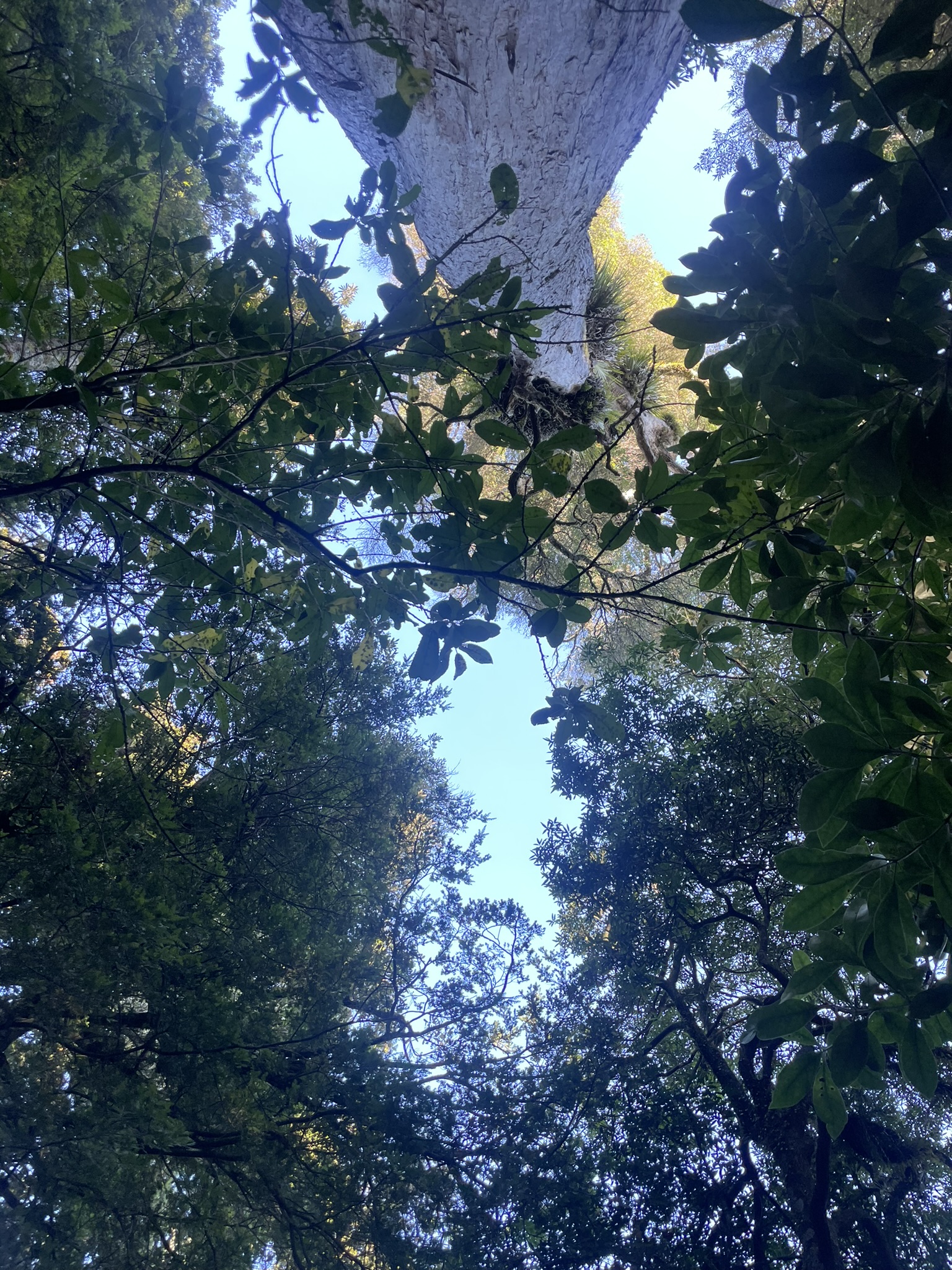
(Above: bush canopy in the Rangawahia Reserve.)
I also wanted to share an older but previously unpublished poem.
This was commissioned years ago for an anthology about New Zealand’s endangered species. Each poet was assigned a topic. My assigned subject was the Manoao Tree (Silver Pine).
Sadly, the book project didn’t eventuate so I thought I’d share the poem here:
Manoao
Small, sensitive, the cleanest of the grassy greens of the understory single leader, forest pine
too many years of mistaken identity growing in the shadow of all that a Kauri can be
rainforest supporter prone to sudden collapse like all things humble, misidentified, or hard to see
human desire-lines walk wide past the subtle glow in long rows of gloaming extroverts
If we were better, we’d take the time to thread the eyes. of this graceful relict.
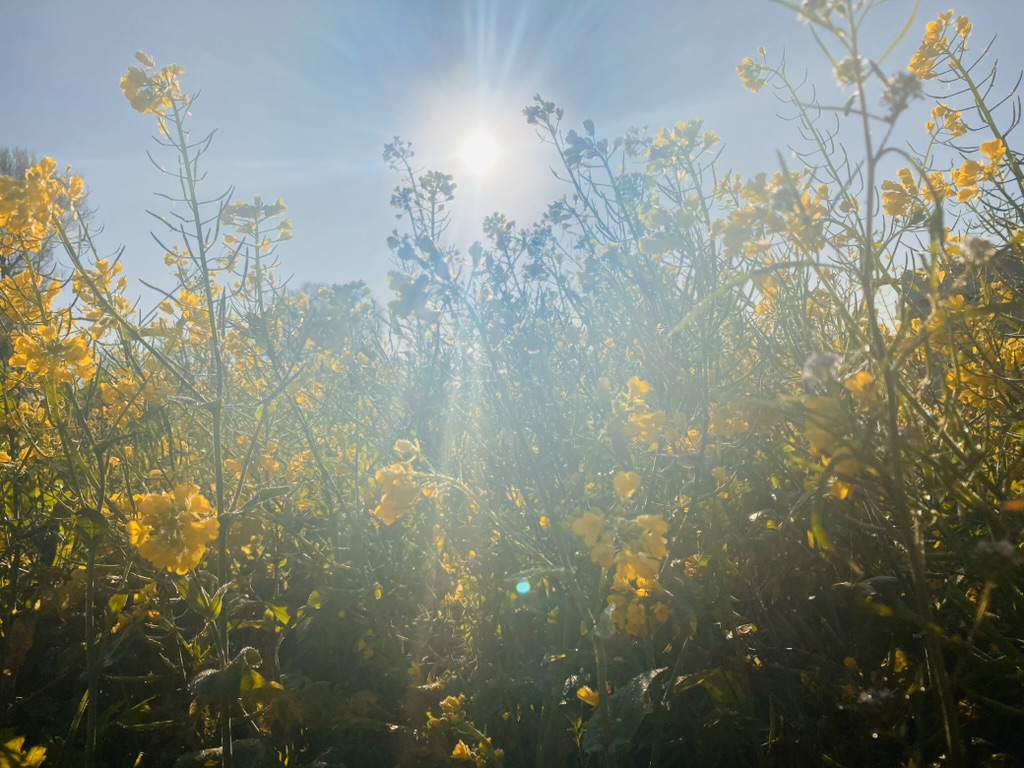
(Above: low winter sun through some crops gone to seed at the Awapuni Community Garden.)
Hi lovelies,
Jeez, another week of scary news in a world gone mad. I hope you are faring okay and doing plenty of sensory, nature-based things off screens to give your nervous systems a chance to recover.
Winter calls for an encounter with ‘a Wild God’
Long a favourite poem of mine, I went looking for a shareable version of ‘Sometimes a Wild God‘ by Tom Hirons and saw, to my delight, that you can both read it and listen to it being read by the author here. There’s something about listening to poems read by their authors which is really special.
This poem speaks to that longing inside us to connect with nature’s raw wildness…how that raw wildness is no joke…and it also has such a great ending. A modern classic, I think.
Song for the week
This week’s song is gentle, evocative and sounds a bit like Nick Drake. It’s ‘Crow’ by English ‘folktronica’ band, Tuung.
As a poet, I can’t fall 100% in love with a song unless the lyrics are thoughtful and interesting. The chorus for this song are so good:
‘And we bide our time And we shed our skins And we shake our bones And we sink like stone And we crawl through mud Til we reach the sky And we bide our time.’
I especially like the photographs. What great seasonal fun.
Make a liver-cleansing, iron-boosting tonic from a much-maligned weed
Most people I talk to are unaware that yellow dock, a plant loathed by many, is a powerful medicinal plant.
When I did a live-cooking event at the Womad Festival last year, one of the things I made was some wild seedy crackers which had yellow dock seed in them which I foraged.
Lot’s of weeds are a bit of a pain, it’s true (hello, tradescantia, hello, convolvulus) …but so many weeds are edible or medicinal. I feel like re-learning all of the offerings of local weeds will be an important passtime for the coming years.
Here’s to the humble dock plant: mineral-retriever with it’s deep taproot, generous-seed-offerer, cleanser of livers and booster of blood.
This week’s affordable art: Whakangā
This week’s affordable art is not wall art, but an artful object, a meditation tool, a little something perfect for the wintery months. This would make a beautiful gift.
(Above: photo borrowed from the Creative Hive NZ website.)
From their website: ‘This beautiful Whakangā set is the perfect addition to your wellbeing with 21 small beeswax candles and an exquisite artisan ceramic kawakawa leaf holder.’
I think it qualifies as ‘art’ and is very reasonable at just $35.00 for the set.
This is such a thoughtful product. The tiny candles are made to burn for twenty minutes; just long enough to take a break or meditate. A friend of mine has a set and the candles are so very small and sweet.
How to make a Wild Food Map of your neighbourhood
This is a great article from Milkwood Permaculture on how to make a wild food map of your neighbourhood. I haven’t done this but I’d love to. If you have younger kids, it could be a fun activity to get them involved in over the school holidays?
As well as great instructions on this project, this article has a handy list of links for online community food maps at the end, like Falling Fruit a global map of crowd-sourced information about public fruit trees. It’s very fun to type your address into it and see what’s within walking distance of your house. You can add your local knowledge to it, too.
Something chill to watch: a Brixton folk artist’s beautiful house and studio
He’s a vibe, and I loved seeing his house and studio. His house is beautiful as is his art. I also appreciated how much he talks about loving being at home. I think since the pandemic, many of us feel the same way, hey?
(I lived in Brixton a zillion years ago when I was on my travels. I found it such a vibrant, exciting suburb of London.)
This manifesto gave me some solace this week. I love manifestos. I think most things I write end up being thinly disguised manifestos; I can’t help it.
I’m going to print it out and stick it on my fridge.
This weekend my oldest ‘baby’ turns 25. Quarter of a century!
(Above: the oldest baby when he was 4. A favourite pic.)
I spent my 25th birthday dancing at Duckie London – a queer club night that’s still going! But I started off the night straddled across one of the bronze lions of Trafalger Square in London, drinking straight from a 1.5 litre bottle of Absolut vodka. Classy, aye? (I wasn’t always the quiet homebody I am now.)
It’s funny, because I remember clearly thinking back then ‘I’m going to climb up here and get on one of the lions…because then I will always remember what I did on my 25th birthday’ …and it worked, I do!
Anyway, there will be birthday celebrations this weekend and no doubt F and I will have a tipple of whisky and contemplate the bizarre passage of time.
Hope there are sweet, calm things in your weekend, too. x
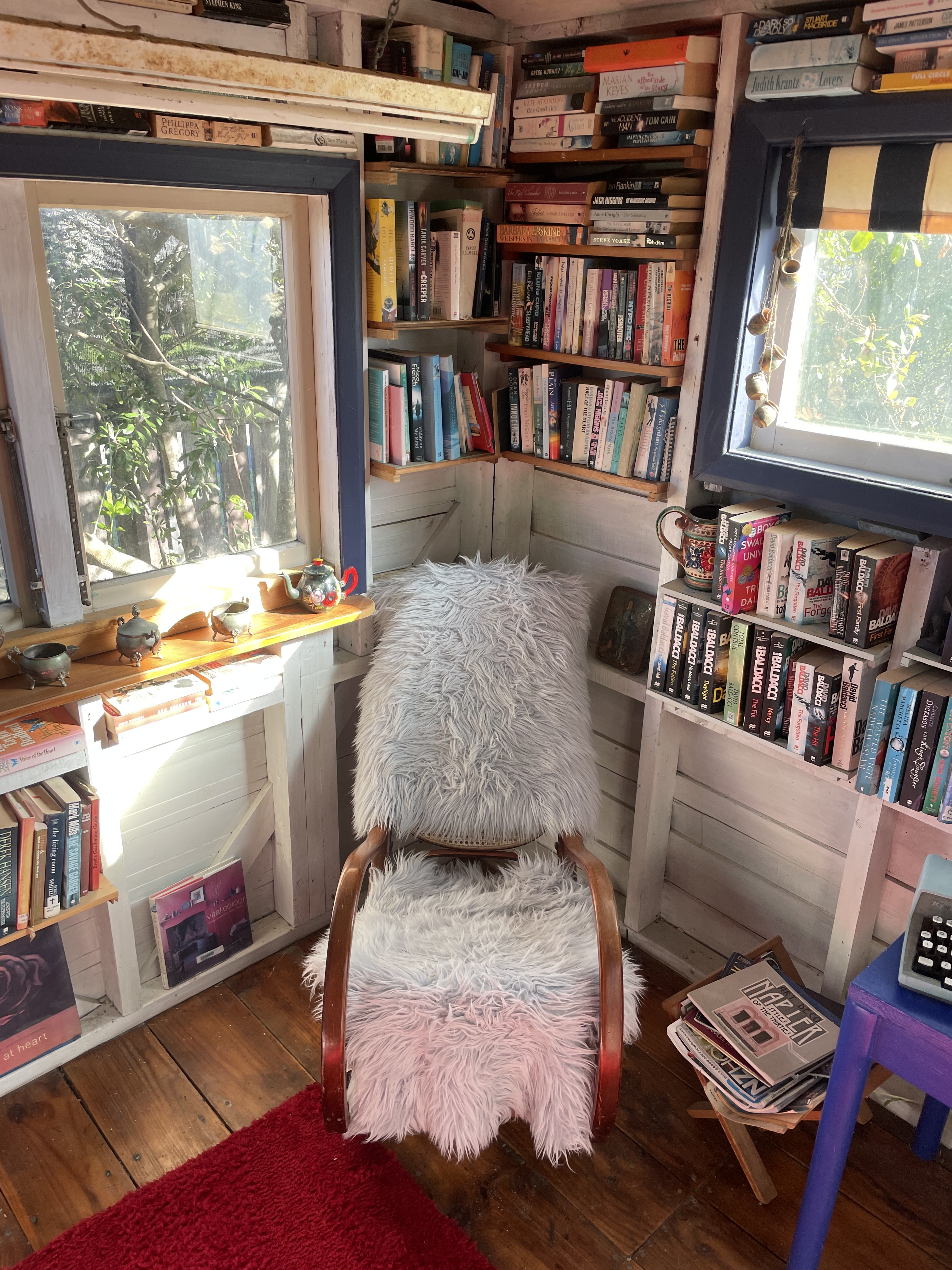
(Above: the sweet and tiny reading hut at the Red Bach, Turakina, where I recently had the good fortune to spend a weekend.)
I lost most of this week to dental surgery recovery and felt quite sorry for myself…however, it has not prevented me from rambling the internet with my forager’s bag over my arm looking for good things for you to read.
It sparked a lot of nostagia in me of the health food cafes of the 1980s in Taranaki and the Manawatū which I would frequent as a punky teen getting interested in all things countercultural. I would gnaw down the sprouted lentil salads served in gritty pottery bowls, eat the earnest sugar-free carrot cakes with oily carob frosting and feel like I was really living on the edge.
A song
This week’s song is my one of my favourite bands, This is the Kit. I love this band so much. They sing about things familiar to me…like gardens, and cups of tea, staying in to cosy up, friendship heartbreak, and environmental angst.
I thought I’d share this song ‘Empty No Teeth’ because I’ve been laid up with dental horrors this week…but also, because I love that the lyrics for this song mention ‘autumn…compost….leaf mulch’ …
(I used to put compost in poems so often that my poet friend Jo banned me from using ‘the c word’ any more. It’s hard, though, because compost heaps are so full of life! and metaphor!
*By the way, you can listen to the slow-growing playlist of Slow Small Media songs over on Youtube here. (I don’t do Spotify…because #payartists)*
Affordable Art
This week’s affordable art is a beautiful scene of a lakeside path meandering through trees. The artist, Gill Allen, writes that it is a scene from Mistletoe Bay in the Nelson region of NZ. I love the dappled light and it makes me think of my slow foraging walks. It offers such a peaceful feeling, I think.
(By the way, if you are an artist who has affordable art to share…or you’re an art-appreciator who has some good leads for me, please share in the comments or email me.)
Polenta is such a comforting rice/pasta alternative for the colder months…and so easy to whip up.
Art to admire …surreal reading women
I spotted these reading women by american artist, Rick Beerhorst on Lithub. I really like the way he captures something of the magic of being lost in a book by the way he paints hovering birds and the like in front of the women. He’s a contemporary artist but they feel like paintings from another age.
A beautiful photo essay of some urban ‘neopeasants’
If you’re a permaculture person, you might know of Artist As Family, an Australian family who have a poetic, creative approach to urban permaculture and ‘re-common-ing’ the ‘burbs.
They just shared a beautiful photo essay (photos by Max Roux): ‘Max slung his camera over his shoulder as we forested, farmed, gardened, creeked, salvaged, ate, played, loved and listened to one another’… and I find it very earthy, heartening, inspiring.
A tantric, non-dual poem expressing life’s ineffable beauty
To be the seed and not wish to be the flower. Or to be the flower and not wish to be seed or rain. To be the rain and be grateful to be the rain. Which is to say, to be the self and delight in being the self. But when I say self, I mean to know the self as seed. As flower. As rain. When I say to know, I mean to ever be in wonder.
*
I hope there are good things in your weekend. I hope you still have moments in your life when you can ‘delight in yourself’. I hope someone buys you coffee/cake/wine/chocolate when you least expect it. I hope you have access to a cosy fire, a good book.
(Above: many hands make work fun. A harvesting and chopping working bee at Kirsty’s place. Photo by Kirsty Porter.)
Fascism is on the speedy rise, climate collapse is escalating, increasingly our governments and power structures are unreliable at best, malevolent at worst. What is there to be done?
I’m in a couple of ‘conscious-collapse’ groups. One is aimed more at emotional support and mutual aid (deep listening, space-holding, nourishing one another with beauty and soothing art), the other is more about practical supports, and intentional-relationship-building over time (working bees, resource sharing, fun gatherings.)
While both groups have group chats in messaging apps, we make a conscious effort to take them offline and get together regularly, because actually being together is so much more healing than more time staring at our phones.
The photo above is the latter group. We had a working bee to harvest all the end-of-season green tomatoes, then we sat around Kirsty’s kitchen table and chopped up the harvest. We filled four buckets (!) with chopped green tomatoes. Kirsty kept two, M & R took one and I took one. Kirsty, M&R turned theirs into Kirsty’s Grandmother’s recipe for green tomato chutney and I turned mine into a spicy Mexican green sauce.
While we worked, we chatted, we laughed and the folks in the group who had only recently met got to know each other better. It might not seem to have much to do with the mitigation of fascism & climate collapse…but it was a practical, positive, soul-warming way to spend an afternoon. Every small action like this brings us closer, braids us together a little more…all while we work on our food resilience skills.
Kirsty might have struggled to ‘capture and store’ her green tomato abundance alone…but with five of us at work…we got it all done in a couple of hours.
What sorts of things are you doing to nourish yourself in these challenging times?
In other tomato news…I like to challenge myself to memorise high-rotate recipes, like fruit crumbles, scones, pikelets, simple cakes…so in the unlikely event I am somewhere I can’t use my recipe books or the internet, I can still make these things. I figure it’s good for my brain, at the very least. Also, it makes me feel next-level to be able to bash them out without cracking a book.
This winter, I am attempting to perfect and memorise focaccia. I made this one with one of the last crops of cherry tomatoes and basil from the garden.
In my household, we are seasonal eaters, which gives the last tomato harvests a real poignancy.
The basil is valiantly carrying on, despite some colder nights…but how much longer for? Time to make some big batches of pesto, I think.
Another thing that happened while I was too distracted by the release of ‘A Forager’s Life’ to give it the attention it deserved is that writer Iona Winter published a grief almanac called ‘a liminal gathering‘.
I submitted poems to it and Iona chose one for the almanac, which I share below. I feel privileged to be amongst the writers, artists, musicians and photographers who are part of this precious container for giving voice to grief.
Iona’s son, the musician and artist Reuben Winter killed himself in 2020. Since Reuben’s death, Iona has used her skills as a writer and communicator to be public with her grief in service to all who grieve and are silenced, or are too overcome by grief to speak themselves.
A review of the almanac by Hester Ullyart says, ‘This is a hopeful resource, much needed. A rope of stars thrown out into the murk of grief. I recommend this almanac for every shelf, for death touches us all, and no one need struggle alone.’
I so agree. This book contains both the intensity of new grief and the wearing plod of long-carried grief. It spans anger, raw shock and emotional pain through to gratitude, reverence, elegy…sometimes in the same piece of work.
If someone you love loses someone they love, don’t buy a sympathy card, buy them this. You will be giving them the gift of a chorus of voices who dwell in the same place as them, a liminal gathering: grief.
In his piece in the almanac Dear Reader, Rushi Vyas captures the some of the nuance of grief in his poem’s ending:
‘Dear Reader, go outside. Feel everything. The wind is cruel. And full of oxygen. The sun is deadly radiation. And our only source of warmth.’
-Rushi Vyas
& here is my poem from the almanac:
negotiating boundaries with the dead
grief: week one
kaimanawa horse in my living room
wild waters white flames
grief: week two
flower’s fingers holding medals
i’m a hobo pedestaled for bravery
grief: week three
in the musty cave mushrooms sprout from armpits
it’s a total eclipse of the total eclipse
grief: week four
hurricane chasers, race to get best footage of worst damage
a raggedy lone wolf to stare down
grief week five:
bat-infested feeling my way with echo-location
drink puddle-water trying for nutrition by chewing on a husk
grief: week six
(but wait there’s more
were you looking for a neat trajectory?)
belly-crawling at toadstool height
make the bed with a chainsaw
grief: week seven
turns out the source of the tinnitus is my own throat’s moaning
some forest fires happen to crack the open the seeds of amoured shells. But not here.
Just another searing morning. The petrol pours itself.
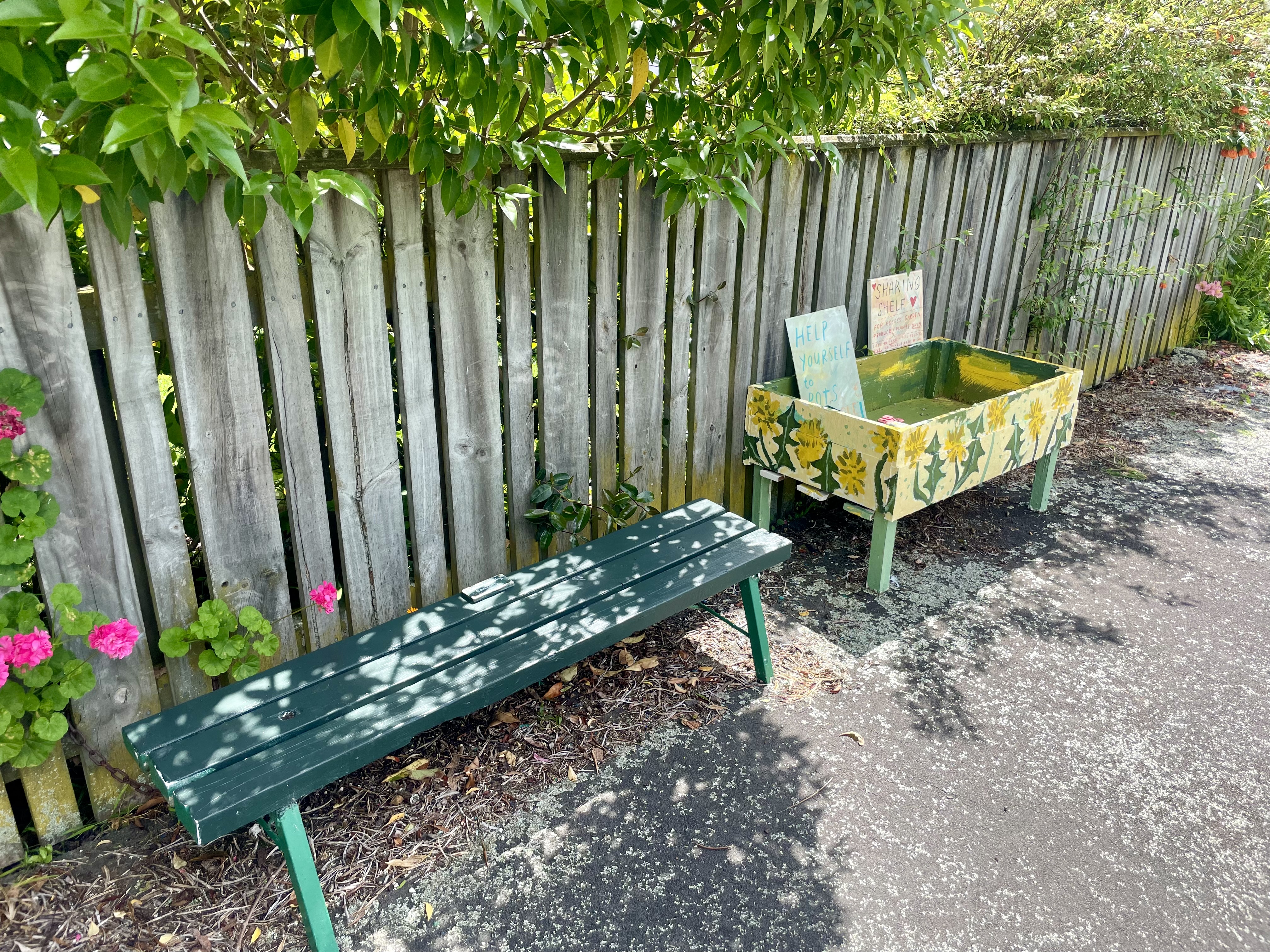
Late last year we put a sharing shelf outside our front fence.
We’ve always shared excess produce from our vegetable garden by putting it in a box on the community seat (for more about the community seat, check out my last book, ‘A Forager’s Life‘) but I wanted to make it a little more formal so that it could be a site of #radicalreciprocity* in the neighbourhood and many people could contribute to it.
(#radicalreciprocity is how I try to live my life. Giving generously, receiving with gratitude and humility, and trusting that there is more than enough to go around if we can all learn to do both.)
I bought the planter from a local young woman who makes them from upcycled pallets and then I painted a dandelion motif on it. The dandelion is a plant that means a lot to me and acts as a symbol of courage and generosity in my personal symbology.
It didn’t take long -a few weeks or so- for neighbours to get the idea and things began to appear in it that weren’t from us.
Part of putting something like this into a public sphere requires a willingness to look after it well so I check it twice a day, first thing in the morning and then at dusk.
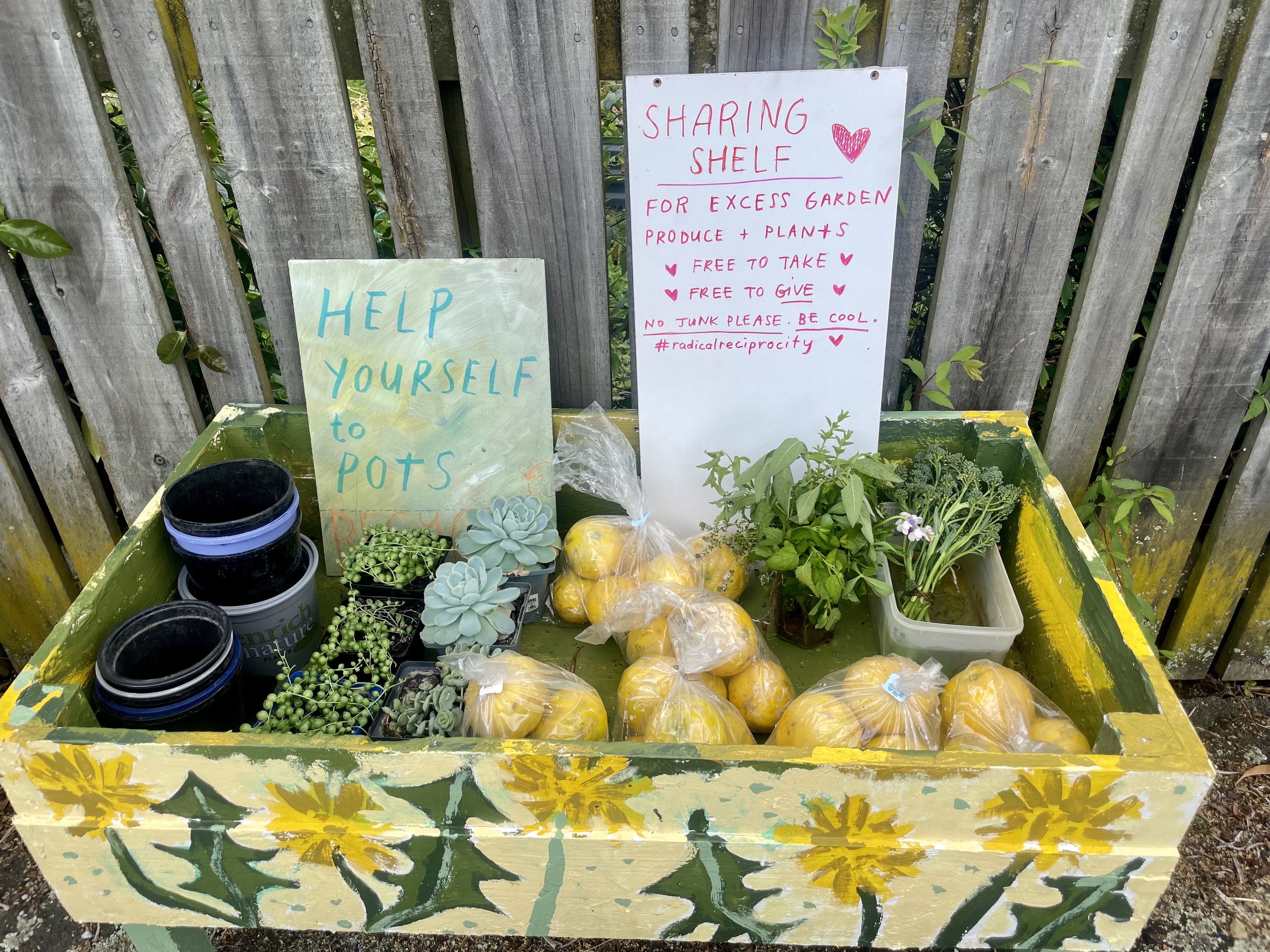
Although the purpose of it is to share the excess garden produce and garden related things, occasionally people put perishable or pantry food in it. The perishable food (things like bread, sandwiches, etc) I dispose of (usually feed it to the backyard birds, or my worm farm, if possible) because I don’t want to be responsible for anyone getting ill from spoiled food. Mostly, though, people seem to get the idea. There’s been all sorts of vegetables, seedlings, cut herbs. It’s been mostly delightful things.
My original sign (paint and vivid marker on an art canvas) melted away in the rain, so I painted an old cutting board with outdoor paint in an attempt to make a more weather-proof sign:
People have not 100% ‘been cool’. There’s the occasional beer bottle or pizza box after a Friday or Saturday night. There was one incident when someone kicked the front of it in, breaking a board. But for the most part, it’s been a success and a fun, new element in my days.
March has definitely been the month of the giant marrow. Hearteningly, these swollen offerings have all been taken, though so I guess there are some good marrow recipes being cooked around Takaro. There’s also been lots of bags of tomatoes and apples.
Every day is different in the sharing shelf. Things flow in and out.
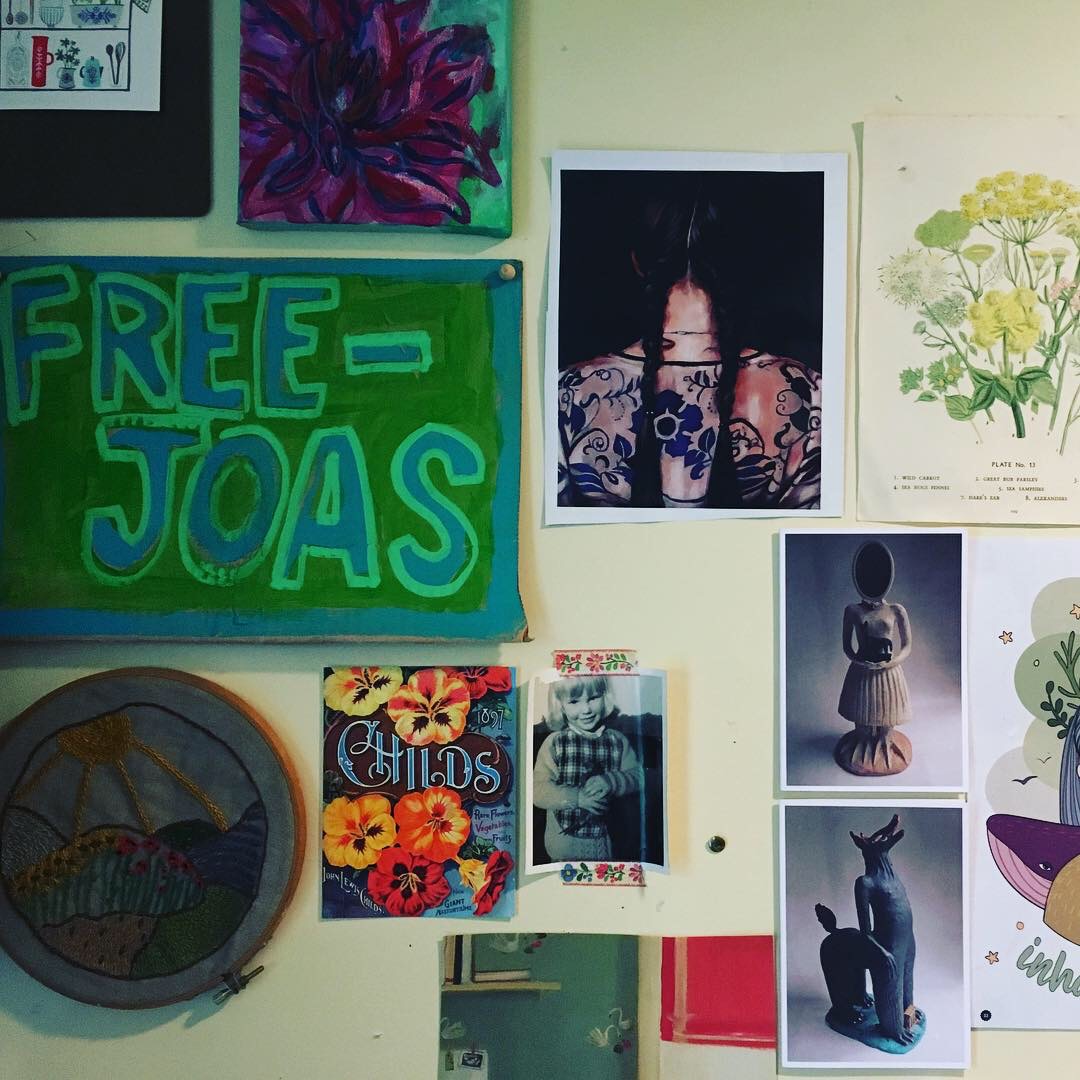
With feijoas just beginning, I’m expecting it to become mostly a ‘freejoa’ booth any day now.









 Helen Lehndorf