
‘A flower falls, even though we love it; and a weed grows, even though we do not love it.’
One of my favourite poets is American poet Gary Snyder. He is described as the ‘poet laureate of deep ecology’ by some and I would agree with that. I guess he is a natural fit for me – he studied Zen Buddhism in Japan for years and writes a lot about the human spirit and nature.
I have to defend his work from most of my poet friends who think his stuff is ‘obvious’ or romanticises nature or whatever – but I think a) the simplicity of his work often echoes that of the Zen Koan (short poems or spiritual conundrums) he is obviously schooled in.
You could say this very famous poem by seventeenth century Japanese poet Masahide is ‘obvious’ and yet in its simplicity it also contains multitudes of meaning:
Barn’s burnt down-
now I can see
the moon.
*
And b) I don’t find his nature writing to be ‘romantic’. I find it to be frank and direct. However, it is hard to write ANYTHING about nature in the 21st century and not be accused of being ‘romantic’ and Wordsworthian. Nature poetry has an undeserved bad rap, I think.
Anyway, here is my current favourite Gary Snyder poem. Like a Zen koan, it is deceptively simple and yet depending on your reading of it can blow out and up and be a big existential gesture. As well as enjoying it aesthetically, I am returning to it lately as a reminder of mindfulness…because the trail is not a trail, there is no destination, ….or if there is it is only death – hence the pressing need to be present in the moment!
Here it is:

The Trail is Not A Trail
by Gary Snyder
(from Left Out In The Rain, North Point Press, 1986)
I drove down the Freeway
And turned off at an exit
And went along a highway
Til it came to a sideroad
Drove up the sideroad
Til it turned to a dirt road
Full of bumps, and stopped.
Walked up a trail
But the trail got rough
And it faded away—
Out in the open,
Everywhere to go.
I’ve had a week of battling my ‘monkey mind’ – that part of the mind that is unsettled and dissatisfied, busy and graceless. This week my monkey mind has been a place of impatience and regret – both fairly useless emotions.
It’s the school holidays, I’ve got far too much work on my plate (which I can’t get to, because it’s the school holidays) and I’m burning, itching, yearning to get to some creative work -writing and making- which is coming waaaaay last at the moment, because of the aforementioned kids, work.
Cue the negative internal brain loops.
The good thing is, I see it, I notice it for what it is – useless thoughts, pointless mental torture – and so as they arise, I work (and boy, does it feel like work) to let them go.
Feel it, notice it, let it go. Feel it, wrangle with it, notice it, let it go. Feel it, watch it flare, notice it, let it go.
When I’m wrestling with my demons, the best thing for me to do is to go outside. Be with my plants. They bring me solace. I can get perspective out in the garden, also nothing soothes a restless mind like a bit of weed pulling.
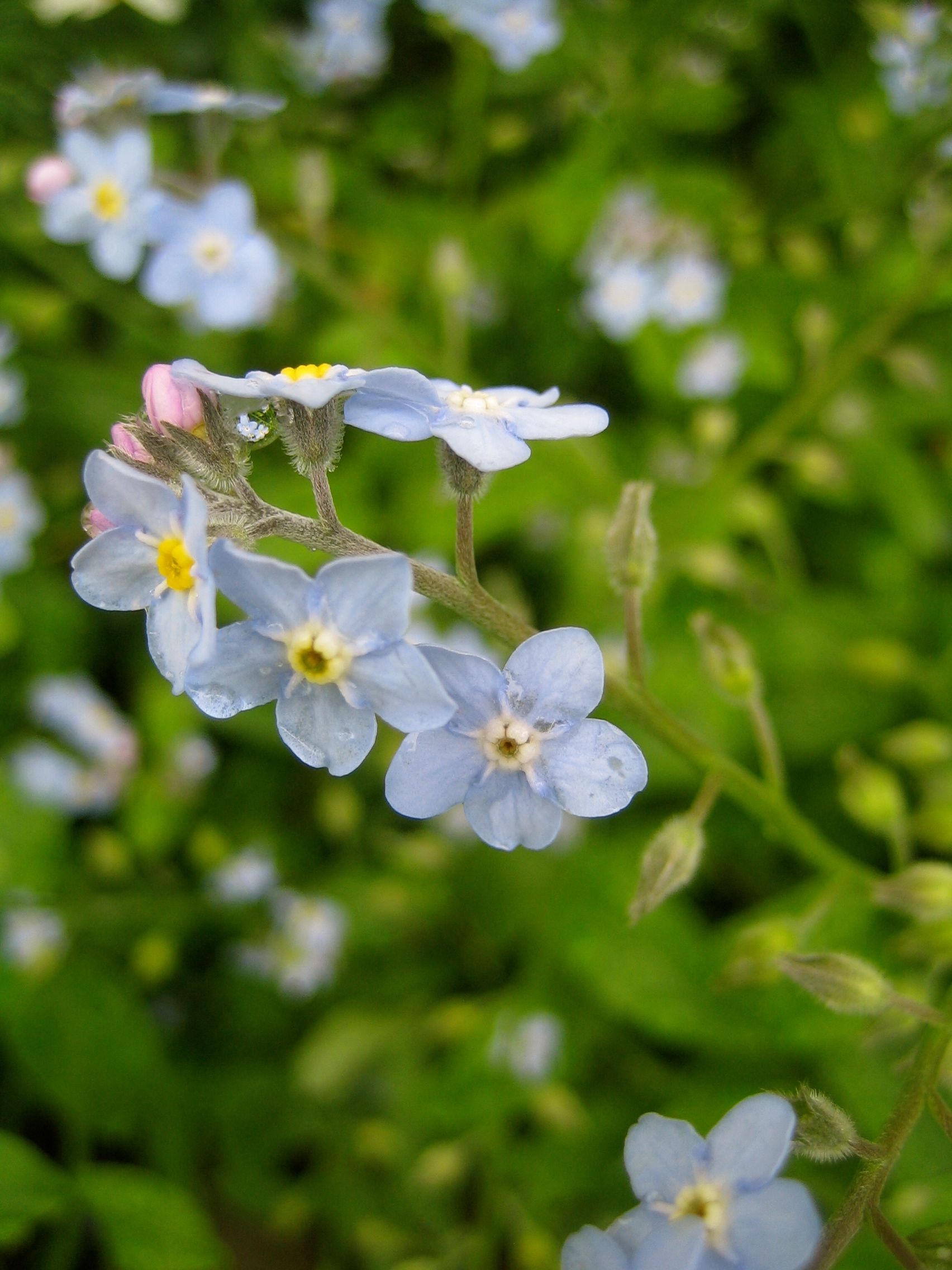
All over the garden, forget-me-nots have self-seeded. They are growing all over the place, occasionally in an actual garden bed. I didn’t bring them to this yard, so they are an inheritance from the gardeners who lived here before me. I love the self-seeded flowers best of all – staunch, self-sufficient little fellas.

Bright blue flares of tiny flowers everywhere – they’ve come in just the right week, when I need reminding what is worth remembering and what to forget.
Do you keep a journal?
Sometimes I feel like my journals keep me.
They keep me sane, keep me engaged, keep me feeling creative even when I don’t have time for larger creative endeavours.
I’ve been teaching journal-writing for years. Teaching is a good reminder to me in how important it is to keep on with journals. People often start the journal workshops with slightly skeptical, guarded expressions…(I don’t know what they are thinking, but I imagine it is something along the lines of ‘Is she going to make me write about my feelings and then read it out?’) but after a couple of hours of my raving and sharing my work wth them, they light up, they see possibility, they go out the door with a new resolve.
Now that book one is nearly birthed, I am working on the next projects. There will be more poetry, of course, there’s another thing I’m working on which I am calling ‘writing blobs’ at the moment, because I’m not sure what they are yet – not poems, not stories, just blobs. Finally, I want to write a journaling book. I’m feeling my way into what that might look like – probably a mix of my teaching and my own journal pages. Would you read a journaling book? What would you like to see in a journaling book?
Here is a recent journal collage: ‘water’:

I was sitting across from Magnus watching him eat his dessert which was, that night, two cut-up oranges.
Magnus was really eating those oranges. He was so present in his enjoyment – he was sucking every drop of juice and had the fixed stare of someone experiencing great sensory pleasure.

I love that about children. They are great teachers in being fully present in the moment.
Watching Magnus eat an orange made me want to eat an orange, so I did. It was delicious. We sucked oranges companionably for a good ten minutes.

Messy fruit offers a particular pleasure, I think. Sensual and fun, all at once. It also demands presence of mind. You can’t suck oranges and read. You can’t chew out a mango and talk on the phone.
Messy fruit as zen practice? Why not.
At least we are free to suck oranges in public…unlike in this quotation about oranges in Cranford, by Elizabeth Gaskell:
“When oranges came in, a curious proceeding was gone through. Miss Jenkyns did not like to cut the fruit, for, as she observed, the juice all ran out nobody knew where, sucking [only I think she used some more recondite word] was in fact the only way of enjoying oranges; but then there was the unpleasant association with a ceremony frequently gone through by little babies; and so, after dessert, in orange season, Miss Jenkyns and Miss Matty used to rise up, possess themselves each of an orange in silence, and withdraw to the privacy of their own rooms to indulge in sucking oranges.”

 Helen Lehndorf