I consider the writer, Iona Winter my friend even though we’ve only met in real life once. We’ve exchanged lots of warm and intimate dialogue via email. I read an early draft of one of her poetry books for her. She included a poem of mine in her grief anthology ‘a liminal gathering’ which I wrote about back here.
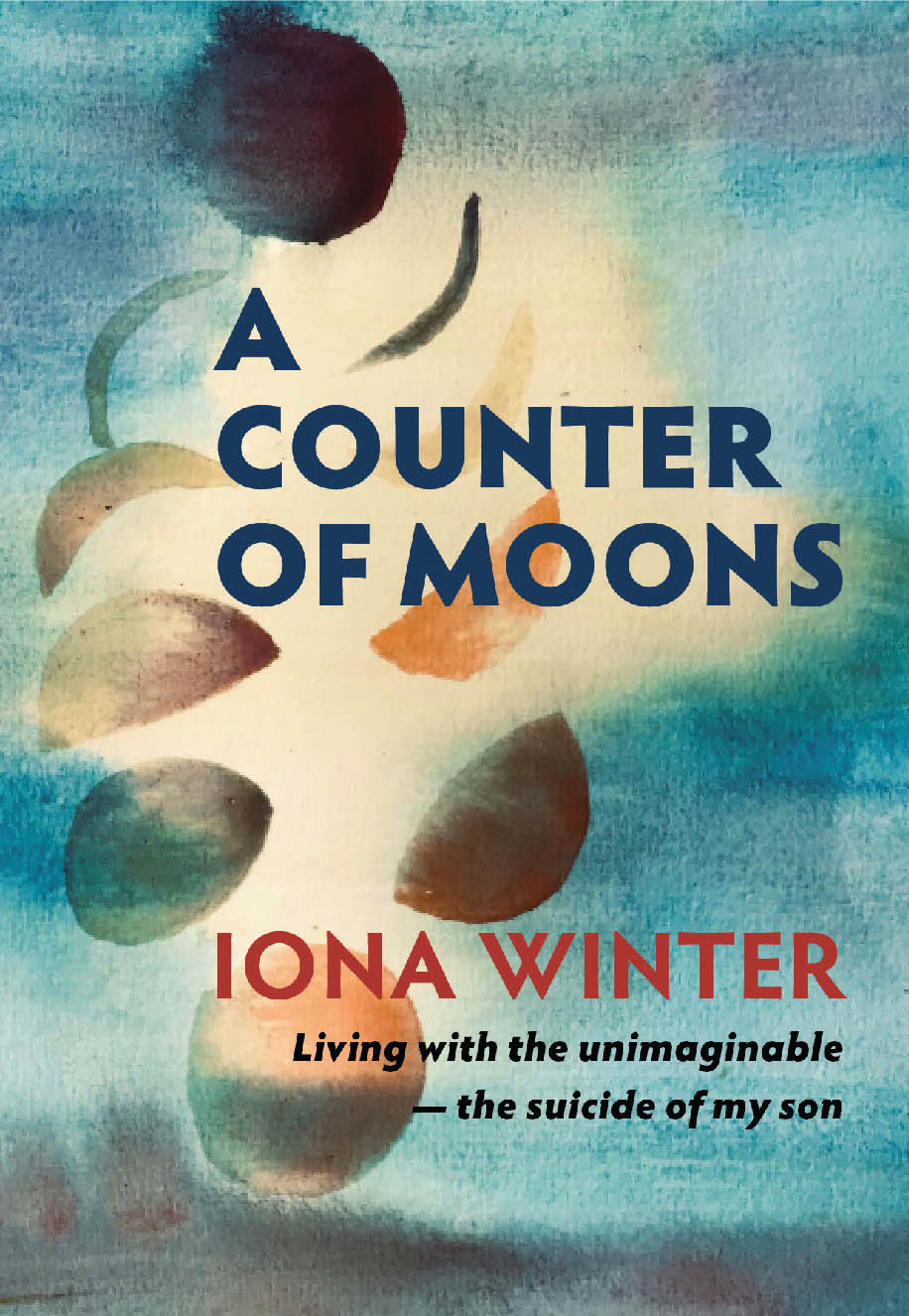
Iona recently released a hybrid memoir, A Counter of Moons. In it, she writes candidly about the time surrounding the suicide of her beloved son, the musician Reuben Winter.
I recently slow-interviewed (via email exchanges) Iona about her new book.
(Content heads-up: Iona’s book discusses suicide, mental health, grief so, naturally, all of these subjects feature in this interview as well.)

Kia ora Iona, thanks for talking to me about your beautiful new book. I really enjoy your poetry so I am looking forward to reading your memoir.
Can you share a little about how this book came into creation?
Iona: Kia ora Helen, thanks for inviting me along e hoa. I love the idea of a slow interview, it’s like we’re having a cuppa together, fireside, with a plate of delicious homemade biscuits!
A Counter of Moons is part of a body of work that began after my tama Reuben took his life, during Covid lockdowns in 2020. I’m deeply grateful to have received the 2022 CLNZ/NZSA Writers’ Award, that enabled me to complete the initial manuscript. This book and my poetry collection In the shape of his hand lay a river (2024), started out life together, as companions…but the world of publishing had other plans. Writing has been my main solace, while facing into an experience that is, for the most part, wordless.
The first project published was the multimedia grief almanac a liminal gathering (2023) Elixir & Star Press – a small indie press I set up in Ru’s memory. Knowing that grief is everywhere, from sharing my grief experiences, I kept hearing that many people carry their grief alone and feel dreadfully isolated. It was like Ru spoke into my ear then, saying, “You need to create a space for other people’s grief Mā”. It wasn’t really an option, more like an essential thing to do.
After Reuben died, I wrote diary entries, poetry, ranty-af essays and explored literature around suicide bereavement and grief. There wasn’t much, in terms of dead-child-grieving-mother books, and the rest was either academic or self-help. What I needed was to read people’s personal stories – something to mitigate the deep grief that accompanies suicide bereavement. I was active on social media for a couple of years, because I didn’t want Ru’s death to go into a void. It felt important not to disappear either, as a grieving māmā; not to garner attention but to raise awareness. Along the way I’ve attempted to challenge the social stigma attached to being a suicide bereaved mother in Aotearoa. A Counter of Moons is a hybrid non-fiction memoir; a snapshot of my life, Reuben’s life and his departure from this realm.
I think of you as a writer who can’t be confined to one genre so it makes sense the memoir turned into a hybrid book. It also makes sense in terms of how grief feels, right? You never know how you’re going to be one moment to the next.
Now that it’s out, how has it been (so far) having it out in the world?
Iona: Yeah, grief is hybrid by its very nature, as is love. I guess you’ll never find me writing something straightforward, probably because my brain doesn’t work that way, but also because I don’t see life, or death for that matter, as linear, formulaic or clearcut. Everything is interconnected and interdimensional. I’ve crafted a hybrid book because that’s how grief is for me – all over the freakin show, intermingled with moments of clarity and belonging, and at others feeling desperately alone and silenced.
It’s been odd since the book came out; a mix of relief, exhaustion, and flatness. Reuben used to say that too whenever he released a new album, and how it often felt ‘over-cooked’. Truckloads of energy went into these grief projects, but putting everything into grief-art, despite being purposeful for myself and others, has taken a massive toll on my wellbeing.
The feedback from those who’ve connected with A Counter of Moons has been potent, heartfelt and moving. To date, I’ve been blessed with generous and hearty responses; yet alongside this I’ve noticed the same pervasive silence that accompanies suicide. All I can do is trust that it’ll make it into the right hands. As a bereaved mother, I saw a major gap in the literature and have attempted to place a signpost there. I’m under no illusion that this book will be a bestseller, because most people seem reluctant to engage with the subject matter; including those who’ve said they can’t because they don’t want to feel sad. I say in the book, “We are expected to get over grief, not wallow in it, and to hide our teary-eyed sleep-deprived faces. Except if you’re me, and these days I say, bugger that. I’ll be real about this, even if it kills me.” It hasn’t killed me yet, and I’m pretty feisty about everyone’s right to do grief in their own way.
In making these three books, I do wonder if there’d be more engagement if I was a shouty wahine standing on the steps of the Beehive! The silence with suicide and difficult emotions, I believe, speaks to our collective fears of going there with our own grief and internal pain. Heaven help us if we are triggered into feeling something other than the socially prescribed or accepted norms.
Here in Palmerston North, a well-known local writer, Paula Harris killed herself in 2023.
Paula was very open, very vocal about her mental health struggles, her suicidal thoughts, her feelings of isolation & her despair at her treatment by mental health professionals.
She wrote about being sectioned in essays published on The Spinoff.
It seemed to me that there was often silence after Paula spoke out on social media or published one of her essays or poems. Not total silence, some people would response and try to say supportive, buoying things, however, it was to little effect.
Whenever suicide features in an art work, there is a often a list of links afterwards and a statement like ‘if you are struggling…help is available.’ In Paula’s case, though, ‘the help’ seemed to make things worse…and with mental health services so underfunded…IS help available, really?’
I’d be interested in your reflections on this, not Paula’s case so much, but more the ‘help is available’ phrase we see/hear so often.
Iona: Thank you for mentioning Paula, and naming the silence.
Last time I saw Paula was at the Verb Writers Festival, we’d followed each other for years on social media. It was great to have a hug, put a face to the name and have a shared rant about the state of the world. It’s important to mention Paula, because she’s just as ‘with us’ as Reuben is. Our dead don’t go into a box, as I’ve mentioned in the book.
Canadian artist Tanya Tagaq says in Split Tooth, “We carry our dead with us like helium ballons. There is no breaking the umbilicus. They have always been with me. They are me.” And it’s up to us to keep their names in the conversation, rather than not. Less avoidance would go a long way towards developing more honest kōrero in our communities.
While I have theories about why people are so afraid to speak about suicide, grief, mental health; when there have been decades of awareness-raising, it still doesn’t make sense. I’ve written about my take on this in A Counter of Moons. The ways we speak of our dead varies a great deal, is often dependant on how they died, and their death-stories seem to have a hierarchy. It’s like I can’t celebrate Reuben’s life, because he took himself out of that life, and the lives of everyone who loved him. It’s as though I must feel ashamed as his mother, for not being a good enough parent. There are many shitty things people have flippantly said to me, about Ru’s suicide. I understand the anger about being suicide bereaved, I’ve been like Mahuika or Kali at times, but beneath any anger are myriad emotions (as we well know). What if we looked inside ourselves first, before opening our māngai to comment on things we know nothing about? What if we made more time for one another without time limits (frankly a preposterous idea when it comes to any kind of grief)?
The silence when we have been open about what’s really going on for us, is palpable. But I reckon the ‘what’s really going on’ is what the general populous find repellent, triggering or easy to avoid. Reuben was often met with silence, as was Paula, and I’ve experienced this in life too. The ‘afterwards list’ of people to contact is probably a way of covering butts, as if to say, “I’m sorry that happened but we did make a list of people for you to connect with.” It’s like there’s even less responsibility taken because of that. I’ve spoken for years about the lack of resources and the lack of funding – and I promised myself not to be political today – but can see that it’s never been high on any politician’s list of priorities. It’s as though we don’t want to see what’s going on in our own backyards; the many dire situations including suicide, homelessness, poverty, and the ways these are spoken to with an increasingly more tokenistic vibe.
In terms of ‘Help’ being available; it can only be available if you are willing and able to access it and there are enough people to provide it. I remember working at Youthline in the 90’s, and how many people would call up simply to have someone on the end of the phone, to combat loneliness. Perhaps we need to attend to the ways we silence one another, and the subsequent loneliness and isolation first?
I heard you say, in an interview you did with Kerry Sunderland, that it was writing that has kept you going since Reuben died.
Can you speak to this? What do you think it is about writing / creativity that has kept you going?
Writing has always been my go-to, when life has overwhelmed me, or when I’ve had nobody to share it with. There’s something incredibly immediate about writing whatever’s in my head down onto the page.
Much of how I defined myself (aka society’s labels) has been stripped away over the last decade with a brain injury, a mesh injury from medical misadventure, being unable to work a normal job ever again, and Reuben’s death. There’s been a great deal of grief and loss to attend to, and with limitations on ‘help’ and a lack of financial resources, I’ve had to dig deep in my own soul and find ways to navigate this.
Poetry, either reading another’s or writing my own, creates space to express what’s going on for me internally. I don’t think we have many options these days, for this kind of expression, that feel safe. The good thing about writing on paper is that you can always use it as a firestarter if you don’t like it! When there’s more space in my head and heart, after expression of intense emotions, I think it leaves space for something new to emerge.
Thank you, my friend, do you have any final thoughts you want to share?
If people want a copy of A Counter of Moons, or the other books I’ve mentioned, I have copies and am happy to post anywhere. Or if money is a barrier, perhaps people could request their local library gets copies? Alternatively, copies can be purchased direct from Steele Roberts Aotearoa.
My hope is that these books will start and continue conversations around suicide bereavement and grief, perhaps even making these conversations more commonplace and without fear or avoidance. As I’ve written in this book, death is a part of life and we need the same village that raises our children, to wrap around us when we face death.
Thank you, Helen, for inviting me along, and for being unafraid to go there with me. Thank you for not joining in with the silence that pervades our society, and for meeting me in a beautiful heart-space, I’m very grateful.
Kā mihi aroha, Iona x

(Above: Reuben and Iona.)
 Helen Lehndorf