news + musings

  • How I auditioned to play myself and got rejected

    (An occasional series where I write about things that happened around my book, ‘A Forager’s Life’.)

    (Above: The audiobook as a tangible object!

    In winter 2023,  a few months after ‘A Forager’s Life’ came out, I received the exciting news that the book was going to be made into an audiobook with Bolinda Audio.   

    (By the way, it’s also available as an e-book) 

    Bolinda told me that they would soon be casting a voice artist and it would be recorded in Australia. They also asked me if there was anything particular criteria I would like for the voice actor. I replied that I’d like a warm, friendly voice and that it was very important to me that the Māori words in the book be pronounced correctly. 

    After I sent that email, I got to thinking ‘hang on a minute, don’t some authors read their own audiobooks?’. Of course they do…although it’s more common with celebrity authors or for celebrity memoirs. But in 2020, I’d had a bit of a go at recording some of my original meditations for the meditation app, Insight Timer.  I’d really enjoyed doing this and I thought my voice sounded pretty good… calm, composed. 

    So then I did something I almost never do…I advocated for myself and asked them if it would be at all possible that I be cast as Helen Lehndorf for the narration of the audiobook?

    They were very gracious and replied, ok, although it was unusual for the author to narrate their own audiobook, I could send them an audition ‘tape’ (MP3)  of me reading a part of the book. 

    I duly locked myself in my office and spent a couple of hours getting a decent recording of about five minutes of one of the chapters which had a bit of dialogue in it so they could hear me doing multiple voices. Listening back to it, I thought it sounded pretty good. I sent it off feeling reasonably confident. 

    A few weeks passed…and then I got an email to say they were sorry, but they didn’t feel I was suitable. 

    In other words, I’d failed the audition to play myself.

    They told me they had cast a young Australian actor, Ayesha Gibson. Then, (possibly because they felt sorry for me?) they asked if I would like to record the book’s epilogue. It would involve a trip to Wellington and a few hours in a recording studio. By this stage I felt a bit embarrassed by my bid to read the book myself, however I thought it would be an interesting experience so I said yes

    (Above: A photograph Ayesha sent me of herself in the Melbourne recording studio.) 

    I was booked to record in the same week as Ayesha. She recorded the whole book over just a few days. (The audiobook version is around eight hours long.) On the day I travelled to Wellington to record my little bit, Ayesha and I were in Whatsapp conversation about the recording process. She was (very sweetly) giving me little updates on how it was all going and would occasionally send me a question about pronunciation or meaning. It felt surreal to be getting these messages as I travelled on the train southwards…knowing we were both recording bits of the book at the same time in two different countries, timezones, studios. 

    My recording session wasn’t until the late afternoon. I was so paranoid about wearing out my voice so bought throat lozenges, a lemon honey drink and tried not to talk as I mooched around Wellington waiting. 

    I turned up at The Armoury Studio trying to look nonchalant and no doubt failing. I had around 3000 words to record. 

    Friends, it was challenging. It was harder than I imagined. Now I understand why Bolinda prefers to hire professional actors. I had to do retake after retake because of all manner of things…throat-clearing, dropped words, flubbed bits, weird nervous breathing. 

    (Above: one of the lovely (and patient) sound engineers at Armoury on my recording day.

    I don’t mean to make it sound like I did a terrible job…I didn’t..but nor am I a professional voice actor. And the sound engineers were lovely and reassured me everything that was happening was totally normal and I was ‘doing great’. However, it was precise, intense work. After just a few hours in the studio, I was so tired. 

    On the train on the way home, I felt relieved I had failed the audition to narrate the whole thing myself. Ayesha did an amazing job and I feel so proud of the audiobook version. 

    A few months later, I got sent a few copies of the Audiobook as a tangible object … an MP3 CD! It’s also available on Audible and, if your local library uses the service, Borrowbox

    And that is the story of how I failed an audition to play myself. 

  • Slow-Small Media for the Weekend #2

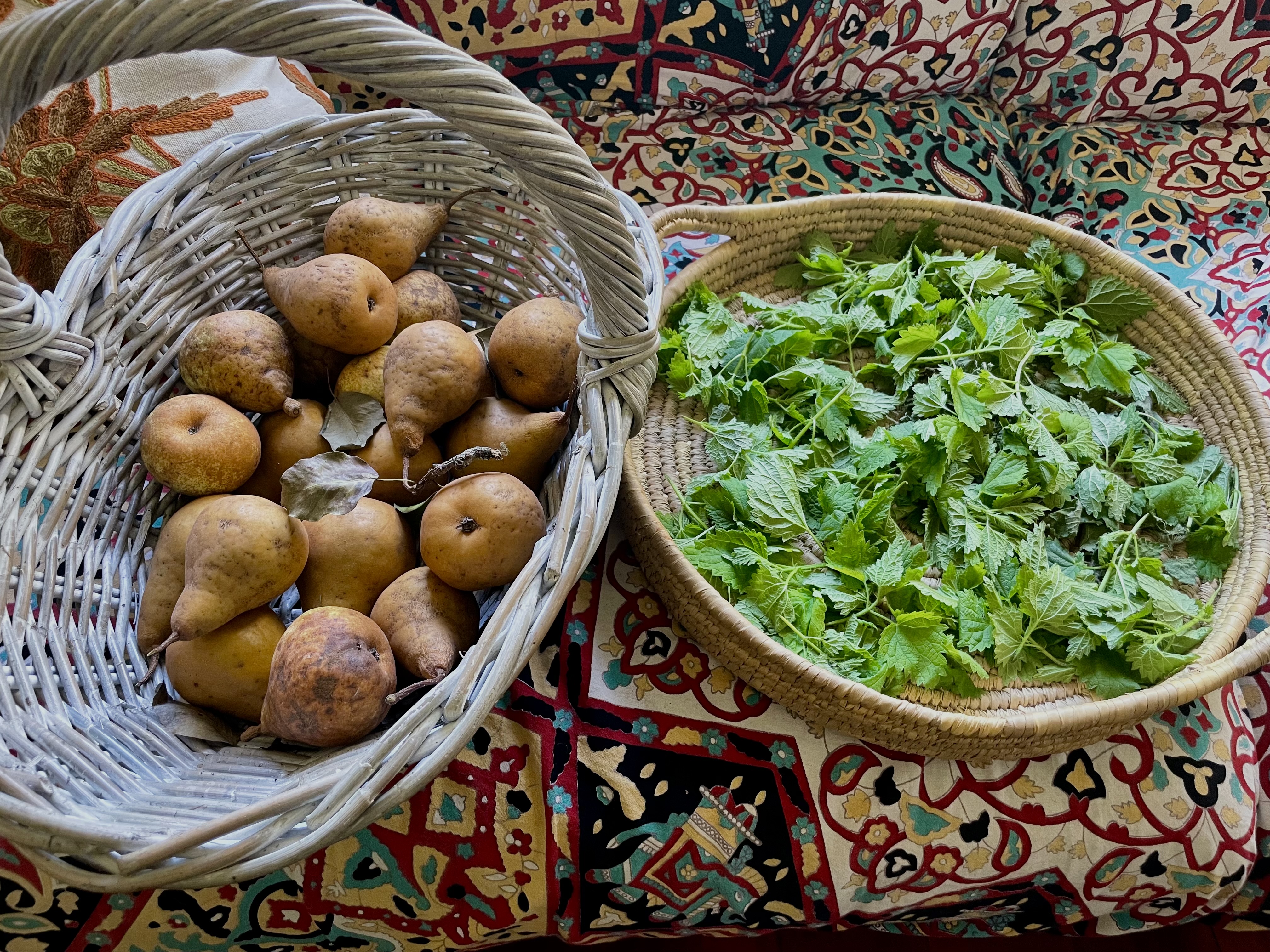
    (Above:These pears got turned into a pear/ginger/feijoa chutney. On the right are nettles drying. Autumn has been so warm…my nettle patch just keeps going and going.)

    When I posted the first ‘Slow-small Media for Weekend’ last week, I asked F if he got the wordplay in the title…? and he said, no, he didn’t–I can always count on him to be honest. I meant it as a play on ‘social media’…but the fact I’ve had to explain it means it doesn’t really scan, I guess. Never mind…I’m sticking with it.  

    A useful resource for reducing food waste in your kitchen

    F and I run a very low-waste, frugal (and yet abundant and colourful) kitchen. I feel I am pretty savvy about not wasting food however I learned things (or had my inspiration refreshed) from this great video by Immy Lucas. where she offers 100 ways to reduce food waste. 

    She has a practical and grounded approach that I really like. 

    & I appreciated that she included reading Braiding Sweetgrass by Robin Wall Kimmerer as one of the 100 things; a book that has opened many hearts and minds to being more grateful and reciprocal towards the earth. 

    An affordable artwork 

    I think everyone should be able to have beautiful art work on their walls and yet so much art is beyond the budget of many …so when I see beautiful art works available for purchase for under $50 New Zealand I will share them with you. Here’s one for this week:

    This graceful fern teatowel from New Zealand maker I feel Natty would make a lovely piece of affordable art, pinned up on a wall, I reckon. It has a calm-inducing quality about it.

    A (secular) prayer

    I immediately loved this earthy version of an ‘our lady’ by Sylvia Linsteadt and loved her invitation to add your own as things occur to you…to keep growing it as an ongoing appreciation of the earth. 

    & Here’s an addition to it from me: 

    Our lady of the slow autumn morning, the crackling fire, the bubbling porridge

    Our lady full of microscopic life, bringing the bubbles to our ferments

    Our lady of a friend’s handwriting on a homemade seed packet

    Our lady of the finch who sits in the open window, looks inside a moment then flits away

    (Above: the sweetest thing about garden/kitchen gifts from friends is their handwriting on the labels.)

    A song

    I’m new to this artist, Sun Kil Moon. Some of his songs sound like lost songs from Neil Young’s Harvest record. The music has a soft, dreamy, lugubrious style that is perfect for autumn/winter listening. 

    Another thing I really like about his work is that he often writes with careful specificity about geographical places, rivers, forests, cities. I guess because I’m a writer, I study and the appreciate lyrics as much as sounds of music. I’m particularly obsessed with this song ‘Carry me, Ohio’. 

    A commenter beneath the song remarked ‘This is the most depressing uplifting song in existence’ which made me laugh and is accurate. This song seems to be very gloomy, and yet it does something upwards to my heart. 

    There’s an apology in the lyrics, verses begin ‘sorry that…’. Is he apologising to a specific person? To a place? To his past self? It’s unclear…and that’s what makes the song so intriguing and beautiful. His music has a hypnotic quality, gloomy lullabies.

    An introduction to Eco-Dyeing

    I dabble in eco-dyeing. I’d like to get much better at it. Sometimes when I start something new I can be quite mean to myself about how janky my early attempts are.

    I have eco-dyed some papers for making cards and for using in my journal. I’ve eco-dyed some of my clothing, too. I didn’t get the lovely, clear leaf prints more experienced people do but still I was excited by the patterns the eucaplytus made on my linen tunic.

    Founder of eco-dyeing and one of my art-heroes, India Flint, writes evocatively about how eco-dyed fabrics take on on the scents of the plant materials and (if you do your dyeing over an outdoor fire, as I do) also woodsmoke. This is true! My eco-dyed tunic, despite many launders, still smells like eucalyptus and woodsmoke…both scents I love.

    If you’re new to eco-dying, here’s a simple introduction .

    & India Flint’s books are wonderful and inspirational. They can be hard to find but most libraries have them.

    I’ve decided to start a creative process journal for my eco-dyeing. I will share a bit of that along the way.

    A new Youtube channel

    I seem to watch more Youtube than any other subscription service these days. I have an endless appetite for watching people who have filmed themselves doing interesting things and sharing their quiet, fascinating lives. This year I’ve been paying for Youtube Premium and if you watch a lot of Youtube, I can’t stress enough how much it improves the experience to not have to deal with the ads. 

    I happened on Black Girl in the Woods somehow (thank you, algorithm) when she was just a couple of videos in. Now her channel is growing fast! 

    She has bought a small piece of land in the USA (mortgage-free) with a pond and some trees. Her videos are honest, gentle reflections on why she did that, her vision for her life and her little plot and some footage of projects on the go. I admire her courage and I appreciate her world-view. 

    A recipe (or two) 

    I’m in the middle of making this fermented hot sauce. It is fizzing away in my fermentation station and by the end of this week, I will bottle it. 

    Do you sometimes get in a rut with salad dressings? I do. Recently, I decided I want to use miso paste more in dressings because we’ve done that thing we’re we’ve triple-bought miso paste and now have too much. So I’ve been trying different miso-based dressings and I’ve been really enjoying the combination of miso with lime and ginger…these three ingredients really sing and zing together. 

    *

    I hope you’re enjoying these digests–let me know in the comments. 

    This weekend I am very excited to be going to see Marlon Williams

    & There’s a stamp and postcard convention happening in town. I’m not a stamp collector but I do have a passion for old postcards, particularly Victorian ones…so I will be going along to be that annoying person who flips slowly through boxes of postcards before musing over a large selection and then paring it down to a treasured handful to buy. 

    I am slow-hand-stitching a scarf with scraps of fabric my friend cyanotype-printed for me (I will show it to you when it’s finished) so I’m hoping there will be some time to sit down and work on that for a while. 

    Have a lovely weekend, beauties! 

  • fennel from the river

    (Above: My favourite selfie, out foraging beside the river.)

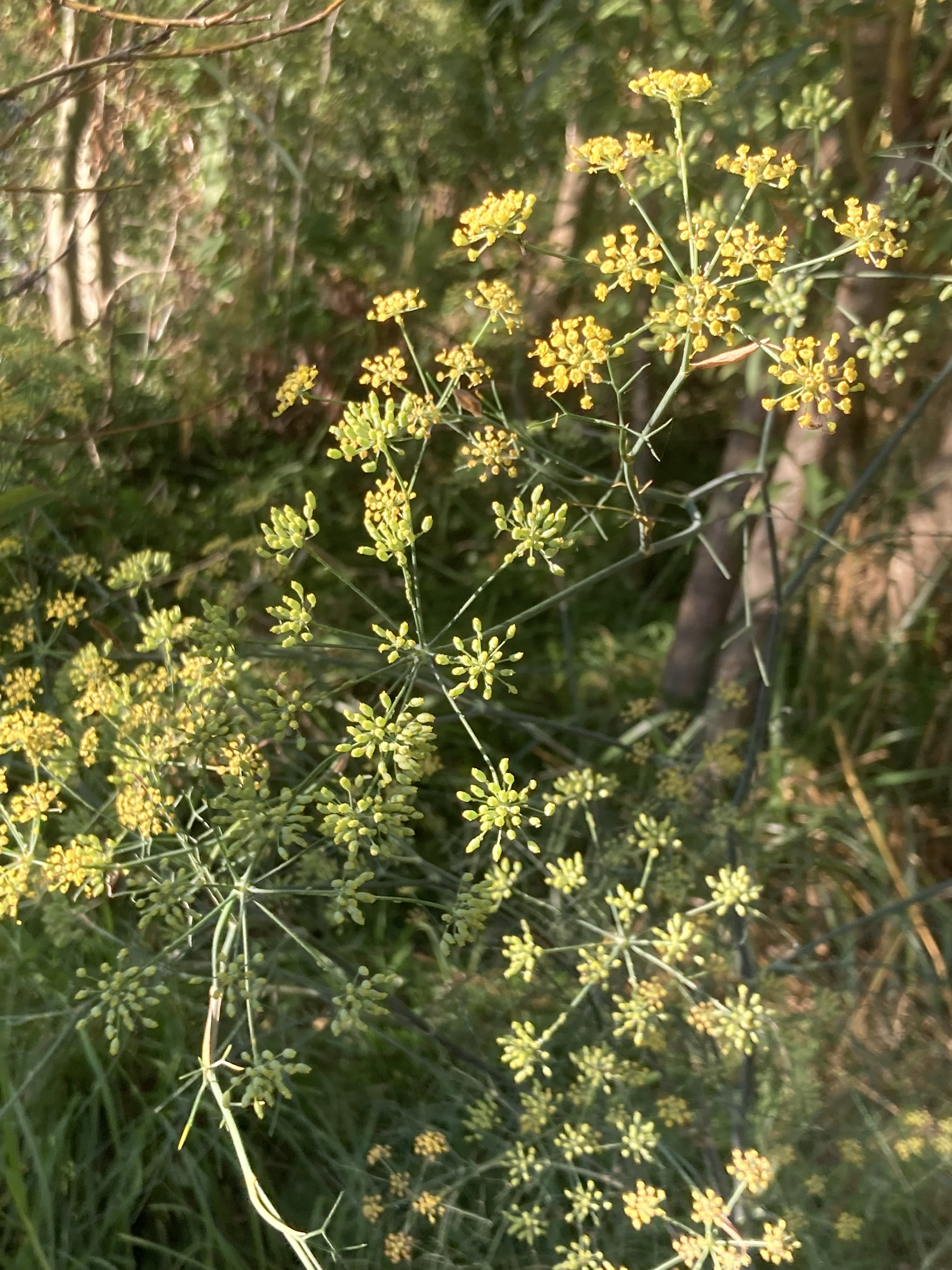
    In autumn, I forage for fennel seeds. Along the Manawatū river, the fennel plants are plentiful. This year, it’s been such a warm autumn, there is still fennel in flower as well as the older plants going to seed. I find fennel such a beautiful plant in all it’s stages: the bright green fronds of early spring, the sunny yellow umbels of summer…then the handsome dried seed heads of autumn.

    (Above: A ‘fennel tunnel, fennel tunnel, fennel tunnel’ < a little phrase from my foraging book.)

    Fennel is an enjoyable thing to forage for because each plant is so laden with seed heads that it’s easy to forage enough for the pantry in just a couple of walks. I fill up this 500ml jar and it lasts me a year of curries and pickles and tea.

    (Above: yellow fennel flowers going to seed.)

    I take secateurs with me and snip some of the seed heads that look grey and dry. Although they are probably dry enough off the plant, I leave them on a tray on my kitchen table to dry more…just to be sure they are totally dry. Then I rub the seeds off over a large bowl.

    (Above: the fennel seed heads drying a little longer at home.)

    I have an interest in Ayurveda. Fennel seed is highly-valued in Ayurveda for it’s digestive properties. In some Indian restaurants, they offer tea spoons full of tiny coloured sweets as a digestif after your meal. These are sugar-coated fennel seeds.

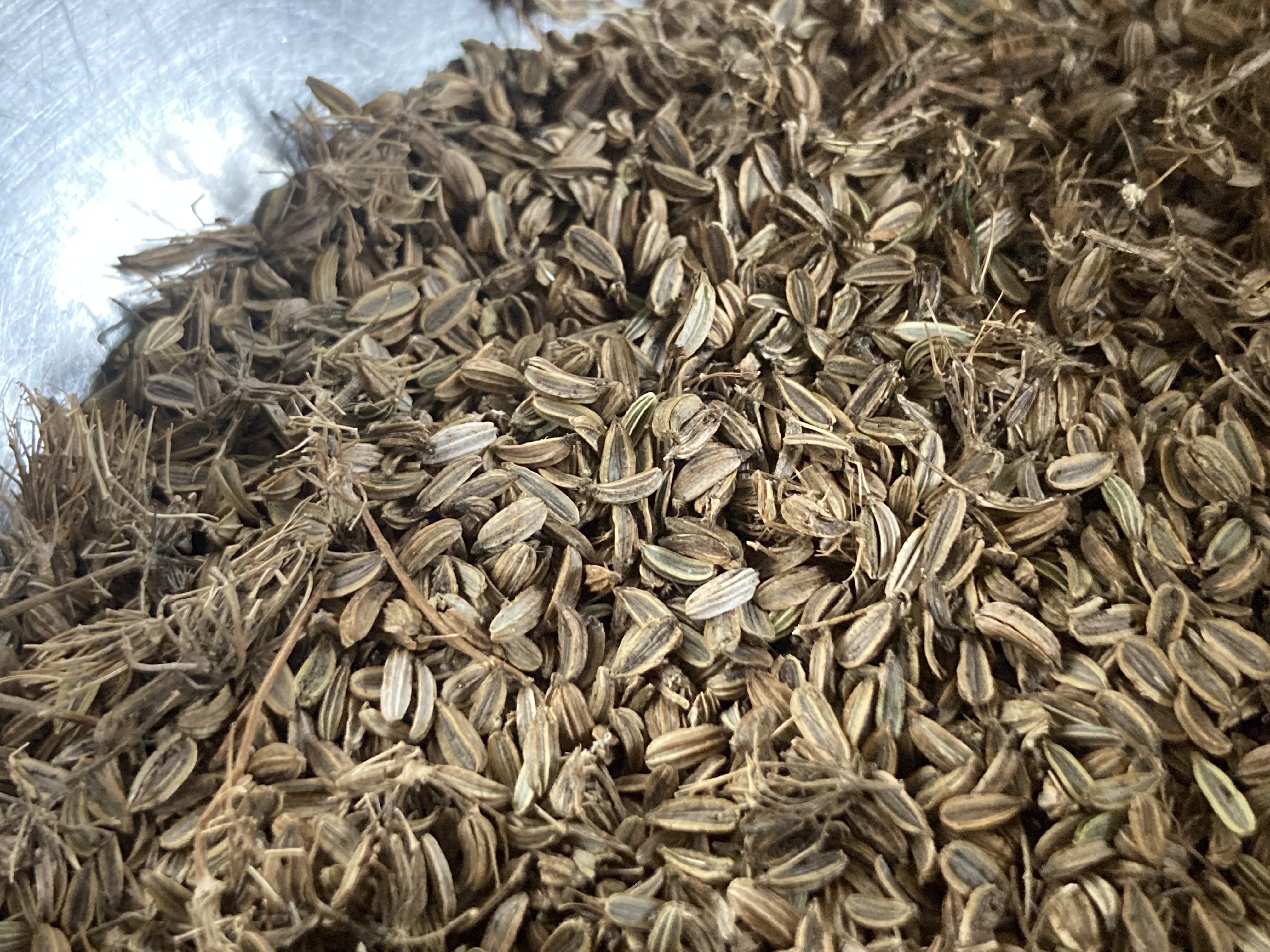
    (Above: The fennel seeds fresh off the seed heads before I sort through and get all the little bits of flower head out.)

    Here is a recipe (well, more a proportions guide) to a digestive tea I make with my foraged fennel seeds. I get the fenugreek from my local Indian supermarket and the licorice root powder from Pure Nature. Fenugreek has powerful digestive properties and can help regulate blood sugar, too. Licorice powder aids digestion and adds sweetness to the tea blend. Ginger helps with digestion also and tastes wonderful.

    Digestive Tea

    One part fennel seeds

    One part fenugreek, seeds or leaves

    One part licorice root powder

    One part ginger powder

    This tea is great to have first thing in the morning to awaken your digestive fire, or agni as it is called in Ayurveda. It’s also good to drink about an hour after a meal to calm the stomach, prevent flatulence, help with digestion.

    *

    I have an avid interest in folk herbalism so I tend to mostly make medicinal things with my foraged finds.

    Autumn is a lovely time for foraging…less chance of getting sunburn and so much to see everywhere! I’ve been enjoying looking at all the different fungi friends who emerge this time of year, picking up windfall eucalyptus leaves for eco-dyeing and harvesting mullein for making winter medicines with.

    What have you been foraging or harvesting?

  • Slow-Small Media for the Weekend

    Introducing … Slow-Small Media for the Weekend, a weekly digest of things which have caught my eye lately. My hope for these digests is that you can curl up with with a cup of tea over the weekend and enjoy these things as an antidote to the overstimulation of social media. 

    A read

    I’ve been enjoying Kirsten Bradley’s new art/writing project about moon literacy and garden tending.  If you like thoughtful writing about land tending and community care coupled with an art practice (cyanoptye) and folk herbalism…this is for you.

    Her article about progressive pickles and caring for her child particularly resonated with me. I, too, have had to let go of a lot of ideas about what loving family routines ‘should’ look like. I have a family member who dislikes eating with us. He eats his meals alone out on the porch.

    Kirsten writes: 

    ‘I have learned that insisting that we do things in the Family Way (…) was something I needed to let go of. (…) 

    Care can look like learning to pay close attention to what is actually doable for this kid, this day, rather than assuming I know better and pushing them too far.’ 

    Read the full essay here. 

    If you have time, read her other essays, too. All rich, contemplative stuff about nature and art and care. 

    A song

    When I find a song I love, I listen to it over and over and over. It feels like spending time with a friend. This has been my song of early autumn: ‘Time to Bide’ by New Zealand artist, Monty Bevins. It’s a whole journey in one song and a great example of song as storytelling.

    I love the spaciousness of the beginning. The song begins in Māori and then switches to English. Then just as you think you have a handle on what the song is going to be… changes pace. It is a song which demands close-listening. 

    + It’s a song that references cold weather and fires so it is a beautiful one to play loudly beside the fire. 

    Read more about Monty here. 

    A zine

    The Theme Zine is a project which brings together an international cohort of artists and writers to collaborate on zines based around set themes. Their latest issue’s theme is ‘Nature as Sanctuary. It’s beautiful short read (and best read on a laptop so you can enjoy the art). 

    An artist crush

    I love the work of American artist Chelsea Granger. I have her plant oracle deck The Dirt Gems and it is just stunning. Her work is so beautiful, humane, colourful, intimate. It feels like steeping into another world…a better one. If you tap the first tile on the top left, you can then view all her art as a slideshow. Trust me, it’s worth it. You’ll feel better about the world afterwards. 

    A watch 

    I found this short (12 minute) film about the ARK (Acts of Restorative Kindness)rewilding movement so soothing and nourishing for my nervous system, I’ve rewatched it four times over the last week.

    It’s got me thinking about where in my small garden I can intervene even less and ‘rewild’ small pockets for all the other creatures I share this little patch of land with. We (humans) like to try to be in charge of our gardens…it takes some real reprogramming (deprogramming?) to let go of control and let nature do what it is so good at, romping greenly. 

    Read more about the ARK movement.

    + I recommend Mary’s two books, also. I’ve read both and they are beautiful and inspiring. 

    A recipe

    If you were too busy in late summer to make a tomato kusundi, Nicola Galloway has a fantastic version made from feijoas.  If you like Indian flavours and haven’t tried kusundi before you will love this spicy, aromatic pickle. It’s a great thing to have around to liven up winter sandwiches. 

    Or if you are in the northern hemisphere, where spring weeds are springing…here’s a great recipe for wild weed pesto with a guide to some suitable weeds. 

    *

    This weekend I’m planning on sharing a morning tea with friends, making Nicola’s kusundi with our feijoa abundance, painting a new sign for the sharing shelf (the orange one in this post got stolen) and digging up some of my abundant strawberry and yarrow plants to share. 

    Tell me what you’re getting up to in the comments. Happy weekend, friends! 

  • ‘now we recognise ourselves less and less’

    (Above: plastic rubbish I picked out from my vegetable beds last week. I collect around this much rubbish each time I tend or harvest from my vegetable beds.)

    I enjoy the writing on The Dark Mountain Project. It’s an ongoing project (based in the UK) that publishes ‘uncivilised writing’, holds gatherings, creates a space for conversations about all manner of unsettling and challenging elements of living at this point of human history. There you will find writing beyond polite eco poetics or nature writing that merely holds nature in a human/nature binary of saccahrine reverence. I don’t always agree with what I read there and that is why I like it.

    Last week I read this piece by Amy Kennedy from the most recent issue with the theme of ‘bodies‘.

    At first it seems a deceptively simple piece of writing, Amy describes a group of parents at a childrens’ birthdday party. One of them brings up the subject of the finding of microplastics in human placentas. The piece explores plastic: our culpability and the unavoidable enormity of the tsunami of plastics in our lives.

    I have a fairly high threshold for ingesting media about climate collapse and environmental degradation. I don’t have my head in the sand.This is not because of courage but more that I am an anxious person who approaches life in a ‘forewarned is forearmed’ sort of way. I like to know something of what’s coming so I can consider in advance how I might respond. (I’d prefer not to be built this way but there is only so much you can do about your neurological wiring.)

    I was surprised by my visceral reaction to this piece with it’s blunt presentation of human culpability in terms of the use of plastics and refusal to look away from the idea of microplastics in human placentas, in human bodies. ‘Now we recognise ourselves less and less’, Amy writes. A familiar feeling for the eco-anxious amongst us and a statement that works on many levels.

    A few years back I wrote a poem in a similar vein about digging up the backyard of my crappy Wellington flat to grow food for my oldest son when he was a baby …only to years later find out that backyard had been a dumping ground for old car bodies and broken machinery and was no doubt full of petrol and lead and other toxins. In my youthful naiveté, I hadn’t considered the urban soil’s history.

    These human missteps we make in the name of love: a birthday cake served with a plastic fork, feeding a baby mashed carrots grown in polluted soil…the hell we plod towards on our road of good intentions.

    The depth to which I was triggered by Amy’s writing surprised me at first (I thought I was made of tougher stuff by now). But then when I thought about it, I realised it touched on a tender spot in my own gardening practice…a spot where I choose to put blinders on.

    I live in the centre of a city. Every time I weed or harvest from my front yard garden (tended so carefully with the best organic soil amendments and lovingly homemade compost) I fish bits of plastic out of my garden: plastic bag fragments, fruit stickers, junk food packaging, lollipop sticks. Some of it seems to get into our compost somehow, despite careful sorting at the kitchen end. The plastic in the vegetable beds seems to blow in from the street.

    (I wondered if this plastic trash were an urban problem but a friend who lives rurally said that there is just as much plastic trash out her way, in the road gutters, in streams, from the plastic packaging of hay bales and farm products.)

    I throw the bits of plastic into a colander that I have with me in my harvest basket then put them in the rubbish bin where they will travel in a plastic bag to the plastic afterlife, which is to say slowly deteriorating into microplastics in the city’s landfill.

    I dwell in a space of both knowing that I have my stubborn blind spots (the macro and micro plastics in my own food garden and in the soil I am creating in my compost) and also having no inclination to stop. I will carry on composting. I will carry on growing food in this microplastick-y soil I am making.

    I enjoyed this essay about composting by Scottish writer Fraser MacDonald (found via Pip Lincolne) He, too, is carrying on composting on despite tangible evidence of plastics in his compost. He writes:

    ‘I make my own compost so that I can convince myself that even when the world seems socially and ecologically broken there are still mechanisms for recovery: it shows that change is possible. Composting is a simple habit of composition or gathering together that integrates past fragments into a future whole, so that what matters is not the individual ingredients but the fertile new thing they can become.

    & that ‘fertile new thing’ possibly contains microplastics…yet still I persist in habits which put me squarely in the ‘doing’ space of the world, in flawed creative acts which give me a sense of agency and regenerate my spirit if nothing else.

    For that purpose alone I believe they are worthy.

  • What do green tomatoes have to do with mutual aid?

    (Above: many hands make work fun. A harvesting and chopping working bee at Kirsty’s place. Photo by Kirsty Porter.)

    Fascism is on the speedy rise, climate collapse is escalating, increasingly our governments and power structures are unreliable at best, malevolent at worst. What is there to be done?

    I am reading a lot of Margaret Killjoy , Adrienne Maree Brown, Bayo Akomolafe and Donna Harraway. Listening to a lot of collapse-aware podcasts. & Trying to be (mostly) off (anti)social media. But beyond what I consume and intake…I am making slow steps towards deeper resilience within my friend groups.

    I’m in a couple of ‘conscious-collapse’ groups. One is aimed more at emotional support and mutual aid (deep listening, space-holding, nourishing one another with beauty and soothing art), the other is more about practical supports, and intentional-relationship-building over time (working bees, resource sharing, fun gatherings.)

    While both groups have group chats in messaging apps, we make a conscious effort to take them offline and get together regularly, because actually being together is so much more healing than more time staring at our phones.

    The photo above is the latter group. We had a working bee to harvest all the end-of-season green tomatoes, then we sat around Kirsty’s kitchen table and chopped up the harvest. We filled four buckets (!) with chopped green tomatoes. Kirsty kept two, M & R took one and I took one. Kirsty, M&R turned theirs into Kirsty’s Grandmother’s recipe for green tomato chutney and I turned mine into a spicy Mexican green sauce.

    While we worked, we chatted, we laughed and the folks in the group who had only recently met got to know each other better. It might not seem to have much to do with the mitigation of fascism & climate collapse…but it was a practical, positive, soul-warming way to spend an afternoon. Every small action like this brings us closer, braids us together a little more…all while we work on our food resilience skills.

    Kirsty might have struggled to ‘capture and store’ her green tomato abundance alone…but with five of us at work…we got it all done in a couple of hours.

    ‘Communities are not built, relationships are built. Communities build themselves.’

    -Patrick Jones

    What sorts of things are you doing to nourish yourself in these challenging times?

    In other tomato news…I like to challenge myself to memorise high-rotate recipes, like fruit crumbles, scones, pikelets, simple cakes…so in the unlikely event I am somewhere I can’t use my recipe books or the internet, I can still make these things. I figure it’s good for my brain, at the very least. Also, it makes me feel next-level to be able to bash them out without cracking a book.

    This winter, I am attempting to perfect and memorise focaccia. I made this one with one of the last crops of cherry tomatoes and basil from the garden.

    In my household, we are seasonal eaters, which gives the last tomato harvests a real poignancy.

    The basil is valiantly carrying on, despite some colder nights…but how much longer for? Time to make some big batches of pesto, I think.

  • don’t buy a sympathy card, buy this

    Another thing that happened while I was too distracted by the release of ‘A Forager’s Life’ to give it the attention it deserved is that writer Iona Winter published a grief almanac called ‘a liminal gathering‘.

    I submitted poems to it and Iona chose one for the almanac, which I share below. I feel privileged to be amongst the writers, artists, musicians and photographers who are part of this precious container for giving voice to grief.

    Iona’s son, the musician and artist Reuben Winter killed himself in 2020. Since Reuben’s death, Iona has used her skills as a writer and communicator to be public with her grief in service to all who grieve and are silenced, or are too overcome by grief to speak themselves.

    A review of the almanac by Hester Ullyart says, ‘This is a hopeful resource, much needed. A rope of stars thrown out into the murk of grief. I recommend this almanac for every shelf, for death touches us all, and no one need struggle alone.’

    I so agree. This book contains both the intensity of new grief and the wearing plod of long-carried grief. It spans anger, raw shock and emotional pain through to gratitude, reverence, elegy…sometimes in the same piece of work.

    If someone you love loses someone they love, don’t buy a sympathy card, buy them this. You will be giving them the gift of a chorus of voices who dwell in the same place as them, a liminal gathering: grief.

    In his piece in the almanac Dear Reader, Rushi Vyas captures the some of the nuance of grief in his poem’s ending:

    ‘Dear Reader, go outside. Feel everything. The wind is cruel. And full of oxygen. The sun is deadly radiation. And our only source of warmth.’

    -Rushi Vyas

    & here is my poem from the almanac:

    negotiating boundaries with the dead

    grief: week one

    kaimanawa horse in my living room

    wild waters                        white flames

    grief: week two

    flower’s fingers holding medals 

    i’m a hobo pedestaled for bravery

    grief: week three

    in the musty cave mushrooms sprout from armpits

    it’s a total eclipse of the total eclipse

    grief: week four

    hurricane chasers, race to get best footage of worst damage

    a raggedy lone wolf to stare down

    grief week five: 

    bat-infested feeling my way   with echo-location

    drink puddle-water      trying for nutrition by chewing on a husk

    grief: week six

    (but wait there’s more

    were you looking for a neat trajectory?) 

    belly-crawling at toadstool height

    make the bed with a chainsaw

    grief: week seven

    turns out the source of the tinnitus is my own throat’s moaning

    some forest fires happen to crack the open the seeds of amoured shells. But not here.

    Just another searing morning. The petrol pours itself.

  • witch sticks & autumn harvests

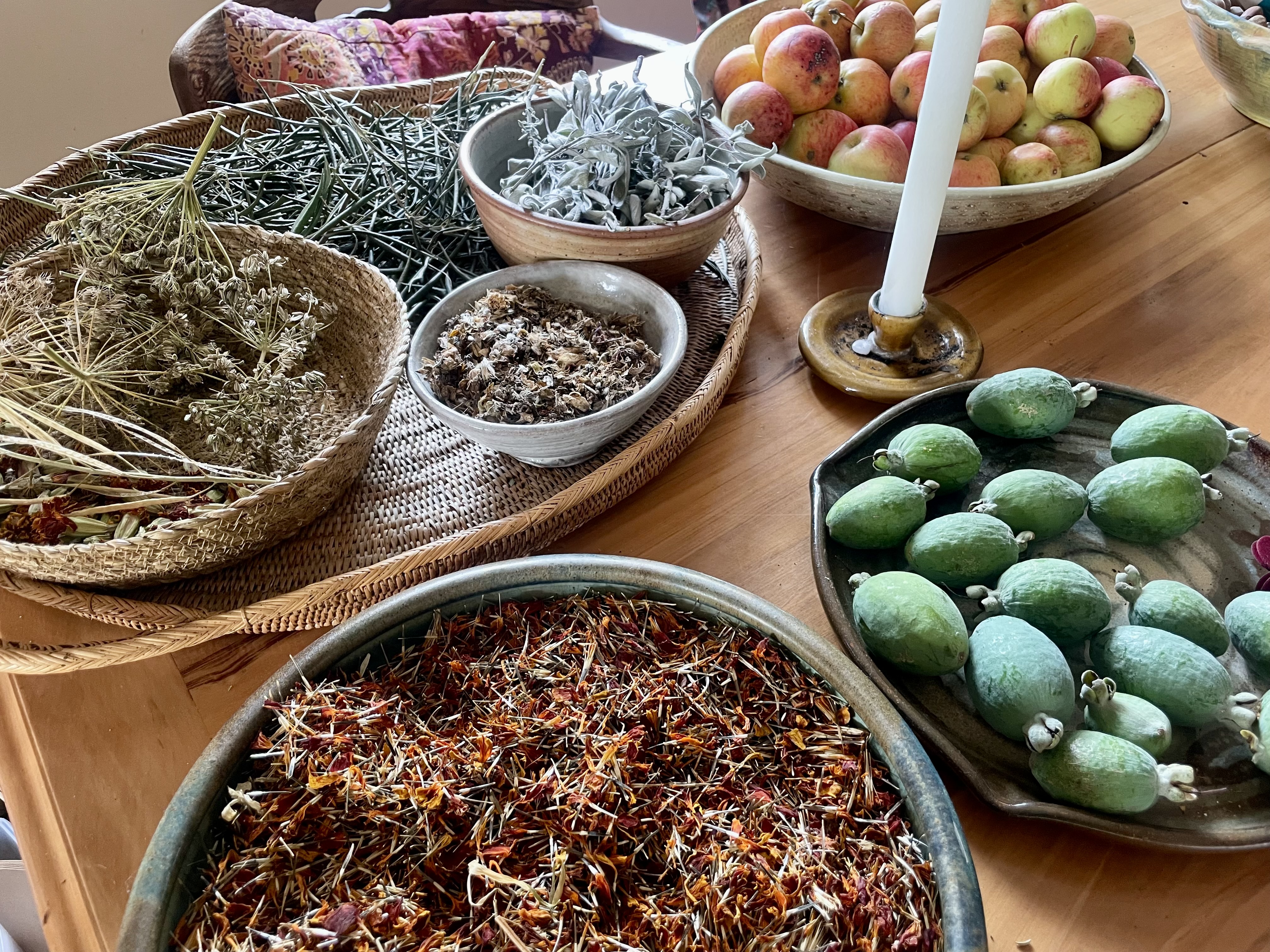
    (Above: Our kitchen table is a busy surface with often-changing bowls and baskets reflecting what is going on in the garden and the foraging season: things drying or waiting to be processed.)

    Autumn is my favourite season and, as a permaculture household, a busier season than summer with our labours to ‘capture and store’. There’s lots of picking and gathering and then kitchen work processing everything.

    (Above: Last sunday morning’s harvest chore was bottling a box of apples from our friend Bev’s orchard. These will turn into crumbles or top our porridge this winter.)

    Last week I gave my potted white sage plant a prune, ready to overwinter it in the greenhouse. White sage is a desert plant, native to the American southwest and Mexican northwest, so it doesn’t love the Manawatū winters.

    In the summer, I put it outside in full sun then prune it down to almost sticks at the end of summer and put it in the greenhouse where it sulks the winter away…but it (just) survives. Mine is about six years old now.

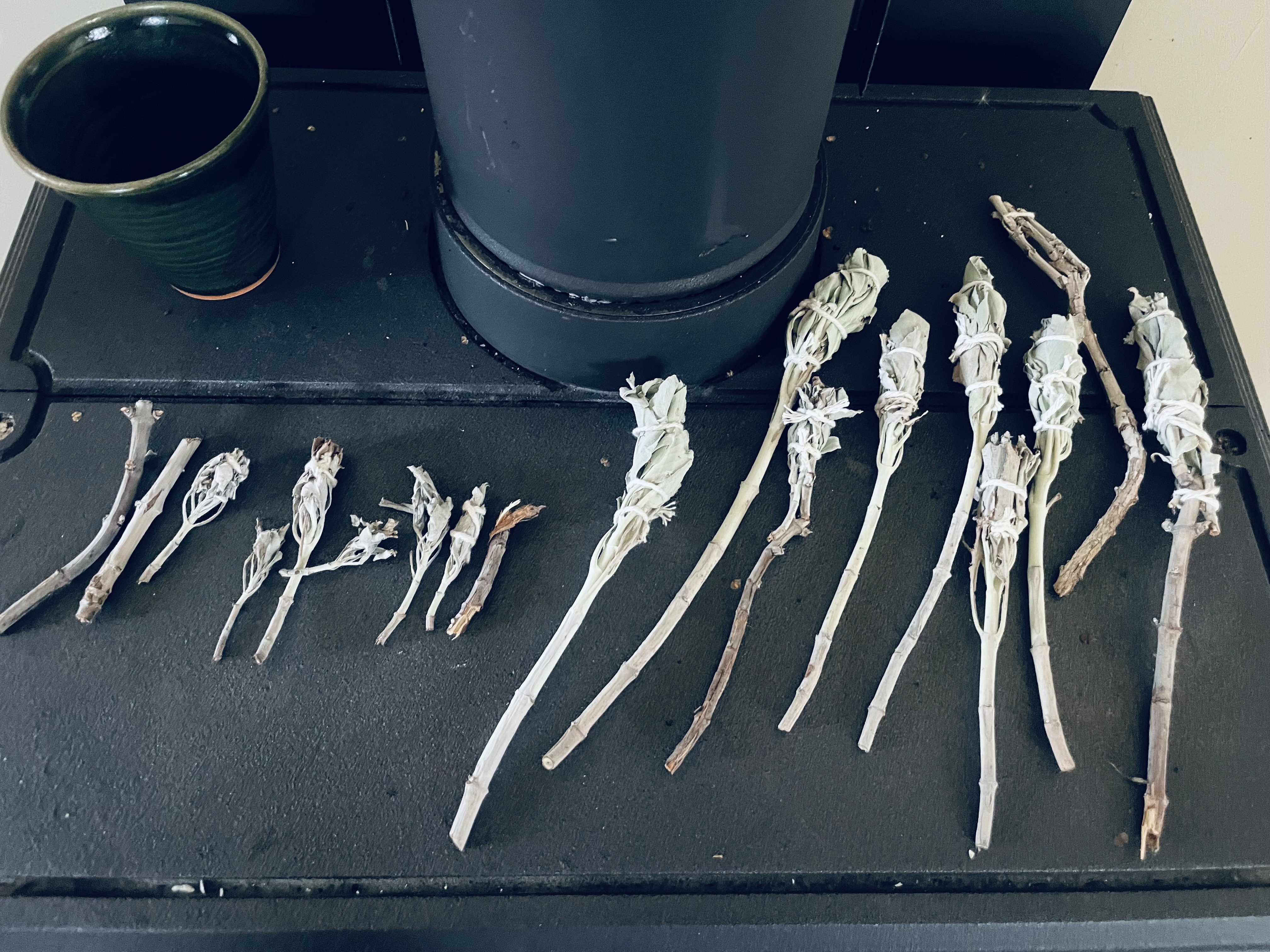
    (Above: white sage prunings, cotton thread. It’s on the sofa because I made the witch sticks while watching something in the evening. I do a lot of processing tasks (this, peeling fruit, cutting up herbs for tea, seed saving jobs) on the sofa…which might seem a bit odd…but I don’t see it as much different from knitting or hand-sewing in front of the TV. Does anyone else do this?)

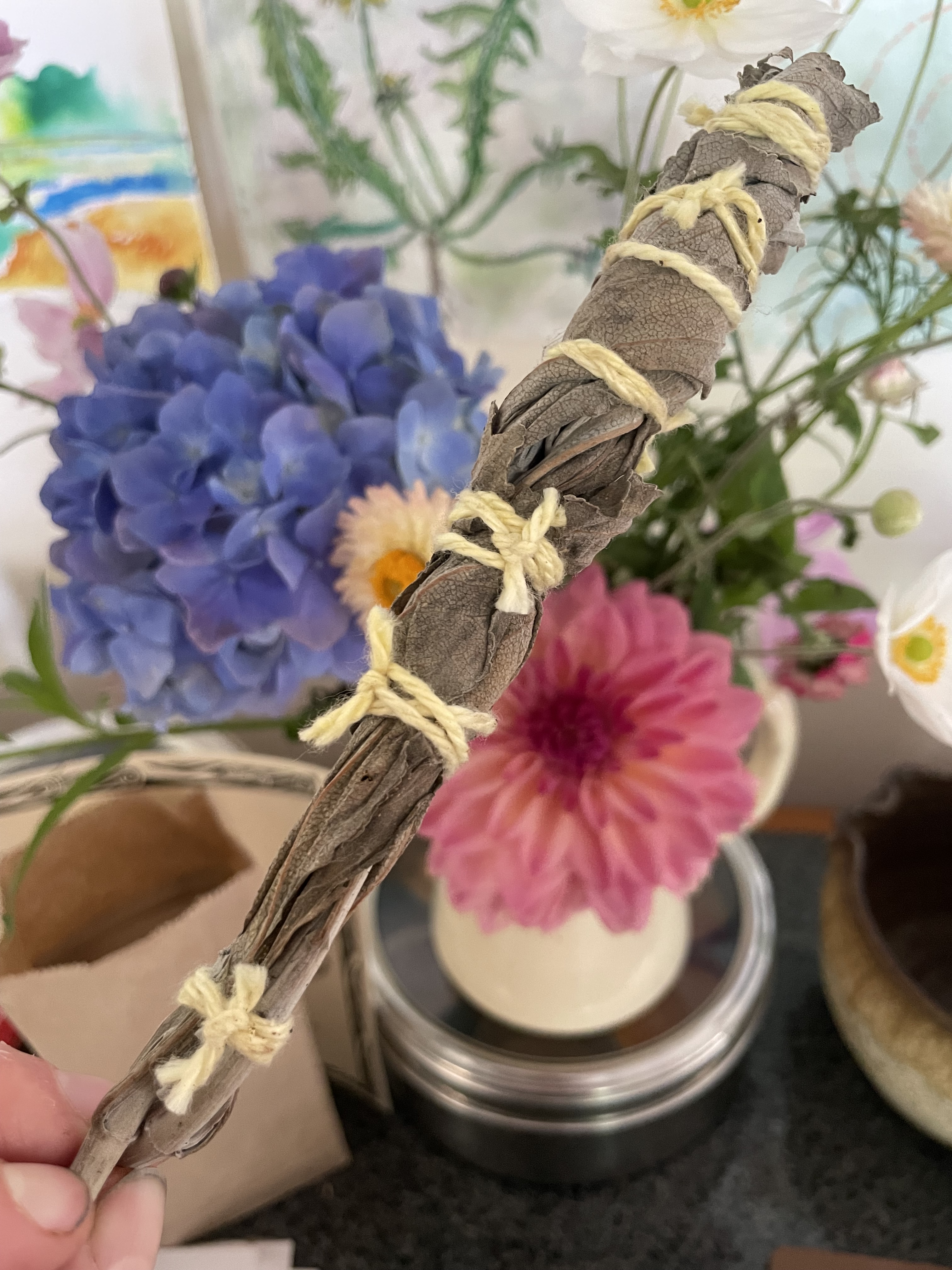
    The prunings can be turned into what I call ‘witch sticks’ for burning by folding up the leaves on the stalk, weaving and rolling them longways and then tying with cotton thread. (Never use synthetic thread: it will melt and emit toxic smoke.) When the leaves have all burned down, you can burn the stalks, too.

    (White sage is a plant sacred to Indigenous people in USA and Mexico, so if you want some…have a go at growing it rather than buying imported sage. White sage is overharvested in the USA particularly. In ‘A Forager’s Life’, I write about alternative plants to white sage for making cleansing/burning sticks.)

    (Above: I got eight decent witch sticks, plus some smaller bits and pieces of stalk…all of which can be burned. Here they are drying on my fire top.)

    I see a lot of ‘how-to’ articles about making cleansing/burning sticks around…but they often forget a detail which I think is important. For them to burn well and safely, don’t wind the string around and around the bundle, securing only at top and bottom. This will mean your stick will fall apart as the thread burns and you could have a higher risk of embers dropping off it. Instead, tie it tightly with small pieces of string at regular intervals, like in this photograph:

    (Above: please forgive my ‘dirt manicure’ as garden writer Gayla Trail calls it. I scrub* my nails regularly but folks who ‘touch soil’ (which is ilke ‘touching grass’ only more grubby) every day struggle to have photogenic hands. ((I have to buy a new nail brush every couple of months…so intent is my endless scrubbing.))

    Do you have a favourite season or are you one of those calm, rational people who loves them all equally?

    I’d love to hear what kitchen or garden chores you’ve been doing lately. Let me know below.

    “As long as autumn lasts, I shall not have hands, canvas or colours enough to paint the beautiful things I see.”

    -Vincent Van Gogh

  • twenty years ago I started a commonplace book and didn’t even realise

    I was reading on writer Pip Lincolne’s delightful Wallflower Cordial the other day about her beginning a commonplace book. Then I remembered I had something similar, although I hadn’t realised it was a commonplace book.

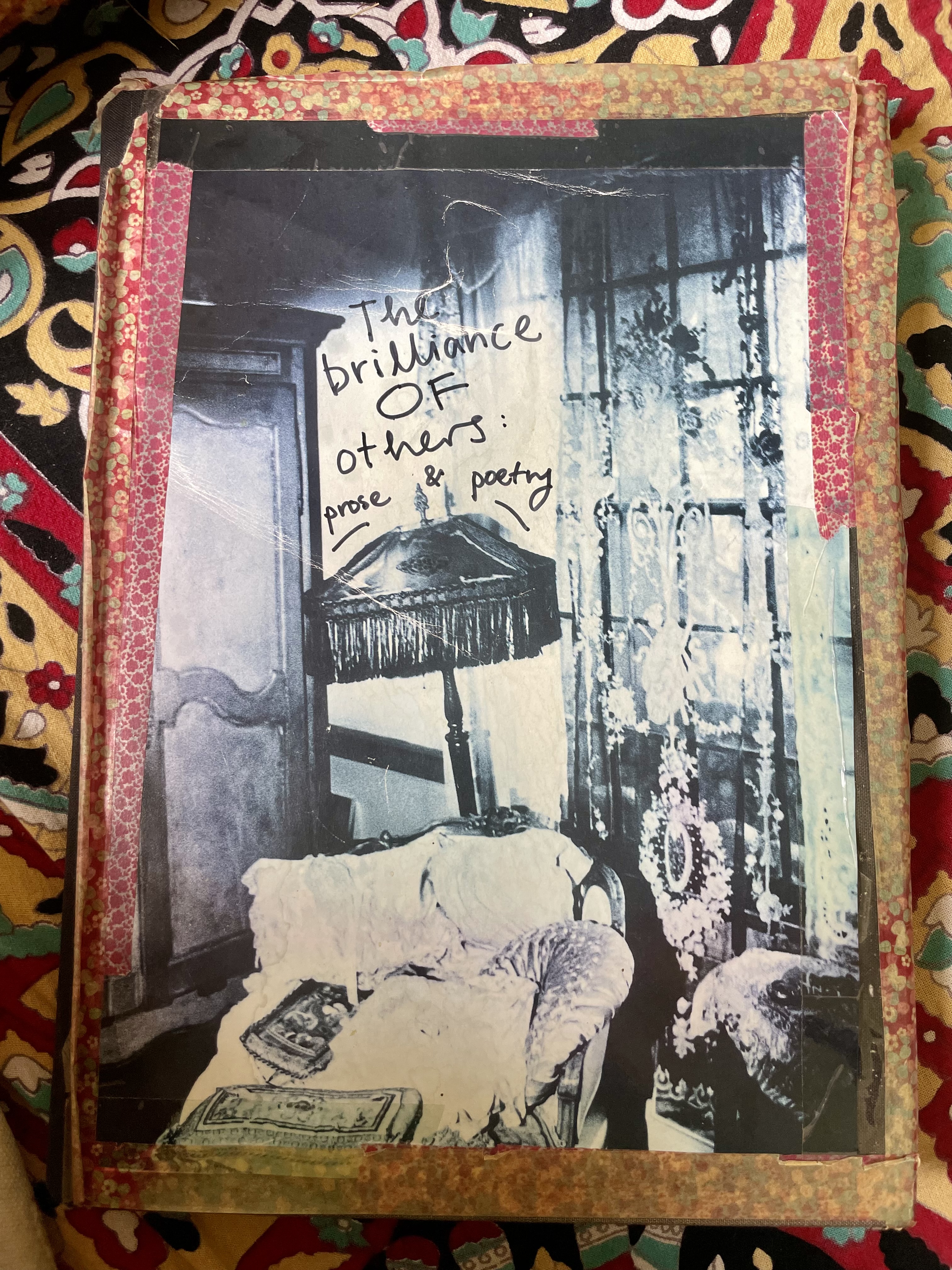
    I called mine ‘The Brilliance of Others’. On the cover is a somewhat gloomy photograph of the reading chair of someone famous. (I didn’t record who so if you recognise it–let me know.)

    On the inside cover it says, “Personal Poetry Anthology: words by other people that move, stimulate, excite…& at the back, quotations.” 

    I guess I hadn’t heard of commonplace books then because that would have been a much more succinct title.

    I started it in April 2004 which was around when I became pregnant with my second child, Magnus. I guess that is why, after over twenty years, it is only half-way full. Nine months later, a decades-spanning distraction was born. 

    Still, from time to time, I remember it exists and I add something. There are currently 51 entries. 

    In it there are poems I’ve copied by hand from library books, some snipped out of the New Yorker (now yellowing…that New Yorker paper doesn’t age well), or printed out. From time to time I subscribed to the Academy of American Poets ‘Poem a Day’ emails and I would print out the ones I particularly liked. 

    (I’ve subscribed to this so many times over the years…usually when I feel like I’m not reading enough new poetry and I should make more of an effort to ‘keep up’…but a poem every day to your in-box is so many poems! & so many emails. Therefore I usually only last a month or two and then unsubscribe again after getting overwhelmed. It turns out even poets can be exposed to too much poetry.)

    (Above: This Merwin poem on brittle, yellowing New Yorker paper still gets me in the gut. What an ambiguous, radiant, brutal final stanza.)

    There’s also the occasional dashed-down note which must have seemed very relevant to something I was thinking about or working on at the time and now I have no clue why. Thus:

    According to USA lifestyle magazine The Good Trade, commonplace books are increasing in popularity again. Younger people are enjoying them as a kind of palate-cleansing, analogue and slow antidote to the relentlessness of social media. I totally approve of this trend. 

    Do you have a commonplace book or something like it?

    Here’s a quote I wrote down from G.K.Chesterton. Why younger me liked it so much, I’m not sure…possibly the poetry in the final eight words?

    “He discovered the fact that all romantics knowthat adventures happen on dull days and not on sunny ones. When the chord of monotony is stretched most tight then it breaks with a sound like a song.” 

  • somehow, ‘a forager’s life’ is two

    On March 18 my book ‘A Forager’s Life’ turned two!

    The two years since it emerged into the world have been, frankly, mad.

    I’m a person who enjoys a slow, simple life and lots of huge (for me, anyway) and exciting things happened with the book since it’s release. In this space, I’m going to share some of the things that happened…even though they are old news in terms of the pace of the online world. They are still very much with me.

    (Above: I threw a morning tea for the staff at my wonderful local bookshop, Bruce McKenzie Books on the day the books arrived in store, March 2023.)

    I was unkind to myself and, freaking out about money once my book manuscript was delivered, started a new job before the book even came out. At the same time, my younger son who has a disability was finishing high school and in a massive phase of transition into post-school life. I had underestimated how intense of this phase would be for him, resulting in a high-pressured time where I was trying to enjoy the opportunities the book bought my way, learn and hold down a new job and be there for the kid. Oof.

    It was all too much and, coupled with the NZ government’s slashes to disability support last year, I only lasted two years in the job before something had to give and I left it so I could adequately look after my boy.

    Now I’m out the other side of the intense part of the booky fizz, the job debacle, am still navigating the kid’s shaky steps into adulthood (I guess I always will be), plus I’m in the midst of the intense mind/body/spirit shake up that is menopause.

    I’m sitting here, a bit dishevelled, trying to put myself back together. It’s been a very strange time of immense, beautiful highs and difficult, fractious lows. (Then there’s everything going on in the world beyond my front door where the world appears to have gone completely mad.) Therefore, I’m hoping this winter is very boring and nesty so I can read mountains of books beside the fire and journal a lot (on paper and here) and let it all integrate into me at a pace I can cope with.

    So, interspersed with posts about other things, there will be the occasional retrospective post my experiences with ‘Forager’s’.

    I hope it’s interesting for you to read about such things from a writer’s perspective? As writers we are supposed to act very cool and nonchalant about the occasionally great things that can happen if you write something that people respond to…but I have never managed to be cool…I’m an awkward, nerdy, sensitive person who gets overwhelmed easily. I’m not at all nonchalant…I get very revved up about exciting things. In fact I get excited about non-exciting things, like the shape of a dried fennel seed head, finding a particularly niche-to-me second-hand book, or sampling from a pan of sun-ripened then slow roasted cherry tomatoes.

    & I know blogging is long dead but (see above point about not being very cool) however I’m hoping if I write here, the right people will find me, despite claims that blogging and personal websites have been made irrelevant by speedy old social media and peoples’ diminishing attention spans. ‘The right people’ are folks who like reading longer form than an Instagram caption and appreciate the reedy, faint voice of a shaky woman trying to lure kindred people into giving their precious attention to her personal website rather than further furnishing the pockets of tech billionaires.

    If that’s you, warmest of welcomes aboard.

    (Do leave comments if you feel moved to. I read everything and promise to respond.)