Tag: writing process

  • Writer Carly Thomas on ‘The Last Muster’

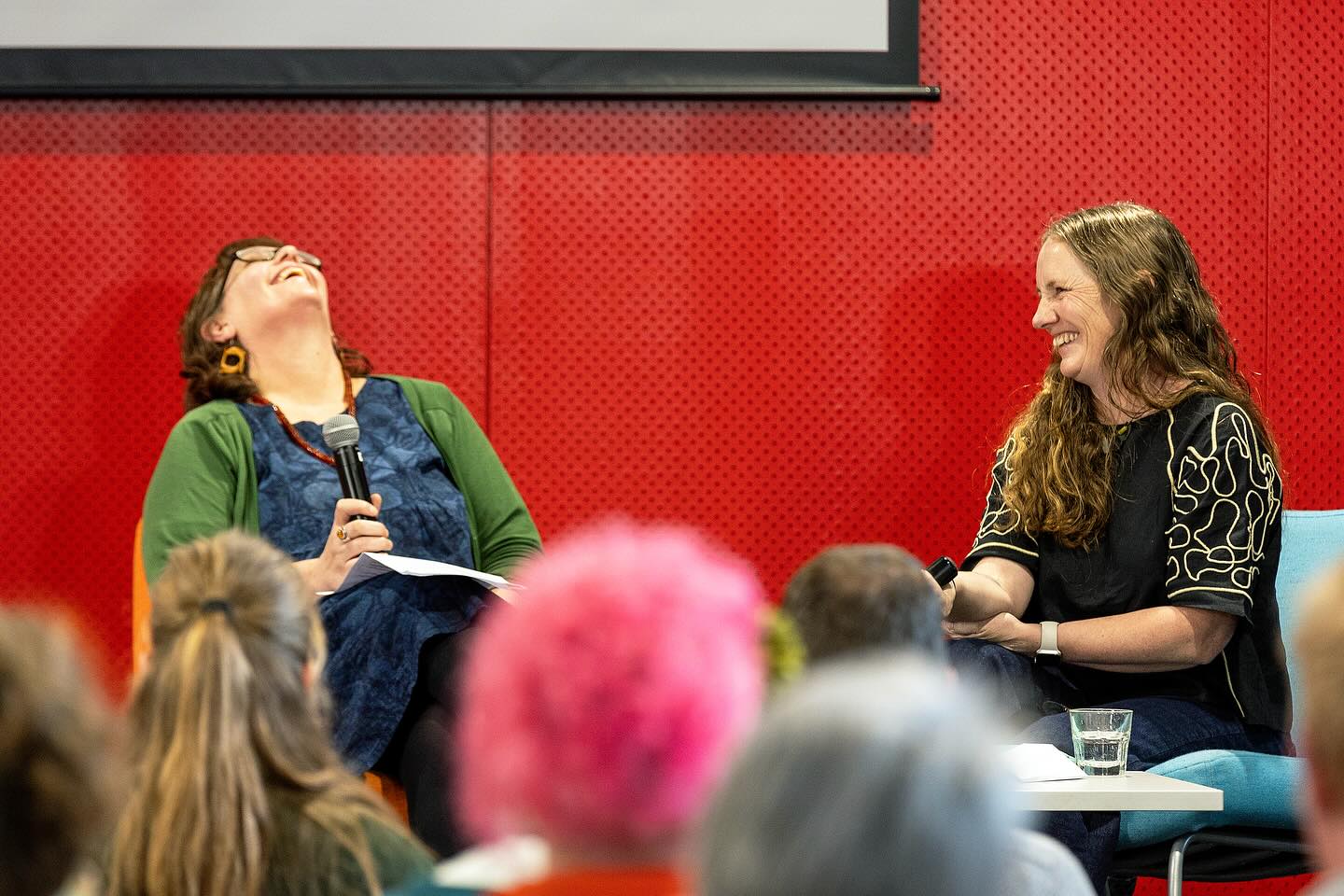
    (Above: Me (on left) and Carly Thomas cracking each other up at her 11 October 2024 book launch at the Palmerston North City Library.)

    Almost a year ago, I interviewed writer Carly Thomas live as part of her book launch event at the Palmerston North City Library. I don’t recall the specifics of the conversation but I do remember there was a lot of laughter. Carly is very funny. Also, very self-deprecating.

    I kept insisting she was courageous, intrepid, fearless and she kept batting such suggestions away. She’s a very humble person. In winter, I invited her to be my second slow interviewee. These interviews take place via email exchanges in an unhurried way. The first one was with writer Iona Winter.

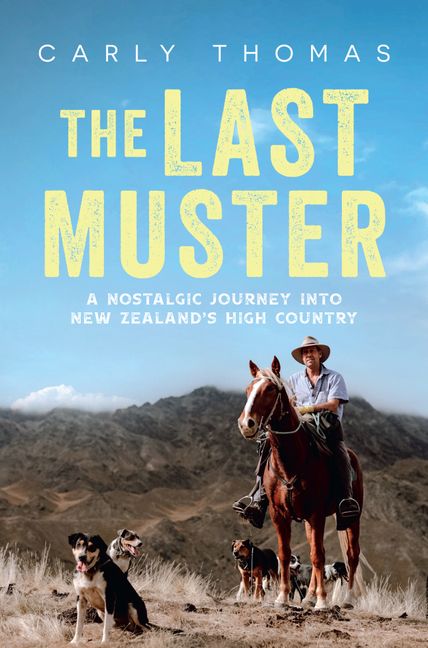
    I wanted to check in with Carly a year out from the publication of ‘The Last Muster’: A nostalgic journey into New Zealand’s High Country.’
    H: Congratulations on the publication of your book! & Thanks for inviting me to help you launch it. That was a great night. 

    Can you tell me a bit about your (very impressive) research trips for this book… you did a kind of ‘action research’ where you joined the mustering gangs. I reckon that was so brave!

    C: The launch was so neat and you were a big part of that so a massive thanks to you, Helen. It all seems like a long time ago.

    Writing a book is a funny old thing, it is all consuming and then it is done. It feels like you have been out at sea, in the thick of storms and intense sunshine and then you come ashore and the tide comes in and it goes out and all is calm. That sounds depressing but it’s not, it’s just there’s a lull, a pause, and then an in-between afterwards. 

    I knew straight away that I would go and work alongside the people I was writing about. I started ringing and emailing high country stations that I had already had contact with through previous writing gigs. It took a few calls before I figured out how to communicate what exactly it was that I was doing. It became apparent that I needed to head south for the Autumn weaning musters quickly and so I got straight into getting down there.

    I’d read up a bit on each station I was going to, but not in depth, that would come later. I like to go into things a bit naive. I figure that asking stupid questions is better than assuming you already know, so I did a lot of that. I learnt as I went, was given ideas on where to go next and in that semi-informed/ follow-my-nose style I got passed onto musters. 

    I didn’t have a big planned out map of things, I really just took whatever next turn presented itself. I started down in Glenorchy at Greenstone Station and was well and truly thrown in the deep end on a four day muster with a motley crew of shepherds. After that the ball was rolling – I’d finish a muster, chuck my muddy saddle and gear in the car and head to the next one. Word got out about what I was doing and it got easier to get on the musters. I was learning skills as I went and got more handy as I went.

    My tools for capturing everything were my phone recorder/ camera/ notes, my big Sony camera (not at all fancy) and my memory for conversations. People would say great stuff, as I was riding along trying to keep a bunch of unruly cattle in line, and I would have to remember it until I could do a voice memo of what they said. It was full on and it took my ADHD multitasking superpowers to a new level. 

    I’d do dumps of writing notes when I could, when I had a day or two in between musters, but not a lot of writing happened till I got home. There was a lot of writing in my head on long car journeys. I would try to hold onto each station’s colours, tone, sound, smell, taste and hum. When I did get to sit down, those were the first words to go down, then I got to the long and arduous job of transcribing.

    Research came last, which I guess is a bit round-the-other-way from what some writers do. As I was travelling about I would try to go to local libraries to find historical tales of the area and old mustering yarns. I also collected a pretty big haul of old New Zealand mustering books from the many secondhand bookshops and op-shops I visited on my travels. Once back home I trawled through online archives and libraries to collect up old stories and facts. I went down massive rabbit holes.

    One particular moment of connection was when I was trying to find the history of a particular homestead that had been abandoned on a station. I was coming up against dead ends and in frustration I called a tiny community library opened once a week by volunteers. As I was on the phone to the woman in charge that day who was telling me “just the person I should talk to was…..”, she paused and then said, “you won’t believe this, but she just walked in the door”.

    The particular 90-something-year-old who was the missing link to the information I really needed was put onto the phone. It was magic. She told me things that were not written anywhere and could have been lost if she hadn’t stepped in right then. I just love that sort of thing and there really is something special about these encounters. 

    The whole book writing process was a combination of high adventure, a saddle-sore body, sleep deprivation, many kilometres on my little nana car’s clock and wondering where I would land next and spending hours researching in drafty libraries or sitting on my couch with a cat, a cup of tea and books piled high around me. I am a contrary soul and I enjoy both of those things equally. 

    H: Writing a book is so different from having a book published, isn’t it? 

    Yes, it really is and I think the main thing for me, this being my first experience of working with a big publisher, was knowing this project was bigger than me. I had to trust my publisher and editor and I took the opportunity to just say “yes” and be more open than I have ever been. It wasn’t just my book, it had many people involved, the most important part being all the people I encountered on the journey, who trusted me with their stories and way of life. It’s a responsibility to take care, while also telling it like it is.

    And then it’s done, the final proof is FINAL and the printers crank into gear. And then you have to let it go, into the open, out into the world, into the hands of others. 

    The tide goes out, I take the dog for a walk, I look at the hills with new eyes and I wonder, ‘what’s next?’.

    H: What did you learn about the horse mustering community over the course of writing the book? Did anything surprise you? 

    Every station was different but a few things were always the same. They love their horses and will always have them in their front paddock no matter what. They are people who choose horses over machinery to get the stock work done and that made them a certain kind of person. Horses may be a slower way of doing things, in some respects, but they are a quieter and kinder way to work stock. Stations that use horses tend to care about their animals, enjoy a slower, older way and there’s also a romance to it all as well.

    The way you see things on a horse, the chats along the way possible without the roar of a bike and the relationship you have with your horse. So yeah, they were a certain type, often a little quirky and more often very stubborn about their way of life. And they all knew each other, the connections ran very deep. 

    I was sometimes surprised by their openness in having me along. Their honesty and their passion to really help me to understand what it all means to them. Sure, there were plenty of tight lipped cowboys, but I also experienced real moments of truth and authenticity. 
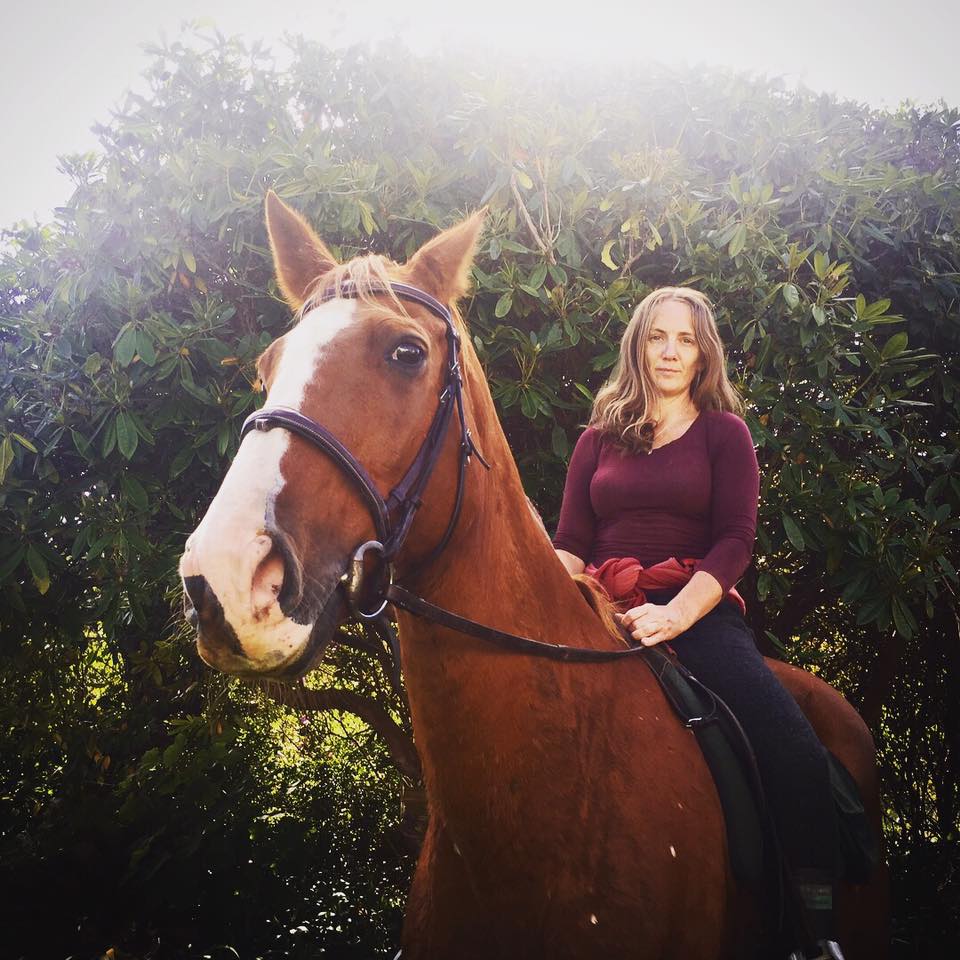
    (Above: writer Carly Thomas on horseback.)

    H: Do you want to share a favourite moment from your travels with us? 

    That’s got to be on Pitt Island on a day off from mustering the cattle and doing yard work. Me and the two kids from the family I was staying with went for a windy adventure with them leading the way. They proudly showed me the very steep cliff drop-off where they weren’t supposed to go, the quick (and very scary!) way down to the beach and the wharf and the old shearing shed retired back when wool prices dropped to pretty much nothing.

    I was told the names of birds and horses and paddocks and we arrived back hungry, windswept and grinning. Brilliant day! 

    H: What have you been reading lately? Can you recommend a few recent reads? 

    Oh so many good books lately! I have discovered a New Zealand author, Fiona Sussman and now her book Addressed to Greta is a favourite. The main character Greta is one of those memorable ones that you fall in love with.

    I have also become a  little obsessed with Elif Shafak, a Turkish writer who wrote There are rivers in the sky. It’s an epic story told over different decades and cultures. A must-read I’d say.

    Oh and The Homemade God by Rachel Joyce. I love a good complicated family dynamic story and this is a goodie. 

    H: Thanks heaps for doing a slow interview with me, Carly. I hope there are lots of horsey good times in your summer.

    C: Thanks mate!

    *

    Carly is already deep in her next project. It’s an ongoing project to capture the stories of Aotearoa’s rural elderly called Landlines.

    Check out their first short film:
  • A new poem and an older, previously unpublished one

    Last week, a new poem I wrote, ‘hemmed in like a boar between archers’, was published on The Spinoff’s weekly column ‘The Friday Poem’.

    I’m grateful to The Spinoff and editor, Hera, for selecting the poem. It was great fun for me to see it on The Spinoff on Friday and to see what image they had selected to go with the poem.

    I wrote the poem last summer. I had a good spell with poetry over the summer and, after a while of feeling like I was wringing out a dry rag when trying to write poetry, suddenly a whole lot of poems tumbled out in a rush. It was a good (and relatively rare) feeling.

    It meant that a poetry manuscript I’ve been fiddling with for over ten years (!) is much closer to completion now.

    I was able to ditch some poems I wasn’t 100% happy with (I call them ‘the weaklings’) and replace them with some of the stronger, new ones.

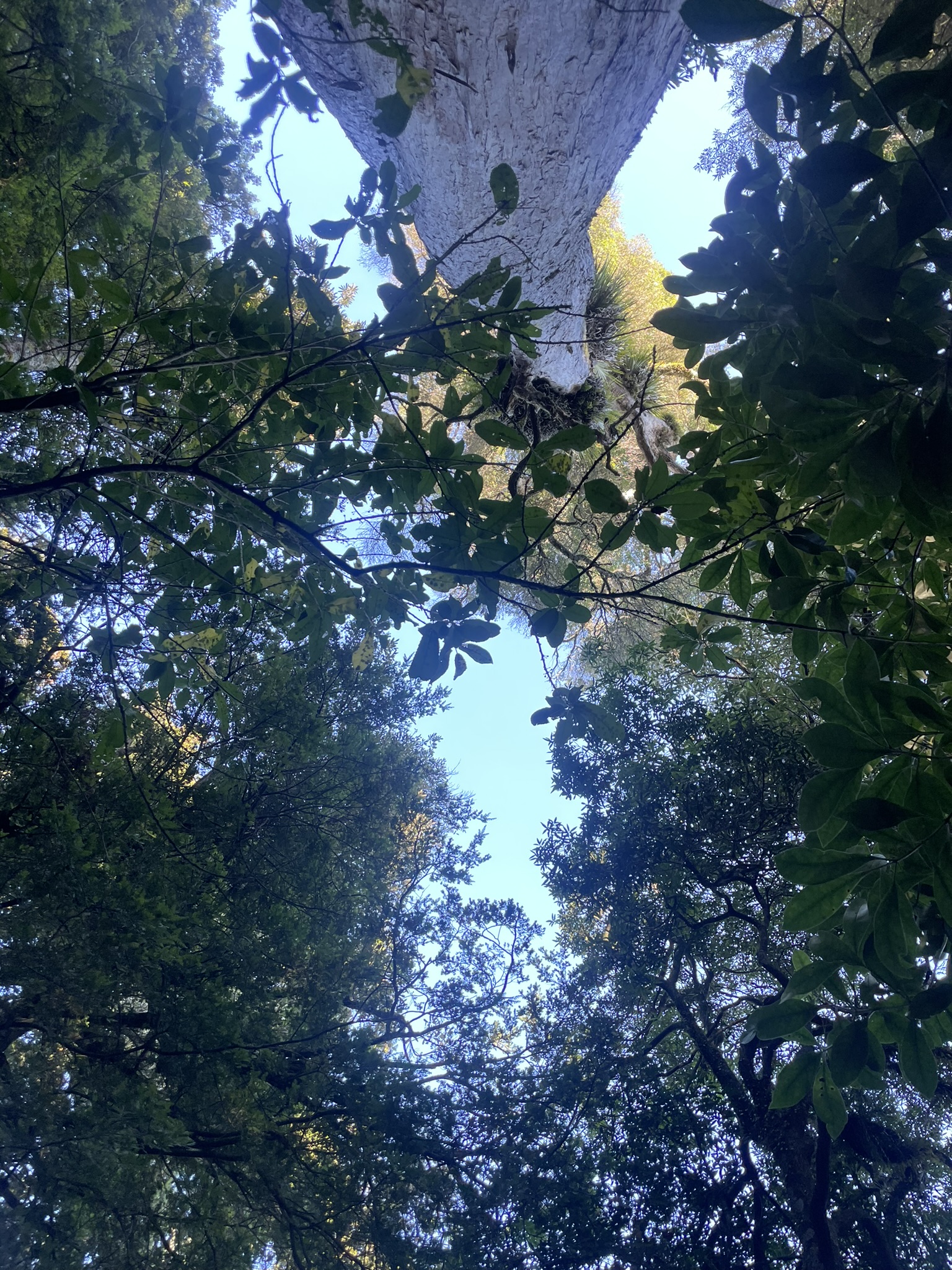
    (Above: bush canopy in the Rangawahia Reserve.)

    I also wanted to share an older but previously unpublished poem.

    This was commissioned years ago for an anthology about New Zealand’s endangered species. Each poet was assigned a topic. My assigned subject was the Manoao Tree (Silver Pine).

    Sadly, the book project didn’t eventuate so I thought I’d share the poem here:

    Manoao

    Small, sensitive,
    the cleanest of the grassy greens
    of the understory
    single leader, forest pine

    too many years
    of mistaken identity
    growing in the shadow of all
    that a Kauri can be

    rainforest supporter
    prone to sudden collapse
    like all things humble,
    misidentified, or hard to see

    human desire-lines
    walk wide past
    the subtle glow
    in long rows
    of gloaming extroverts

    If we were better, we’d
    take the time
    to thread the eyes.
    of this graceful relict.

    *

  • Sometimes reaching out to your heroes works out

    (Above: Morag Gamble + my book! *squeals with delight* Image borrowed from Morag’s website. I love this photograph. I look at it when I’m having low moments to do with writing stuff and it cheers me up.)

    Today I’m returning to an occasional series of sharing anecdotes from my experiences after publishing A Forager’s Life . This is a story about how I reached out to some writing or permaculture heroes, people I respect and look up to, and how it panned out.

    I have an amazing publicist at Harper Collins, Sandra Noakes, without whom I would not have had such good reach with the book or opportunities like feature articles in national publications, appearances at literary festivals and featuring on the bill at WOMAD.

    Any writer worth their salt, however, will do their best to get word out on their own steam as well. If you believe in your work enough to publish it…you have to keep backing it beyond publication. Publication isn’t the finish line. In some ways, it’s just the start line of phase two. Reaching out to people can be an excruciating experience. You have to steel yourself for plenty of ‘thanks but no thanks’ or, worse, silence. (*cue the sound of crickets chirping.*)

    Just after the book came out, I wrote to a dozen people (nature writers, permaculture heroes, eco-podcast hosts) introducing myself, explaining why I thought they might be interested in the book and offering to send them a copy. Out of that dozen – two said yes.

    Out of the two who said yes please to me sending a book…one worked out wonderfully well. The other person ghosted me. Being real with you, it’s hard not to take it personally…but for my mental health I’m choosing to believe that they were in a place of overwhelm with life and my book was one of the things that could fall off their ‘to-do’ list with minimal consequences …rather than: they just didn’t like the book.

    I share these details with you, not for sympathy, but to demonstrate how thick-skinned you have to be in the writing. business (and I’m not particularly…I bruise fairly easy). Take my recent lovely news about the Verb Home Based Writer’s Residency. I’m still so over the moon about this. What people don’t see, though, is the manifold rejections from other opportunities that I have thrown my hat in the ring for. The writing life takes tenacity…the amount of tenacity demanded can be wearing and I have definitely had fallow years where I just couldn’t find the grit to keep on trying. Or when the responsibilities of my life precluded space for creative pursuits.

    Anyway, this is a happy story, not a gloomy one!

    One of the permaculture heroes I approached was the indomitable, prolific, generous Morag Gamble. This name might not mean much to you if you aren’t active in the permaculture world but in permie-land, it means a lot.

    Morag is a permaculture teacher, mentor, writer who lives in Australia but works at a global scale. She has an excellent Youtube channel with dozens of helpful permaculture clips, she teaches permaculture teachers at the Permaculture Education Institute, and she runs a non-profit which gifts permaculture education to refugees in East Africa. She’s an incredible woman for whom I have a lot of admiration and respect.

    You can imagine my delight when she took me up on my offer to send her my book. I wrote a friendly letter and posted it off and then a while after that…she got back in touch to say that she’d read and really enjoyed the book (!!) and invited me to be a guest on her podcast! I was, and still am, thrilled.

    + Morag’s daughter also reviewed the book here.

    The podcast was conducted via Zoom. On the day, I was so nervous, my mouth kept going dry which is very annoying when you want to chat away and try to sound relaxed. I needn’t have worried, though, because Morag is just as warm and genuine as she seems in her videos and podcasts and talking to someone so aligned in values was an absolute dream.

    Here’s Morag’s description of our conversation: “As a published author of books like ‘A Forager’s Life‘, Helen has a beautiful way of emphasising humans’ reciprocal relationship with plants and the wisdom of plant tending. She also highlights the significance of hyperlocal food systems and the power of food commons and radical reciprocity.”

    You can listen to our conversation here.

    & while I didn’t have to tell you that I got the slot on Morag’s podcast because I chased it…I like to be honest about ‘behind the scenes’ things in the writing world in the hope it helps people get a sense of how things work and (maybe) to inspire you to keep going with whatever your dream is…even when things feel too huge or overwhelming.

    People will say no to you or they won’t respond at all…and that’s okay. Everyone is busy, often to the point of overwhelm, and I think one out of twelve is not too bad…especially given how delighted I was with the outcome. A more courageous writer than me would have sent out hundreds of emails…not just a dozen…but that was the maximum of what my nervous system could handle.

    I hope this story might have given you a little bit of inspiration to take the next step forward in working towards your aspirations. x

  • twenty years ago I started a commonplace book and didn’t even realise

    I was reading on writer Pip Lincolne’s delightful Wallflower Cordial the other day about her beginning a commonplace book. Then I remembered I had something similar, although I hadn’t realised it was a commonplace book.

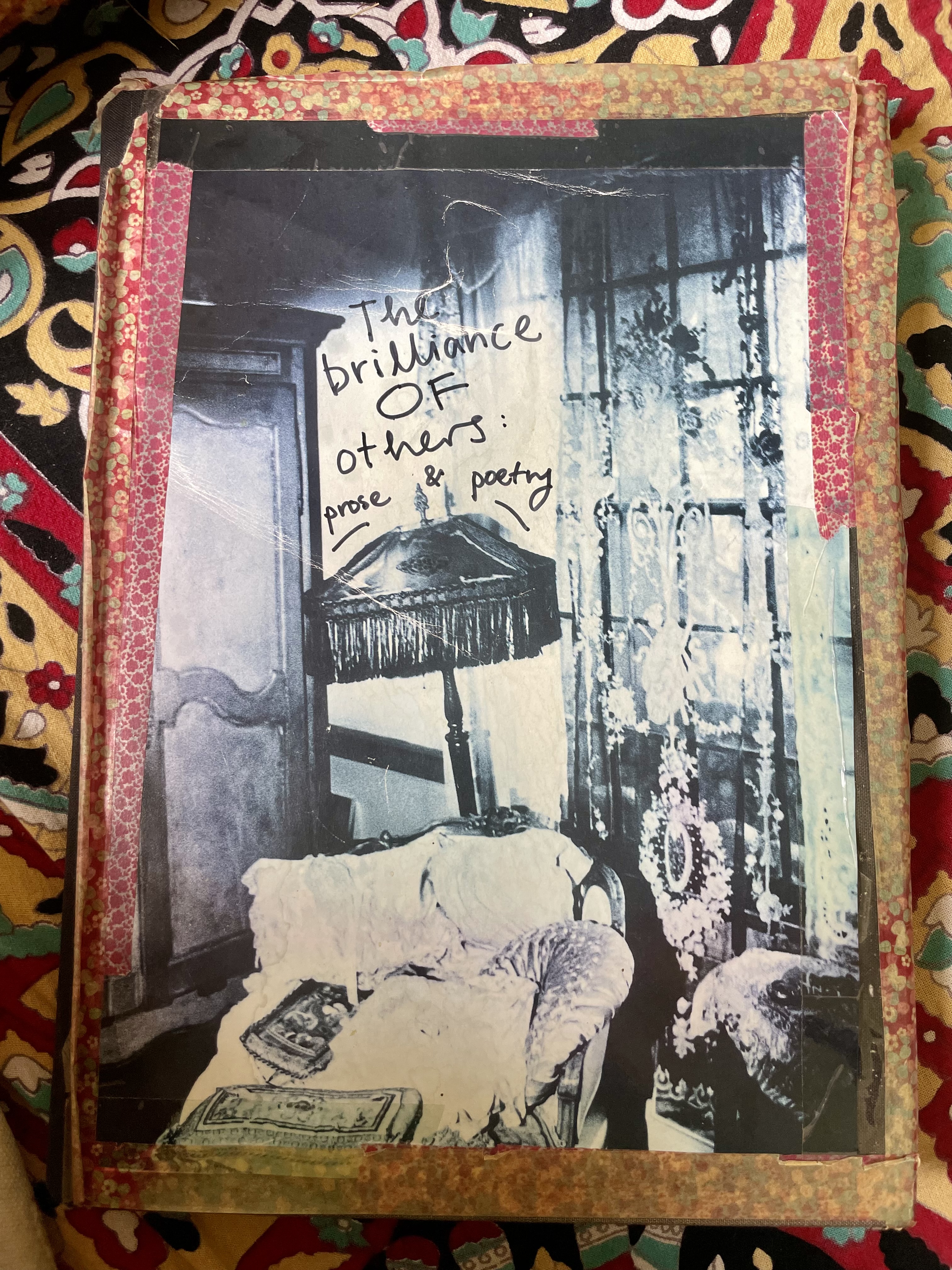
    I called mine ‘The Brilliance of Others’. On the cover is a somewhat gloomy photograph of the reading chair of someone famous. (I didn’t record who so if you recognise it–let me know.)

    On the inside cover it says, “Personal Poetry Anthology: words by other people that move, stimulate, excite…& at the back, quotations.” 

    I guess I hadn’t heard of commonplace books then because that would have been a much more succinct title.

    I started it in April 2004 which was around when I became pregnant with my second child, Magnus. I guess that is why, after over twenty years, it is only half-way full. Nine months later, a decades-spanning distraction was born. 

    Still, from time to time, I remember it exists and I add something. There are currently 51 entries. 

    In it there are poems I’ve copied by hand from library books, some snipped out of the New Yorker (now yellowing…that New Yorker paper doesn’t age well), or printed out. From time to time I subscribed to the Academy of American Poets ‘Poem a Day’ emails and I would print out the ones I particularly liked. 

    (I’ve subscribed to this so many times over the years…usually when I feel like I’m not reading enough new poetry and I should make more of an effort to ‘keep up’…but a poem every day to your in-box is so many poems! & so many emails. Therefore I usually only last a month or two and then unsubscribe again after getting overwhelmed. It turns out even poets can be exposed to too much poetry.)

    (Above: This Merwin poem on brittle, yellowing New Yorker paper still gets me in the gut. What an ambiguous, radiant, brutal final stanza.)

    There’s also the occasional dashed-down note which must have seemed very relevant to something I was thinking about or working on at the time and now I have no clue why. Thus:

    According to USA lifestyle magazine The Good Trade, commonplace books are increasing in popularity again. Younger people are enjoying them as a kind of palate-cleansing, analogue and slow antidote to the relentlessness of social media. I totally approve of this trend. 

    Do you have a commonplace book or something like it?

    Here’s a quote I wrote down from G.K.Chesterton. Why younger me liked it so much, I’m not sure…possibly the poetry in the final eight words?

    “He discovered the fact that all romantics knowthat adventures happen on dull days and not on sunny ones. When the chord of monotony is stretched most tight then it breaks with a sound like a song.” 

  • Some background on ‘Write to the Centre’

    Some background on ‘Write to the Centre’

    My whole adult life I have kept journals, capturing bits of my life in words and images. I’ve also taught journal writing classes from time to time. Journal writing is a key part of my creative process as a writer and my self-care regime as a human. Journals get some bad press – sometimes seen as self-indulgent, angsty or just plain pointless. I can only share my own experience with keeping a journal, which has been positive, helpful and life-affirming.

    Earlier this year I was part of a literary panel and a member of the audience asked us the question ‘If you were the only person left on the planet, would you still write?’ I had the microphone in my hand, so I answered first: ‘Of course!’ I said ‘I love writing, it wouldn’t bother me if no one else was going to read it.’ I anticipated my fellow panelists would agree with me, but instead the other three writers were looking at me incredulously and answered with variations of ‘Hell no! Why bother?’ and talked about how they write with an audience in mind.

    This could be a factor in the journal or no journal divide, perhaps?

    Keeping a journal is essentially writing to/for yourself. You either find intrinsic value in this, or find it as interesting as watching paint dry.

    I have been toying with the idea of writing a book about journal writing for a few years but was wrestling with whether other people would find it interesting, or horribly self-indulgent? I decided to leave it to fate (aka, a panel of board members) by applying for a grant, figuring if the panel granted my proposal, it would be signal enough that there was some value in the idea. They liked it and I received a grant to create the book.

    The book is nearly done and all going well with the printing process it will be released on October 15th.

    I have gone through some real ups and downs during the making of this book..it is a very personal, vulnerable, possibly somewhat naive book…it is not the New Zealand way to be so ‘out there’ with emotions and sometimes ugly private stuff. I feel a little like I am about to walk onto a stage in a crowded auditorium, flash my undies and then cry….or something.

    My journals aren’t ‘beautiful’, the visual parts are usually pretty haphazard, hastily daubed, scrawled or slapped together and the writing is not profound or intellectual…it is unfettered expression…and is offered as such. Now all I can do is wait for the publication process to unfold and hope that the book is met with open hearts, just as it was created with one.

    BJ_2006_12
  • art will eat itself

    I am working on two writing projects at the moment (around the day job, the kids, the endless house-keeping and cooking)…

    One is my next collection of poems and the other is less simple – a project involving over a decade of journals. I am scanning a whole lot of journal pages from 1999-2012…it will be a very visual book. This project is tricky – I haven’t quite found my way with it yet. It’s like it isn’t sure what it wants to be….I don’t want it to be a ‘how to’ about journaling, because I don’t find those books especially helpful myself…plus I don’t think I have much to add to that canon….however it may have elements of that. I am writing some prose pieces to sit amongst the scanned journal pages, but I’m not sure they are right in tone. It’s like I am putting together a book that is almost devouring itself – like the OUROBOROS.

    I’m both sharing parts of my journals and yet critiquing them and journaling and the creative process all at once.  It’s all very messy and more than a little scary, however I’m going to keep chipping away at it and trust that as I work the shape of the book will become clear. Basically, I am trying to write the sort of book I would be excited to find in a bookshop….full of images, honesty, ruminations on creative process, thoughtful mess.

    In the meantime, I take comfort from writers who have gone before me.

    ‘Any writer who knows what he is doing isn’t doing very much.’

    -Nelson Algren

    &

    ‘The furtherest out you can go is the best place to be.’

    -Stanley Elkin’