Category: simple pleasures

  • witch sticks & autumn harvests

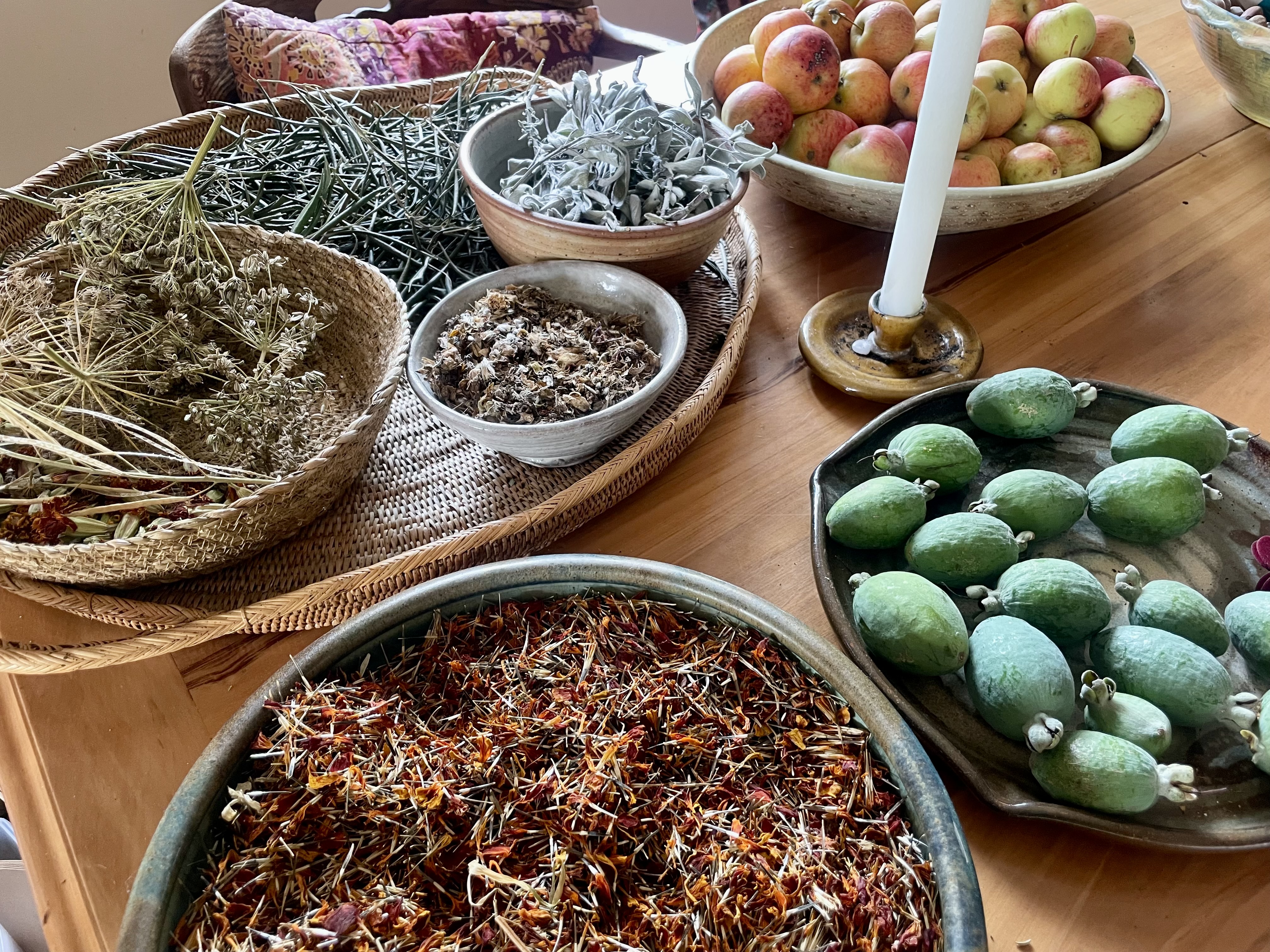
    (Above: Our kitchen table is a busy surface with often-changing bowls and baskets reflecting what is going on in the garden and the foraging season: things drying or waiting to be processed.)

    Autumn is my favourite season and, as a permaculture household, a busier season than summer with our labours to ‘capture and store’. There’s lots of picking and gathering and then kitchen work processing everything.

    (Above: Last sunday morning’s harvest chore was bottling a box of apples from our friend Bev’s orchard. These will turn into crumbles or top our porridge this winter.)

    Last week I gave my potted white sage plant a prune, ready to overwinter it in the greenhouse. White sage is a desert plant, native to the American southwest and Mexican northwest, so it doesn’t love the Manawatū winters.

    In the summer, I put it outside in full sun then prune it down to almost sticks at the end of summer and put it in the greenhouse where it sulks the winter away…but it (just) survives. Mine is about six years old now.

    (Above: white sage prunings, cotton thread. It’s on the sofa because I made the witch sticks while watching something in the evening. I do a lot of processing tasks (this, peeling fruit, cutting up herbs for tea, seed saving jobs) on the sofa…which might seem a bit odd…but I don’t see it as much different from knitting or hand-sewing in front of the TV. Does anyone else do this?)

    The prunings can be turned into what I call ‘witch sticks’ for burning by folding up the leaves on the stalk, weaving and rolling them longways and then tying with cotton thread. (Never use synthetic thread: it will melt and emit toxic smoke.) When the leaves have all burned down, you can burn the stalks, too.

    (White sage is a plant sacred to Indigenous people in USA and Mexico, so if you want some…have a go at growing it rather than buying imported sage. White sage is overharvested in the USA particularly. In ‘A Forager’s Life’, I write about alternative plants to white sage for making cleansing/burning sticks.)

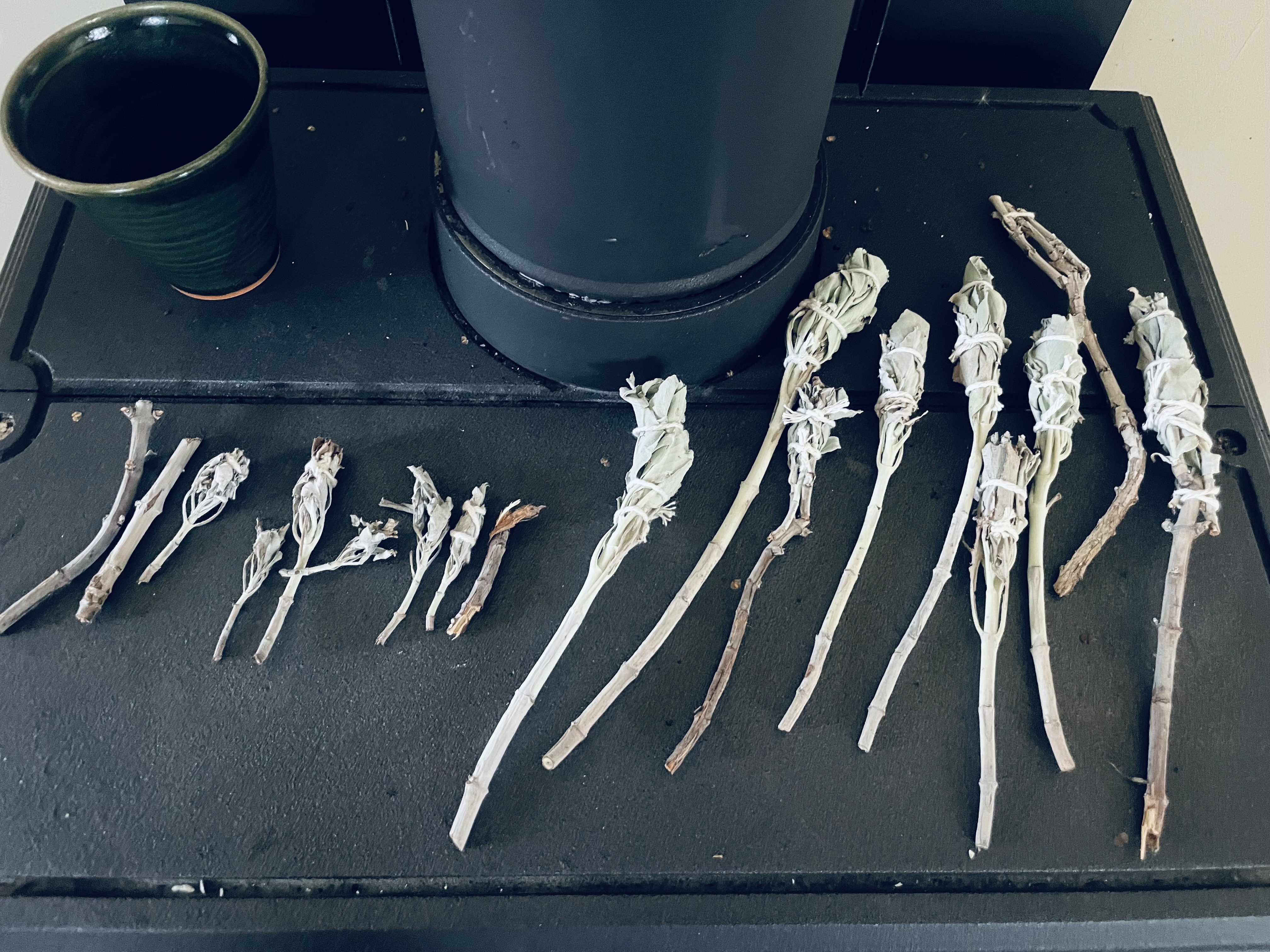
    (Above: I got eight decent witch sticks, plus some smaller bits and pieces of stalk…all of which can be burned. Here they are drying on my fire top.)

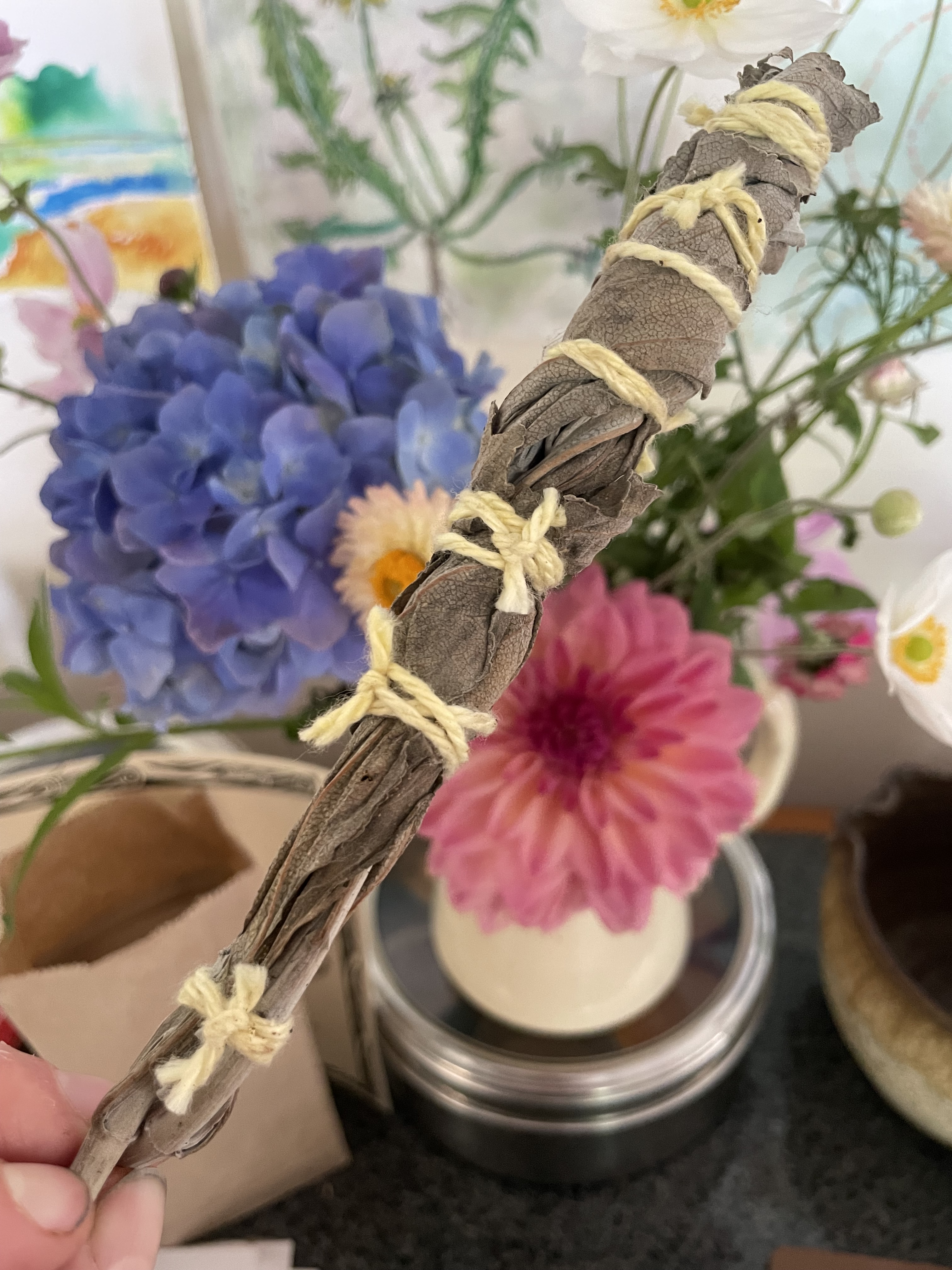
    I see a lot of ‘how-to’ articles about making cleansing/burning sticks around…but they often forget a detail which I think is important. For them to burn well and safely, don’t wind the string around and around the bundle, securing only at top and bottom. This will mean your stick will fall apart as the thread burns and you could have a higher risk of embers dropping off it. Instead, tie it tightly with small pieces of string at regular intervals, like in this photograph:

    (Above: please forgive my ‘dirt manicure’ as garden writer Gayla Trail calls it. I scrub* my nails regularly but folks who ‘touch soil’ (which is ilke ‘touching grass’ only more grubby) every day struggle to have photogenic hands. ((I have to buy a new nail brush every couple of months…so intent is my endless scrubbing.))

    Do you have a favourite season or are you one of those calm, rational people who loves them all equally?

    I’d love to hear what kitchen or garden chores you’ve been doing lately. Let me know below.

    “As long as autumn lasts, I shall not have hands, canvas or colours enough to paint the beautiful things I see.”

    -Vincent Van Gogh

  • fresh inspiration

    When is an ‘inspiration wall’ not an inspiration wall?

    When it’s been up for almost two years and you’ve stopped seeing it anymore…

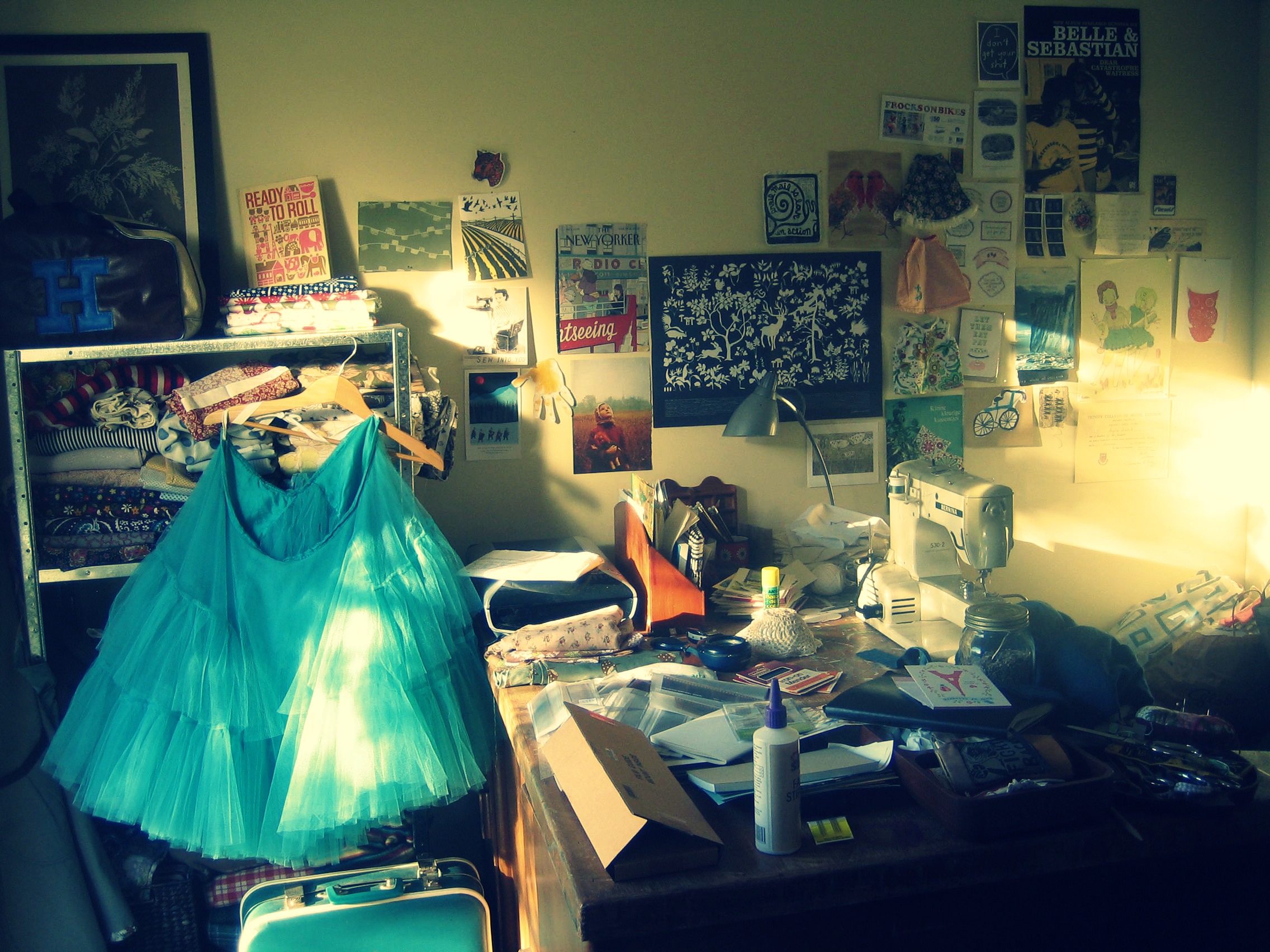
    I have a creative room out in my backyard. Our garage was converted to a sleepout by previous owners and now we’ve set it up so half of it is guest-room (well, guest-nook) and half is my creative space.

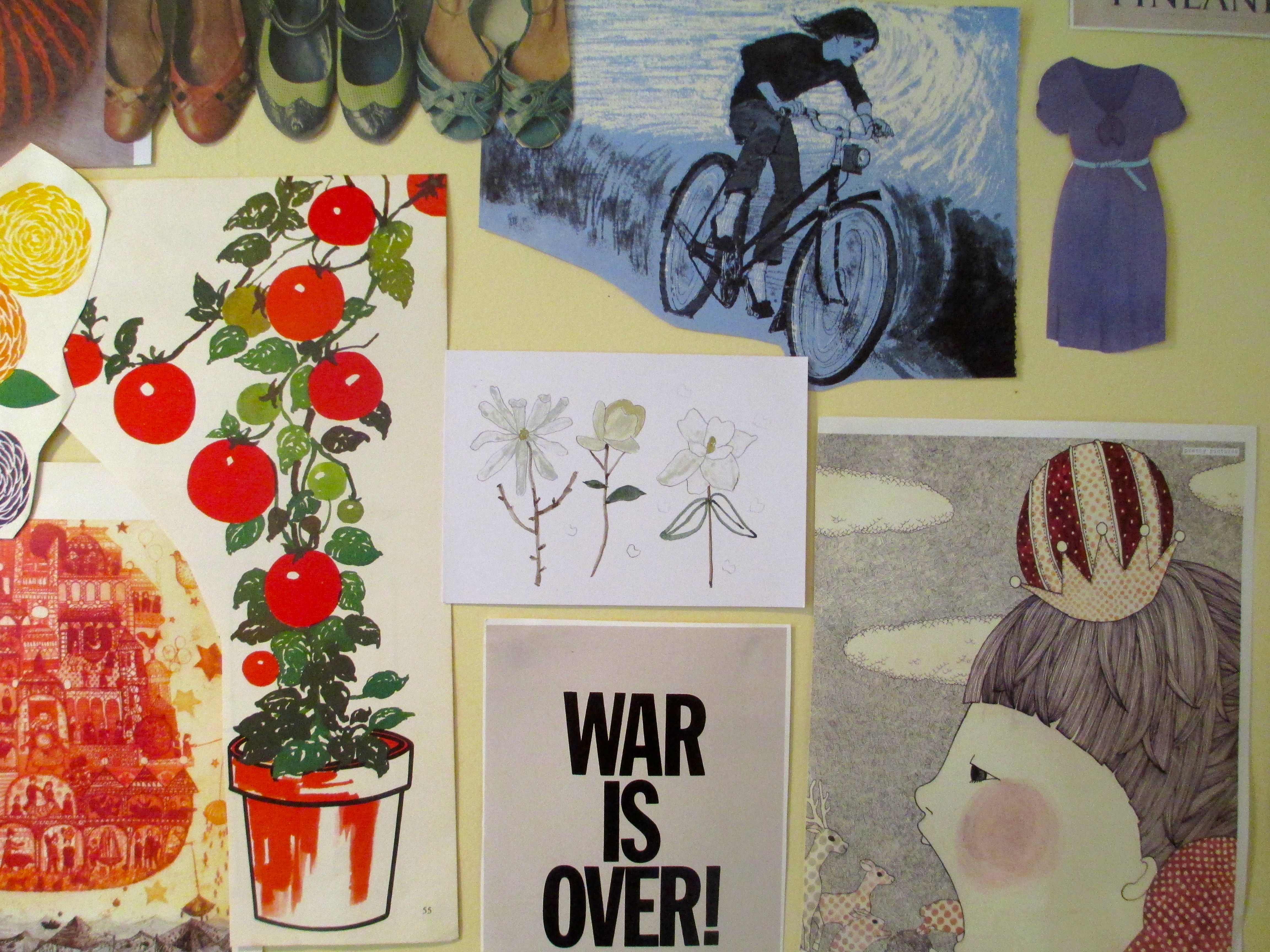
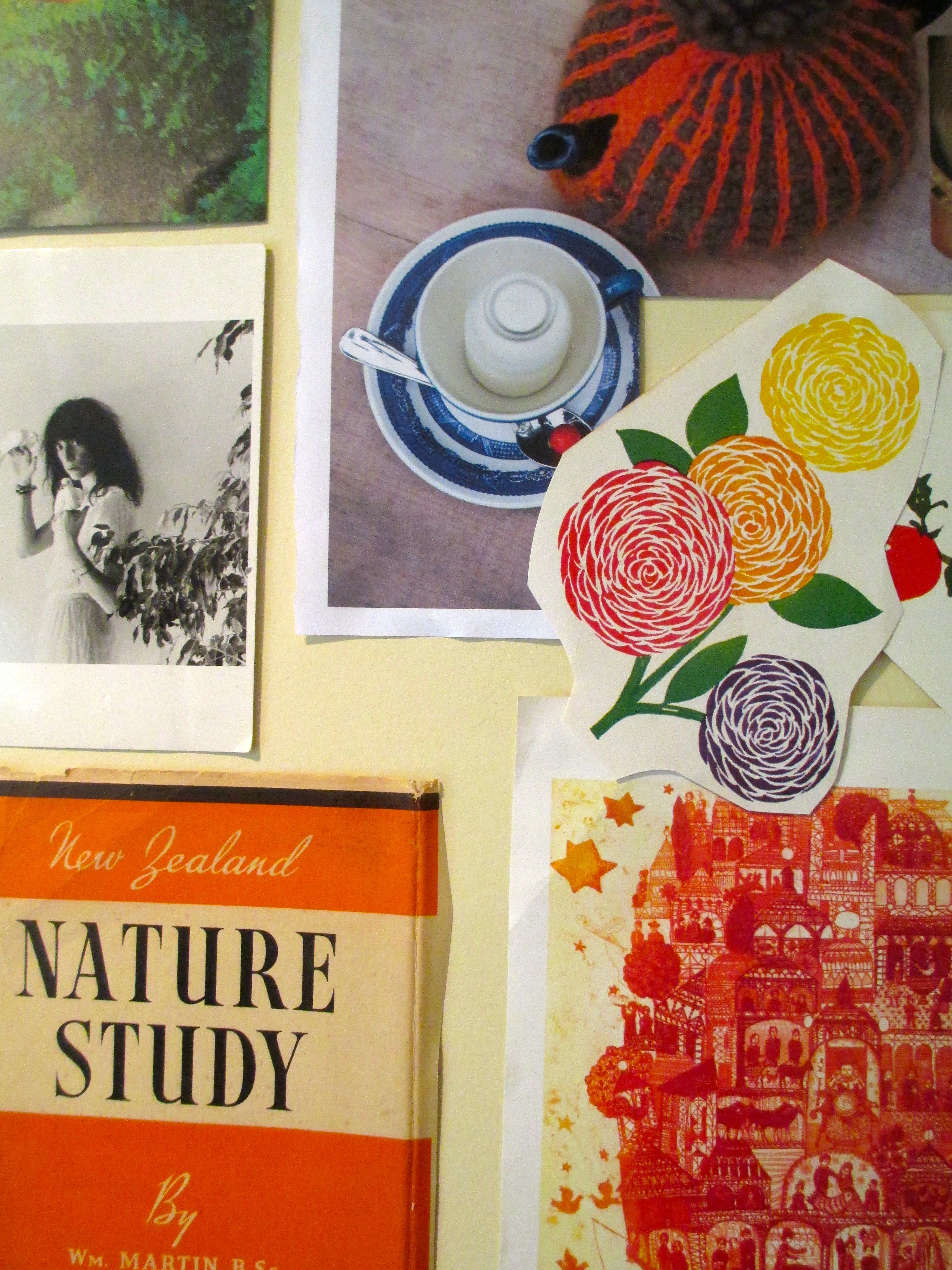
    The wall beside my desk I put up a montage of inspirational images. It was overdue for a freshen up, so for a couple of months I slipped anything that caught my eye into a folder (magazine cuttings, mail my friends sent me, vintage book pages etc etc) until I had enough material to redo the wall.

    Here is the old inspiration wall:

    sw_old

    & Here is the new:

    sw_2sw_3 sw_4

  • gifts from the thrift

    How is the first official week of winter treating you? (Game of Thrones fans will get the reference here….)

    june

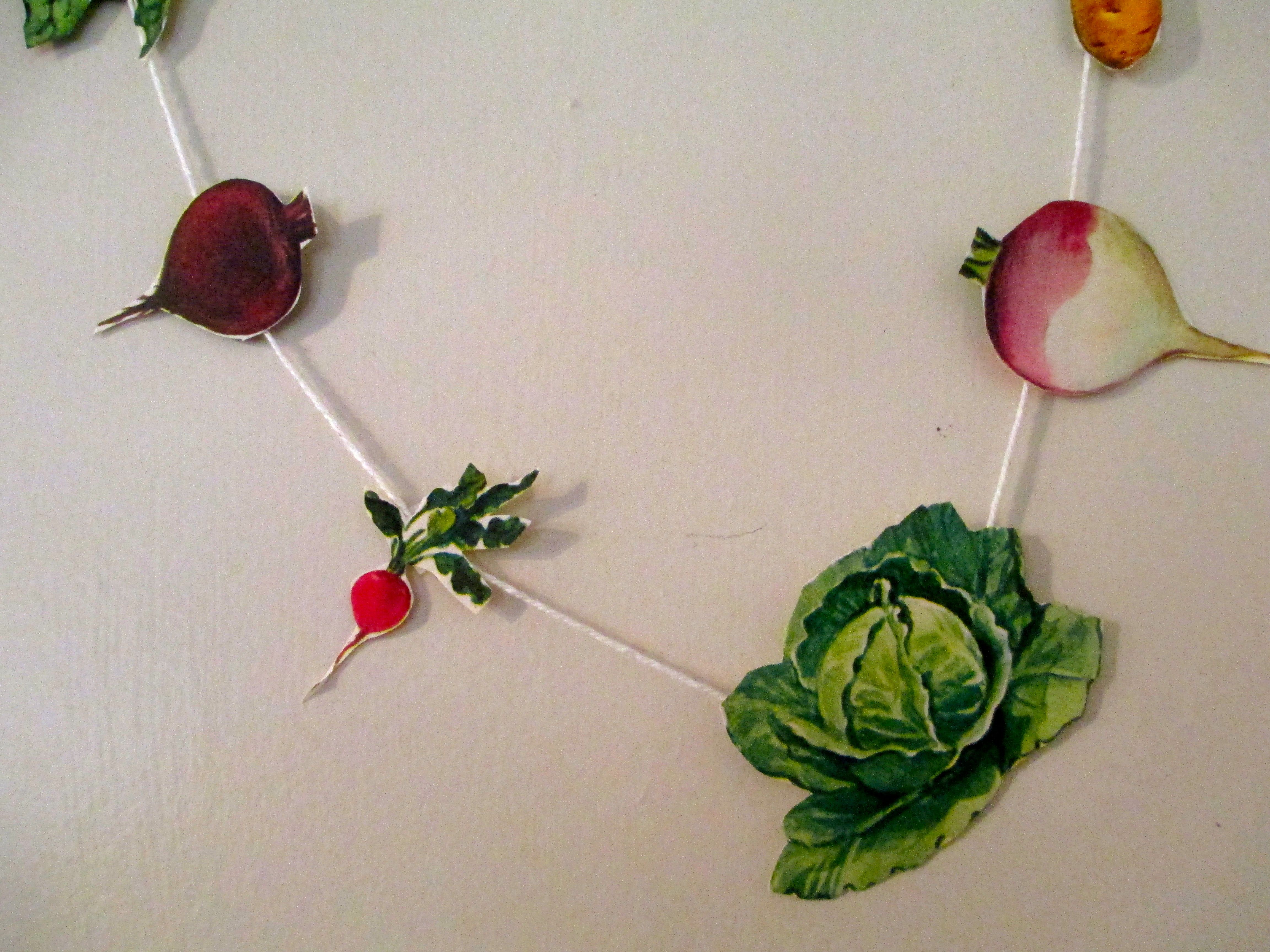
    Here is some vegetable bunting I made for the kitchen because….well, just because:

    vegbunting

    Here’s some stuff from the op-shop lately. (I buy most of my clothes from the op-shop also, but they aren’t all that exciting to photograph.) The sweet, the curious and the plain old strange have come my way…

    Something about this wee vintage dog appealed to me – the way he is obviously such a good dog and his face is on that angle of appealing to a person standing near….also he is standing on the tucker box – guarding it, or wanting to eat it’s contents…?

    op_june_1


    op_june_2

    New (to-me) art for the wall – an American Jay bird. I love the pencil of the foliage and the way only the bird is coloured. This is on wood and has a kind of enameled or something surface. Quite unusual.

    op_june_3

    A Holly Hobbie tile, mounted on wood. This will go to one of the manifold little girls in my life.

    op_june_4

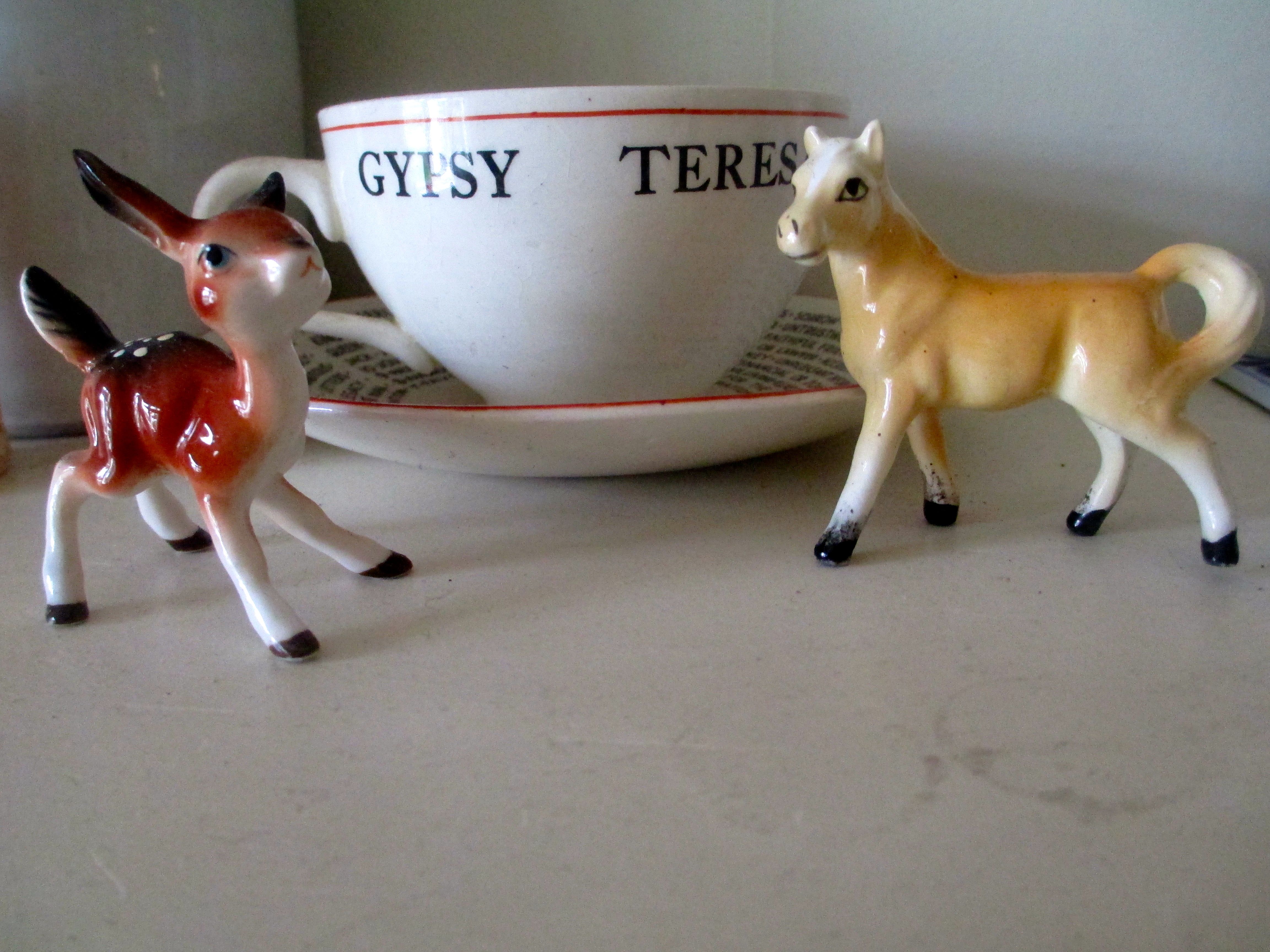
    Not op-shopped, but these two sweeties were being thrown out when Fraser’s grandfather moved house, so I duly rescued them.

    op_june_6

    Finally, a strange little mushroom man. Yes, I am aware that he is quite penile in appearance…I think this is partly what appealed. He’s like a wee fertility totem! 🙂

    op_june_5

    This is why I love op-shopping – the randomness, the chance – you just never know what you might uncover. It really is a treasure hunt.


  • Interview with Johanna Knox author of ‘A Forager’s Treasury’

    forager_treasury_coverAs a keen forager myself, I was so excited to hear that my friend Johanna Knox was writing a foraging guide for New Zealand, but despite the fact I was pre-disposed to like it, I am truly impressed and in awe of what she has produced. It is a beautifully written, helpful and down-to-earth book with great illustrations and in a handy format for toting along on foraging expeditions. I talked to Johanna about foraging recently and here is what she said:

    HL: Congratulations on your new book, Johanna! Can you tell me how you got into foraging? 

    JK: Thanks Helen! I was always fascinated by all the uses of plants, and I experimented madly as a child and a teen. As an adult I got into it again after I had children. I saw the natural world anew – through a child’s eyes again. Plus I got interested in food activism, and foraging kept cropping up as part of that.

    HL: Why do you think foraging is an important skill to have? 

    JK: In the Western world we’ve grown so distant in our relationships with the plant kingdom. Obviously there are exceptions – all the amazing researchers and trampers and wanderers, and gatherers and growers like you, who are maintaining and developing give-and-take relationships with the plant world. But as a society in general we’ve become disconnected from the truth about how we need plants for our survival and wellbeing.

    If we forget how all that works, we also forget what plants need from us in return. That way lies disaster. So foraging is a fun and productive way to help revive that relationship.

    You can definitely save money foraging too! Plus it’s empowering to be able to look around you, wherever you are, and see the ingredients for food or medicine or perfume or dye. johanna_2 

    HL: What have you learned from your foraging adventures? 

    JK: To be patient about knowledge! To not try and identify everything and know all about every plant at once.  That’s just frustrating. You have to read and listen and think and observe, and gradually things dawn on you. You can short circuit parts of that process if you get someone to show you stuff directly, but you still have to do your own research and observation and thinking.

    HL: Do you dumpster dive, too, or is your ‘foraging’ restricted to natural foods? What do you think of dumpster diving? 

    JK: Dumpster diving is admirable. I haven’t been party to it since before I had kids. Maybe I’ll take it up seriously one day …  I like the idea of doing it as a 70 year old.

    HL: What would your ‘Absolute Top Five List of Things To Forage (even if you are not a keen forager)’ be, and why? 

    JK: This is hard! I reserve the right to change this list tomorrow.

    Today:

    Kawakawa: my first native plant friend, so easy to identify, so abundant, so useful in so many ways.

    Fennel: I never used to like fennel – it gave me a stomach ache, but once I learned to use it more subtly in cooking and also found you could dye things almost fluoro yellow with it, I gained a new appreciation for it.

    Nasturtium: Every part is edible – and nutritious – and medicinal in that mustardy old-time-remedy way … And it’s so decorative. Good for party foods.

    Elderberry: Gather the flowers around November, and the berries late in summer and gather heaps. Make bulk syrup and freeze it and then use it in everything all year round. It’s so expensive in shops, and so cheap to make your own. And this tree is not endangered in the slightest.

    New Zealand mint: I love it that New Zealand has a native mint. But like many New Zealanders it’s a bit reserved and self-deprecating. Tough though, with hidden depths … and it gets louder when you mix it with alcohol. If you can’t find it wild, grow it in your garden as a ground cover.

    HL: How has foraging changed the way you see the world? 

    JK: I think I have a much greater appreciation for New Zealand’s native plants now, what they need, and their enormous value in ecosystems, as well as all the amazing things you can do with them.

    HL: Do your family & friends ever get embarrassed when you forage and collect windfalls when you are out with them? 

    JK: Not so much embarrassed – just impatient! I always hope I can sweep them along in my own enthusiasm, but there are times when I have to accept they’ve got other things on their mind!

    HL: Do you forage for mushrooms? Just how dangerous is it? 

    JK: I have anxiety around fungi. I realise rationally that if you know what you’re doing it’s not dangerous. And I can identify certain fungi that are edible – like boletes and basket fungus… but I can’t bring myself to eat them.

    I gathered field mushrooms once, cooked them up, and ate them. I knew beyond reasonable doubt that they were field mushrooms. But for a couple of hours afterwards I was still hyper-aware of my body, and every odd twinge, wondering if I’d poisoned myself.

    I’ve been wondering if this goes back to reading the Babar books as a child.

    Do you remember that bit where the old king elephant eats a ‘bad mushroom’ and dies? There’s this awful picture of him lying on the ground all green and wobbly. That’s one of my most vivid book memories from my preschool years – staring and staring at that picture in horrified fascination, trying to comprehend it … Now I wonder if that book set me up for a lifetime of anxiety around wild mushrooms!

    Whatever the reason, A Forager’s Treasury takes a botanical approach rather than a mycological one.

    HL: Is there a foraged food you eat almost every day? 

    JK: There’s no one foraged food, but definitely a recipe I pull out more regularly than most others – that’s weed pakoras. It’s such an easy, substantial, satisfying way to use any edible weeds you can find near your house, and whip up a meal or a side dish when you’re running short of stuff in the pantry

    HL: What is your best discovery in terms of our native plants? (Recently, I had delicious tea at a cafe which had Kawakawa in it, and now I’m keen to try that.)

    JK: Perhaps harakeke. There are so many varieties, and you never stop learning about it. It’s just this most incredible multi-purpose plant – the nectar as a sweetener, the pollen as a nutritious condiment, the seedpods as a rich chocolate-brown dye (and I love the smell of them), the sap as a healing gel … and that’s not counting all the uses of the leaves as fibre.

    HL: Does foraging have a spiritual element to it for you, or is it strictly pragmatic? 

    JK: I’m not a very spiritual person I’m afraid. I was brought up in a family of geeky atheists. But I think science has served some of the same purposes for me as a spiritual or religious path might for some others.

    It’s given me a sense of awe and wonder about nature and the universe, a feeling of being just a small part of something grand and mysterious, and a reassuring sense of my own insignificance. It also helps provide the co-ordinates for a moral compass (however hard it is to follow that compass sometimes).

    I can’t say it’s helped me fully come to terms with human mortality – I’m still working on that one! But I have the impression many people on spiritual or religious paths struggle with that one too.

    When you’re out gathering, all those feelings and ideas certainly come into play.

    Thanks so much, Johanna! Over the next couple of weeks I intend to post a review of ‘A Forager’s Treasury’ and Johanna has also given me a recipe to share with you all as well.

    If you want to learn a little more about Johanna – look HERE. HERE is a recent review of the book, and there is a website which goes along with the book HERE.

    Happy foraging!


  • Pioneer cooking for energy efficiency


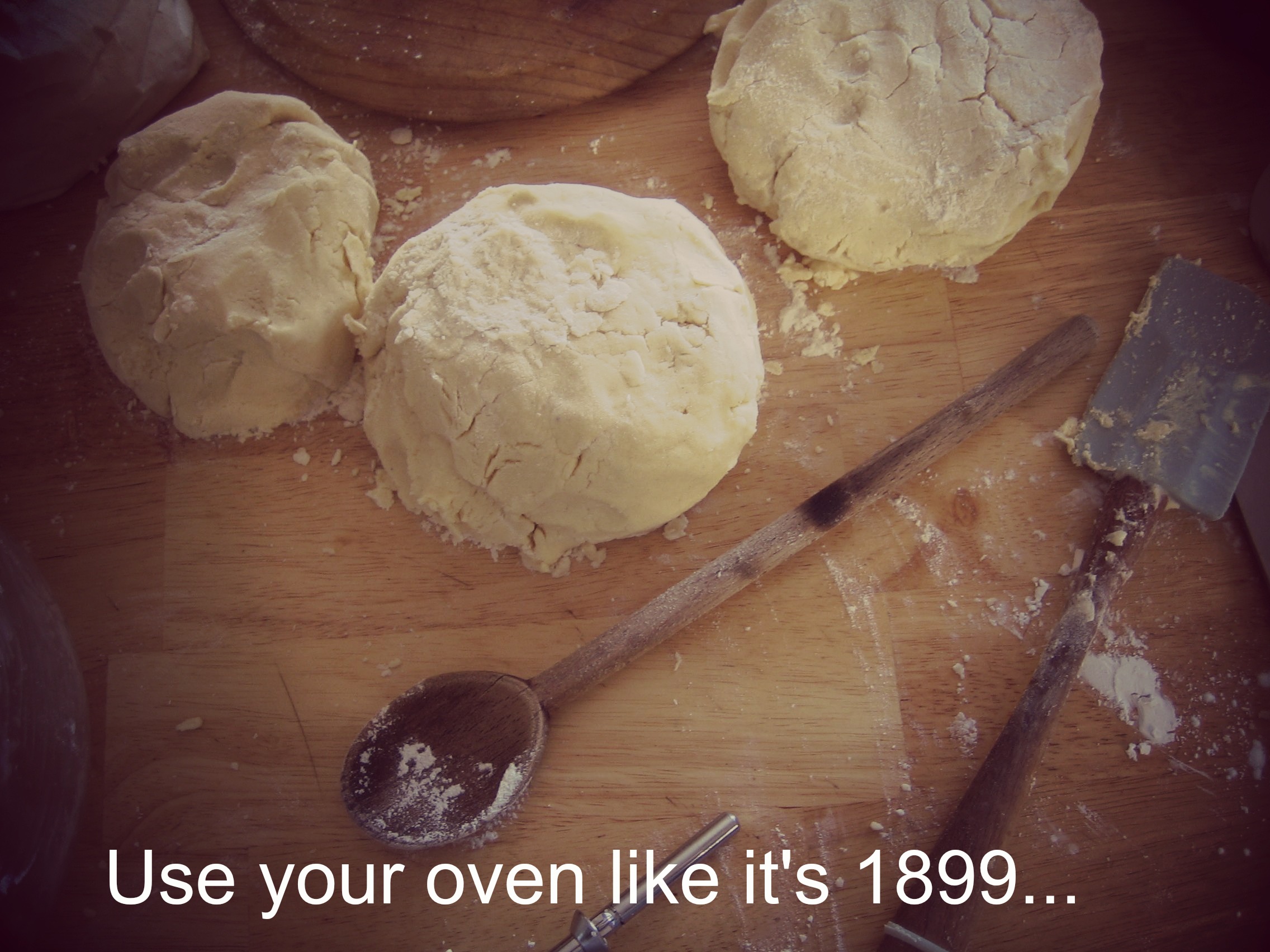
    In an effort to be more energy efficient, save money on bills and be more organised with food practices, for the last few years I have gotten into viewing a warm oven like a pioneer woman would. What do I mean by that? Well, as anyone who has read ‘Little House On The Prairie’ will know, pre-electricity, getting an oven hot took a lot of human and resource energy, so people would do all sorts of things with the oven while it was hot, and even cooling – making the most of it.

    Of course these days I can have a hot oven at the flick of a dial, but I try to respect the energy it took to heat the oven, and save money on my gas bill by using the heat for multiple things and trying to avoid heating it just for one purpose.

    This takes a little bit of organisation, lateral thinking and time, but once you get into the swing of it, it becomes second nature.

    Once the oven is turned off – it stays hot for a long time! Think up ways to use the warm but cooling oven. I have a few suggestions below but would like more…

    Here are some of the ways I maximise a hot oven – if you have other suggestions, please let me know in the comments!

    -when baking, if I’m baking a cake, or biscuits or muffins – I often bake a double mixture, freezing excess for school-lunches or whatever, so I’m not heating the oven to make one thing

    -bake multiple things at once…a cake, a loaf of bread, some muffins…

    -when baking, think ahead to dinner – could you use the heat of the oven to roast or bake something for dinner so you don’t have to later?

    -when baking, wrap potatoes in foil and tuck them around the baking trays, then take them to work for an easy lunch

    -when baking, pour two inches of rice into a casserole dish, cover with stock until stock is about two inches above rice. Put lid on, put in oven. Check occasionally to make sure there is enough liquid. The rice will absorb the stock, cook, and you will end up with yummy flavoured baked rice for re-heating at dinner time or for a salad base.

    -when baking, why not also whip up something for lunch? Beat eggs, add greens and cheese. Grease muffin trays, pour in eggy mixture and you have a dozen baseless ‘quiches’ for lunch with minimal effort!

    -put a mixture of dried fruit into a small oven dish (apricots, dates, figs, prunes, sultanas, whatever), add a couple of teaspoons of spices (cinnamon, ginger – whatever flavours you are fond of), cover with warm water, put lid on, put in oven. You will end up with delicious macerated fruit – yummy on cereal, ice-cream or by itself with whipped cream.

    -bake fresh fruit using same method as above…

    -put oats in an oven tray and toast the oats for muesli. You can add sweetners and oil to the oats, but you don’t have to – even toasting the oats without sweetners adds a lot of flavour

    -thinly spread roughly dessicated coconut on a pizza tray and toast. Toasted coconut is delicious spread over desserts, yoghurt or curries. (You have to watch it though – whip it out as soon as it goes lightly brown. It burns easily.)

    -toast nuts, or seeds. A yummy snack is stirring a tablespoon of tamari into one cup each of pumpkin seeds and sunflower seeds. Then toast. Delicious by itself or sprinkled over salads. Also adds a yummy crunch to sandwhiches.

    -in tomato season, if you have a tomato glut, or if they are really cheap and you buy a box or whatever, cut in half, brush with olive oil and put in turned off oven to make ‘sun-dried’ tomatoes. You will have to do this a few times to get entirely dry tomatoes, but even semi-dried tomatoes are delicious and intense in flavour, you will just have to use them up faster than dried.

    -if you have people over and you have used the oven to make dinner, put some kalamata olives in a about half a cup of olive oil, add finely grated lemon peel, herbs of your choosing and black pepper. Warm in the cooling oven and serve with bread. Olives are delicious at room temperature, but slightly warmed with these additions? SUBLIME.

    -turn elderly bread into croutons – cut into small squares, brush with oil using a pastry brush, bake

    -rice crackers gone stale? Don’t throw them out – put them on a pizza tray and put them into the oven after you’ve finished baking and oven is turned off. It brings them back to life. Works for wheat crackers, also.

    -if you are a gardener, keep your eggshells. Put them into the turned off, cooling oven. They will go dry and brittle, making them easy to crush up with a mortar and pestle (or just use a bottle!) for sprinkling onto your vege garden. They add calcium and trace elements to the soil. You can also sprinkle rings of egg-shell around brassicas and salad vegetables to deter slugs. (Of course the egg-shells will break down by themselves if you throw them whole into the compost, but this way they will break down much much faster and you can put them directly on the garden, skipping the compost heap.)

    -if you have a herb garden, use the turned off/cooling oven to dry herbs for cooking or herbal tea. Pick herbs, wash, dry very thoroughly with a tea-towel, spread thinly on an oven tray, put into oven. (I do this with lavender and it fills the house with a heady lavender smell.)

    -thinly grate lemon peel on the fine side of your grater, spread thinly on a pizza tray, put into a cooling/turned off oven. Then you have dried lemon peel for adding to cooking or making lemon salt.

    -use the turn off/cooling oven to dry dishes! If you are hand washing dishes, put some of the large, space-taking items like pots and pans into the warm oven to dry. Gets them off the bench, out of the way and drying so there is room for the rest of the dishes.

    OK! I hope that gives you some ideas, anyway. Now that I’ve been doing this a few years, I get all twitchy when I see people heat their ovens just to bake a dozen muffins! There will no doubt come a time when we have to return to some pioneering ways because of the world’s diminshing resources, so I am getting into the swing of it now. I hope I might have inspired you too, as well, if you weren’t already.


  • the creativity muscle

    I’ve spent so little time in my studio this year that I’ve been jokingly calling it “the cave of forgotten craft”.

    What with the new day-job and the intensity of the yoga-instructor training I’m doing, plus my general feeling of knackeredness which I’ve written about lately…the time and inclination to make stuff kind of ebbed away over the year.

    I can feel the desire to get back into it rising in me, which is a relief, because I was wondering if the yen had gone altogether.

    The other day I went into the cave of forgotten craft and it was a scene frozen in time of a busy and yes, untidy, person making several different things at once with a happy mess strewn around.

    I went in there, opened the window, pottered around tidying and remembering long forgotten projects and just kind of steeped in this abandoned part of of myself.

    When I teach journaling workshops, people often arrive like this – the desire for creativity is there, but there is a whole lot of ‘stuff’ in the way of their leaping in – fear, uncertainty, self-consciousness. The way through that is gentle baby-step exercises or as my friend Johanna calls it “throat-clearing”.

    Anyway, it was good to hang out in there. I’ve aired it out. I’ve tidied it. I’ve mooched. I emptied the rubbish bins and dusted the surfaces.

    Next time I go in there I might even…..make something.

  • poetry-nerd-gasm

    The Red Cross hold an annual book sale here. It is amazing – two giant halls filled with books, magazines, music. It is so big and so busy it can be more than a little overwhelming! I go every year and always find incredible things.

    This year I decided to focus just on vintage children’s books (one of my passions) and I found plenty….but then I couldn’t help myself having a stroll past the poetry table on the way out and I am SO GLAD I did.

    Firstly I found these beauties – the Plath is a recent edition and looks in mint condition – like no one ever read it (shame on you, previous owner). I love the mushrooms on the cover. I was excited to find this early James K Baxter (pre-beard!) and someone had sellotaped a cutting out of the newspaper about his death in the back cover with a rather depressing photograph of him dead in his coffin.

    Then I found the Lowell and Ashberry and was very happy. I had nothing by either poet in my collection so they fill a substantial gap.

    But then…..THEN…>>>>>>

    I found a copy of Turtle Island by Gary Snyder! A book I’ve been hunting for for years. 

    I was so excited I yelped ‘OH MY GOD!’ out very loud and clutched it to my chest in a possessive manner.

    A man standing next to me looked at me with some amusement and said ‘What? WHAT??’

    so I held up the book so he could see the cover.

    He pulled a face conveying how unimpressed he was and shrugged….proving that one person’s poetry-nerd-gasm is another’s ‘whatevs’.

    I love Gary Snyder is an irrational, gushing kind of way. His books are hard to find. (If anyone has any Snyder they feel ambivalent about….contact me, maybe we could swap or I can buy them off you!)

    There is a wonderful photograph on the back of the book of him with his wee son Kai. I guess he was in his 30s here:

    In my studio, I have a photograph of him in his late 70s, with Alan Ginsberg which I snipped out of a New Yorker and framed. I love how happy he looks and how typically lugubrious Ginsberg looks. When I’m feeling blah about poetry, I just need to look at this picture and it makes me feel a bit better. It reminds me that a) poetry is for life and therefore I (hopefully!) have a long time to write, to improve, to grow in my work…and b) friendship, especially friendship with other writers is how you keep going through the poetry life:

    Here it is in all it’s beauty:

    Best Red Cross book sale find EVER.


  • inspiration books

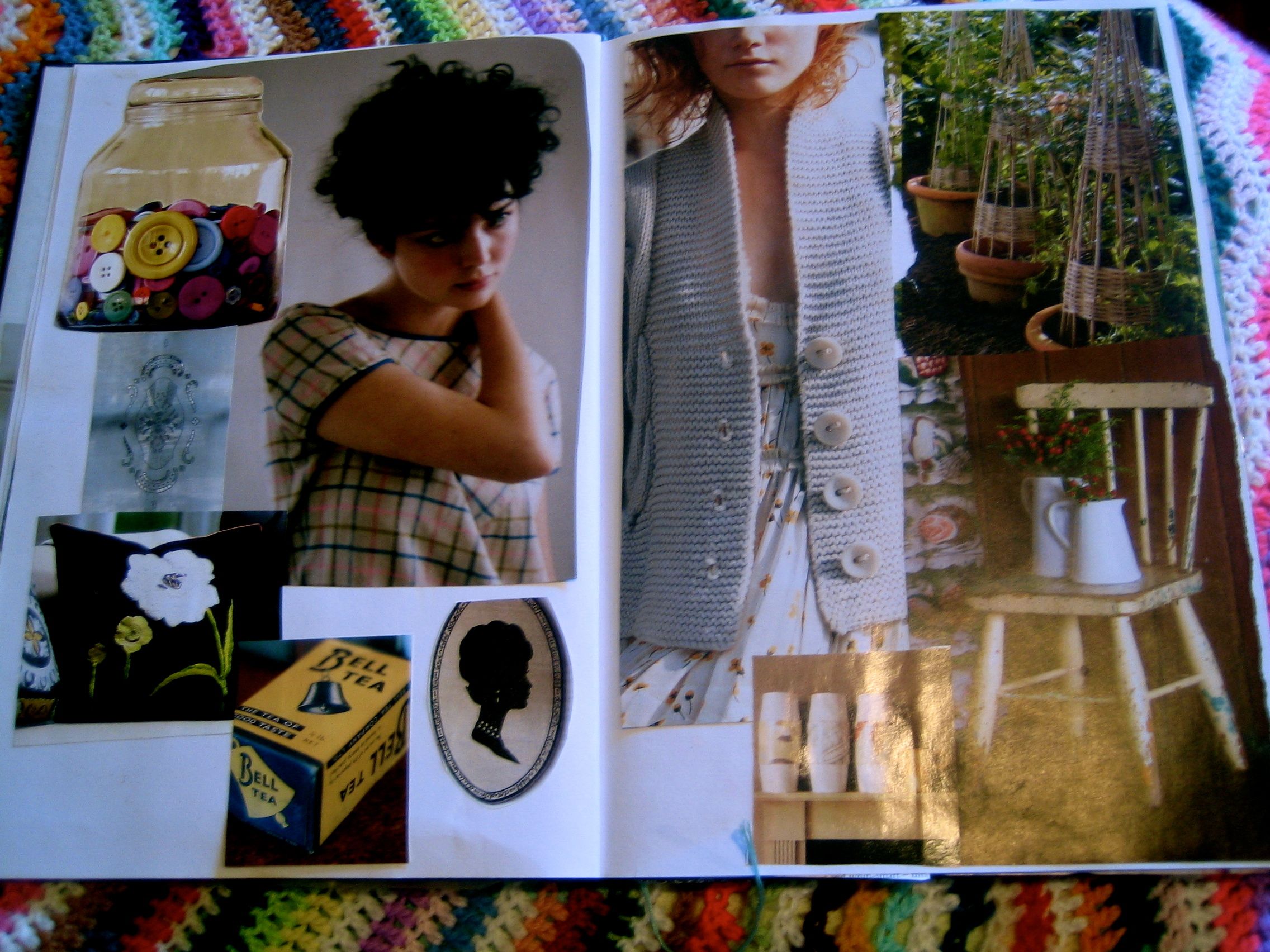
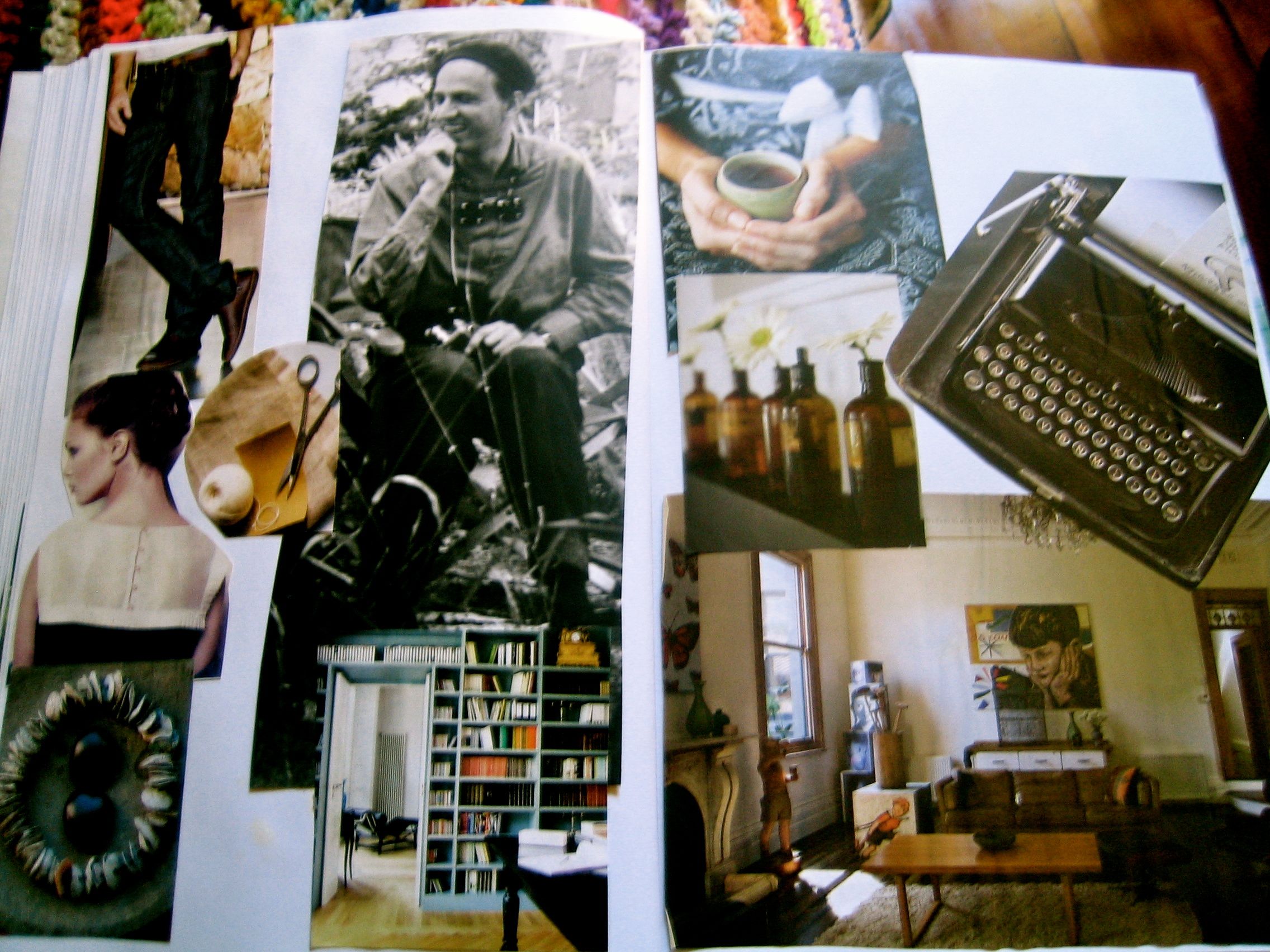
    I get a lot of magazines passed my way from family and as I read them I snip out anything which catches my eye and fill blank journals with pictures. I’m a very visual person and this practice inspires everything from poetry to life habits to cooking to gardening to craft to how I set up my house! (It’s like old-school Pinterest, right? Ha!)

    It doesn’t have to be something I would DO, or WEAR, or necessarily WANT, though…it’s more just about the visual inspiration. I don’t think about it too much – if my eye hovers over it for more than a couple of seconds, I cut it out.

    I’ve been doing versions of this as long as I can remember. I’ve thrown a lot of these book out, too – because of course my tastes and predilictions change over time and it isn’t like there is anything much of me in them – so I feel relaxed about chucking them if they no longer serve their purpose, which is to inspire me!

    Here are some pages from my 2010 inspiration book:


  • Graft is launched

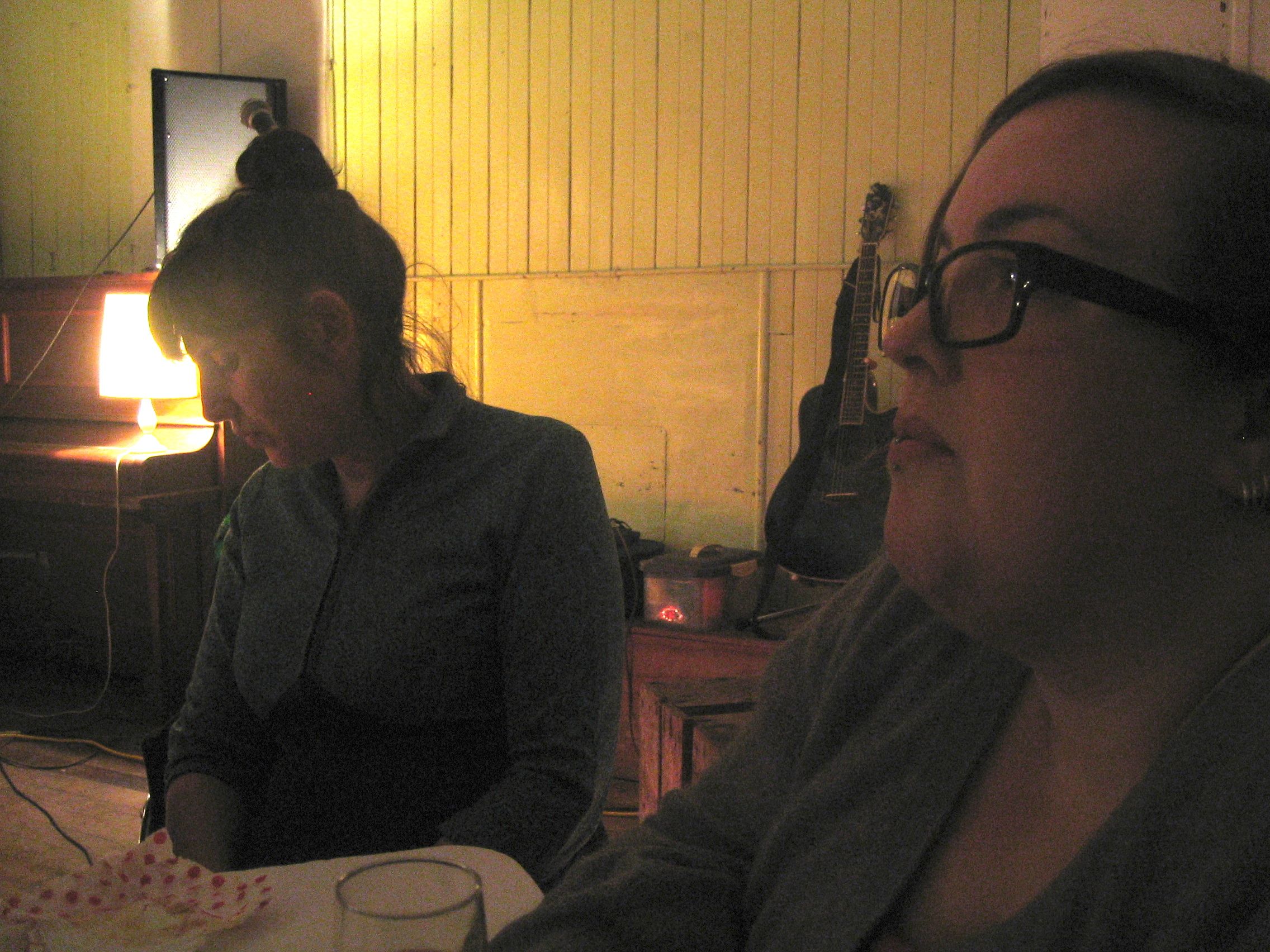
    I went to a lovely poetry event in Paekakariki last Saturday – the launch of Lynn Davidson’s ‘Common Land’ (VUP) and a local celebration of the recently launched ‘Graft’ by Helen Heath (VUP). Both poets were interviewed by Paekakariki poet, Dinah Hawken. It was a lovely laid-back affair with mood-lighting, a traditional ‘hall supper’, wine, tea and live music after the poetry. Quite relaxed and wonderful!

    Here are Dinah Hawken, Lynn Davidson and Helen Heath:

    Here are two of my dear friends, whom I love very much and who will probably kill me for putting a photograph of them on the internet:

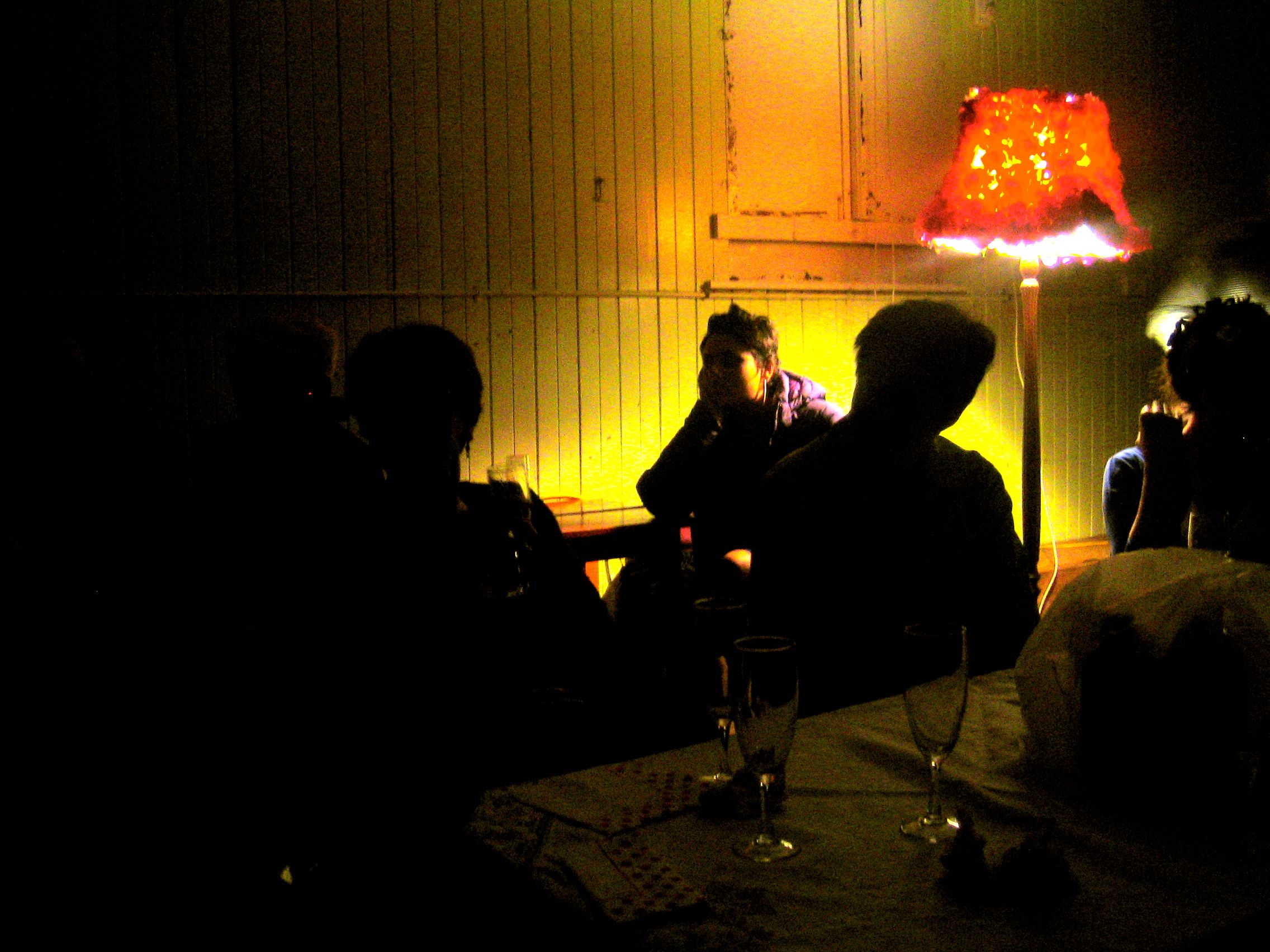
    Here is a random shot of some people enjoying the night – I wanted to show you the beautiful rose-lamp! :

    Congratulations, Helen, on all the ‘graft’ that went into this terrific book. It has certainly paid off – what a great achievement!

    ‘Graft’ is rich and carefully-crafted book. There are affecting and emotional poems about the terroire of motherhood and grief. There are sad/funny/sad poems about a composite character from the Hutt Vally called ‘Justine’. There are playful and moving poems about science and scientists. In short, there is a lot going on in this slim volume and it is a dense, satisfying read.

    Here’s to charmed evenings in little town halls, with moody lighting, poetry, live music and home-made lamingtons! I could do that every Saturday…

  • there is no cure for curiosity

    A friend sent me a little card with this quotation on it:

    “The cure for boredom is curiosity. There is no cure for curiosity.”

    -Dorothy Parker

    I am an eternally curious (nosey?) person. I often follow the path of curious things, which sometimes leads to adventures and happy accidents…and sometimes to wasted time and dead ends.

    Here are some things I saw out walking recently:

    A boat called ‘Romance’…

    A bear-face in a beam – do you see it, too?

    Never forget to look UP! Look what I saw on a cafe ceiling, recently…wheat and coloured discs…

    And, in my idea of heaven…a tiny secret garden in the middle of a big city…bursting with vegetables and herbs…

    How do I know it was a secret garden? Well, firstly because it was tucked away in a corner you are unlikely to stumble on…and secondly, because the sign said so:

    I hope you find some interesting things out walking this week. X