Category: gardening

  • Capture and store: Silverbeet

    A couple of weeks ago I wrote about how we were eating a lot of silverbeet in an effort to keep up with the spring bolts of the plant.

    This has continued, I’ve discovered that if you snip off the ‘bolt’ stem…the thick stem growing up the centre that is beginning the process of sending the plant to seed…sometimes the plant will do another flush of leaves so I’ve delayed having to remove the plants entirely. (While our local spring continues to be more like winter…with ground temperatures too low for summer meditteranean plants like tomatoes and zucchini…there’s no urgency to make space.)

    If you’re not a permaculture practitioner, ‘Capture and Store’ is one of the main permaculture principles. The idea being…it isn’t enough to grow things (or create energy)…an important piece of the equation is to honour the garden by capturing the harvest and, if possible, storing some for later on.

    Occasionally, I like to write articles about the ways our permaculture family ‘captures and stores’ around our small, urban property. As food and energy prices rocket, I imagine these skills will ripple out beyond permaculture to become more important for households.

    Yesterday, my son Willoughby and I spent around an hour and a half processing the silverbeet, celery and flat leaf parsley plants which had begun to bolt.

    The celery stalks went into dinner and the fridge. The celery greens and flat leaf parsley bolt-stems we chopped up and put into our dehydrator. I will put them and some NZ sea salt through our electric spice grinder to make a herb salt which is great for adding to soups and stews.

    We picked a huge amount of silverbeet. Approximately the equivalent of five of those plastic-wrapped bunches you can buy at supermarket.

    Here’s how we processed it to become freeflow bunches of chopped silverbeet, similar to the way spinach comes frozen at the supermarket.

    We harvested the ‘bolt’ stems. I cut off the leaves with a pair of kitchen scissors into a large bow of water and gave it a wash.

    We then chopped it.

    Next step was a quick blanch in a shallow pan of boiling water. Just long enough that it wilts and goes bright green.
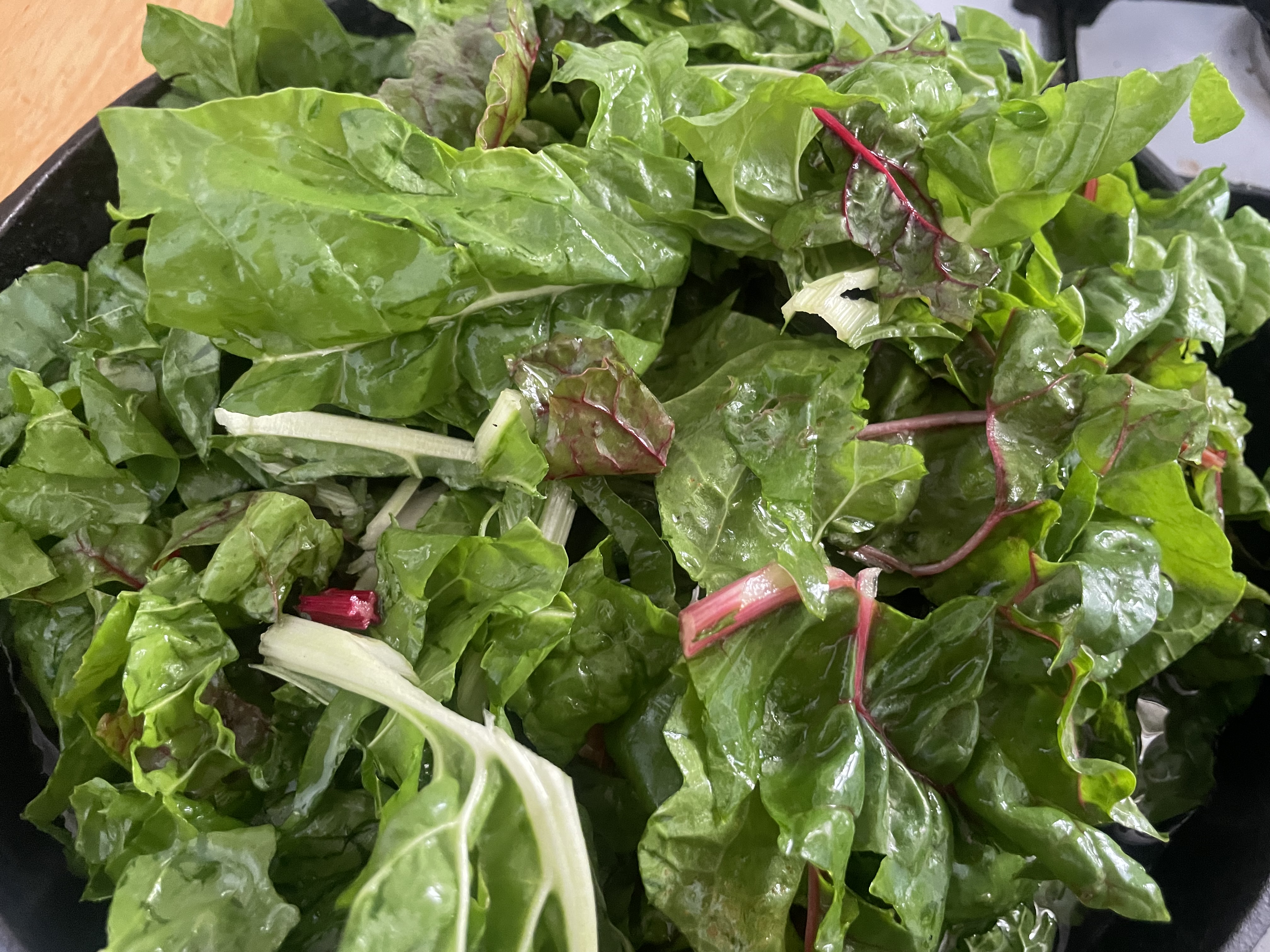
    Then I strained it and pushed as much water out as I could with a wooden spoon (obviously it is too hot to touch with bare hands at this stage. I left it sitting in the strainer to cool.

    Once it had cooled enough to handle, I formed it into balls. (Think about the amount you’d like to add to a soup or stew.) The trick to a tasty end result is to squeeze and squeeze it getting out as much of the liquid as you can. Silverbeet seems to retain a lot of liquid so keep squeezing…think of it as a workout for your hands!

    After that, place the fistfuls on a biscuit tray and put into the freezer.

    Once they are frozen, remove from the freezer, put into a ziploc bag or plastic container and put back into the freezer and there you go, you have one meal amounts of pre-prepared silverbeet ready to add to your cooking.

    You might ask why we’d bother doing this when silverbeet grows all year round in most of New Zealand’s climate? I suppose a big motivator is frugality, but also, I find I use more silverbeet if it is prepared this way. I also loathe waste and, because I know the effort I’ve put into growing the food, I prefer to have it travel through the kitchen rather than go straight from garden bed to the compost heap.

    Silverbeet is so nutritious! I think it needs a PR campaign. In NZ we tend to take if for granted or spurn it because it’s so ubiquitous in our vegetable gardens. Forget about overpriced supermarket spinach….eat your silverbeet!

    If I’ve inspired you to make more of your silverbeet, here are two excellent links with multiple tasty-looking silverbeet recipes.

    11 tasty silverbeet recipes from Delicious magazine

    12 yummy silverbeet-based dinners from NZ Woman’s Weekly magazine

    One of my favourite ways to eat A LOT of silverbeet at once is to make an Indian Saag Aloo, using silverbeet instead of spinach. Delicious and so greeeeeeen.
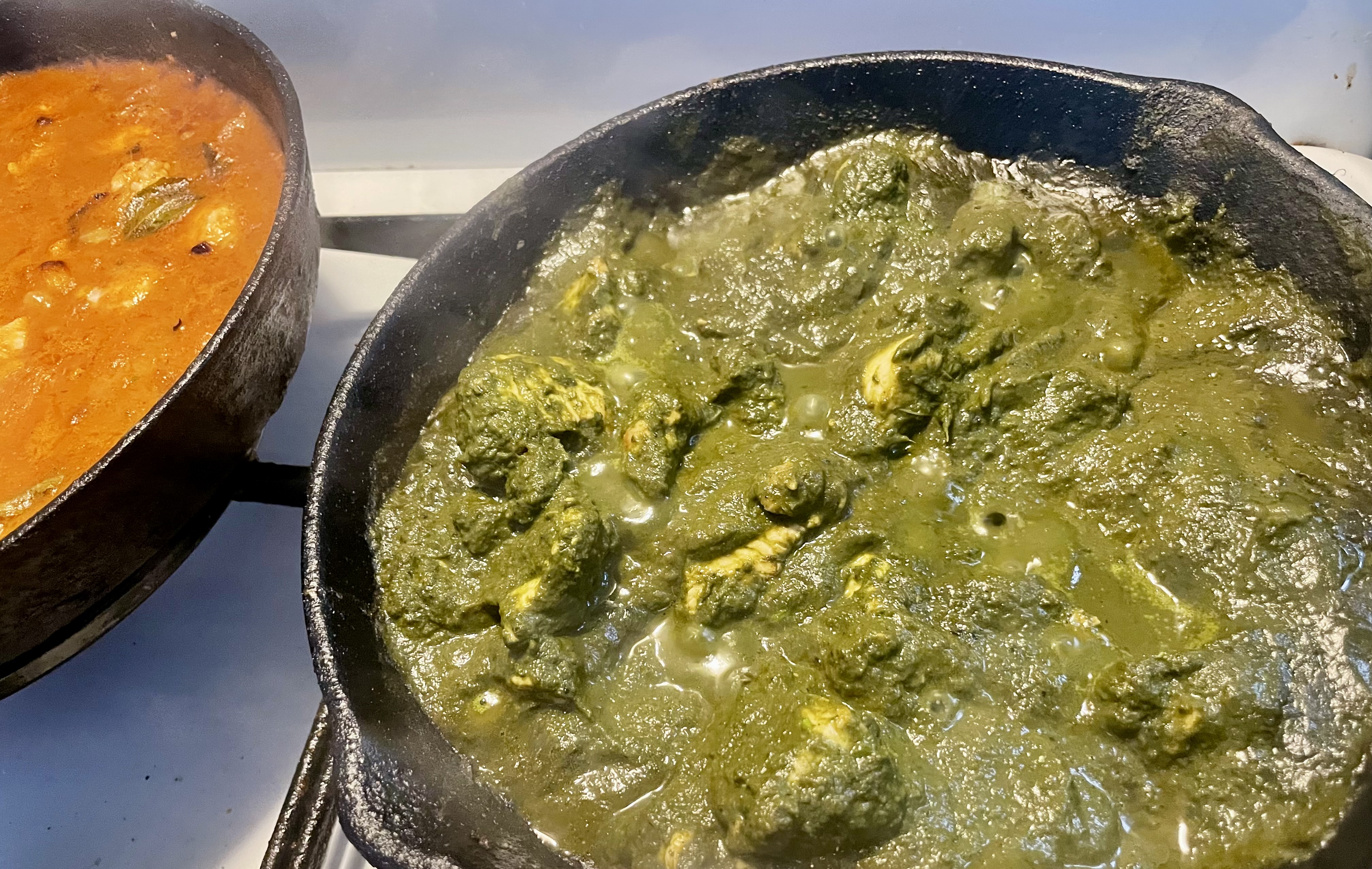
    If you have a signature silverbeet dish…please share it with me.

  • ‘now we recognise ourselves less and less’

    (Above: plastic rubbish I picked out from my vegetable beds last week. I collect around this much rubbish each time I tend or harvest from my vegetable beds.)

    I enjoy the writing on The Dark Mountain Project. It’s an ongoing project (based in the UK) that publishes ‘uncivilised writing’, holds gatherings, creates a space for conversations about all manner of unsettling and challenging elements of living at this point of human history. There you will find writing beyond polite eco poetics or nature writing that merely holds nature in a human/nature binary of saccahrine reverence. I don’t always agree with what I read there and that is why I like it.

    Last week I read this piece by Amy Kennedy from the most recent issue with the theme of ‘bodies‘.

    At first it seems a deceptively simple piece of writing, Amy describes a group of parents at a childrens’ birthdday party. One of them brings up the subject of the finding of microplastics in human placentas. The piece explores plastic: our culpability and the unavoidable enormity of the tsunami of plastics in our lives.

    I have a fairly high threshold for ingesting media about climate collapse and environmental degradation. I don’t have my head in the sand.This is not because of courage but more that I am an anxious person who approaches life in a ‘forewarned is forearmed’ sort of way. I like to know something of what’s coming so I can consider in advance how I might respond. (I’d prefer not to be built this way but there is only so much you can do about your neurological wiring.)

    I was surprised by my visceral reaction to this piece with it’s blunt presentation of human culpability in terms of the use of plastics and refusal to look away from the idea of microplastics in human placentas, in human bodies. ‘Now we recognise ourselves less and less’, Amy writes. A familiar feeling for the eco-anxious amongst us and a statement that works on many levels.

    A few years back I wrote a poem in a similar vein about digging up the backyard of my crappy Wellington flat to grow food for my oldest son when he was a baby …only to years later find out that backyard had been a dumping ground for old car bodies and broken machinery and was no doubt full of petrol and lead and other toxins. In my youthful naiveté, I hadn’t considered the urban soil’s history.

    These human missteps we make in the name of love: a birthday cake served with a plastic fork, feeding a baby mashed carrots grown in polluted soil…the hell we plod towards on our road of good intentions.

    The depth to which I was triggered by Amy’s writing surprised me at first (I thought I was made of tougher stuff by now). But then when I thought about it, I realised it touched on a tender spot in my own gardening practice…a spot where I choose to put blinders on.

    I live in the centre of a city. Every time I weed or harvest from my front yard garden (tended so carefully with the best organic soil amendments and lovingly homemade compost) I fish bits of plastic out of my garden: plastic bag fragments, fruit stickers, junk food packaging, lollipop sticks. Some of it seems to get into our compost somehow, despite careful sorting at the kitchen end. The plastic in the vegetable beds seems to blow in from the street.

    (I wondered if this plastic trash were an urban problem but a friend who lives rurally said that there is just as much plastic trash out her way, in the road gutters, in streams, from the plastic packaging of hay bales and farm products.)

    I throw the bits of plastic into a colander that I have with me in my harvest basket then put them in the rubbish bin where they will travel in a plastic bag to the plastic afterlife, which is to say slowly deteriorating into microplastics in the city’s landfill.

    I dwell in a space of both knowing that I have my stubborn blind spots (the macro and micro plastics in my own food garden and in the soil I am creating in my compost) and also having no inclination to stop. I will carry on composting. I will carry on growing food in this microplastick-y soil I am making.

    I enjoyed this essay about composting by Scottish writer Fraser MacDonald (found via Pip Lincolne) He, too, is carrying on composting on despite tangible evidence of plastics in his compost. He writes:

    ‘I make my own compost so that I can convince myself that even when the world seems socially and ecologically broken there are still mechanisms for recovery: it shows that change is possible. Composting is a simple habit of composition or gathering together that integrates past fragments into a future whole, so that what matters is not the individual ingredients but the fertile new thing they can become.

    & that ‘fertile new thing’ possibly contains microplastics…yet still I persist in habits which put me squarely in the ‘doing’ space of the world, in flawed creative acts which give me a sense of agency and regenerate my spirit if nothing else.

    For that purpose alone I believe they are worthy.

  • the L-family’s beautiful permaculture garden

    One of my favourite things to do is to visit other people’s vegetable gardens and have a good nose around…I always learn so much and get inspired to go home and get into my own.

    Here are some photographs from a beautiful, well-established permaculture garden on the Kapiti coast I visited in late spring last year.

    Here is their garden photographed from just beyond their porch, you can see this from the house:

    aands_1

    I loved the way they had their main crops (potatoes, corn) in large clear beds, their salad crops growing more ‘wildly’ in the shadey edges, and they had planted an orchard at the foot of the garden which doubles as the chicken run…the chickens keep the grass from around the base of the trees (most fruiting trees don’t like grass growing around their bases), and the chickens fertilize the trees with their poo…meanwhile, the trees offer shade to the chooks, and food, too. (Unfortunately for my chickens, the two huge trees in their run are feijoa trees, and it seems chooks don’t like feijoas, so no happy harvest for my lot!)

    aands_2

    Everywhere I turned there were different crops – here you can see salad vegetables, calendula, dark leafy greens and garlic…

    aands_7

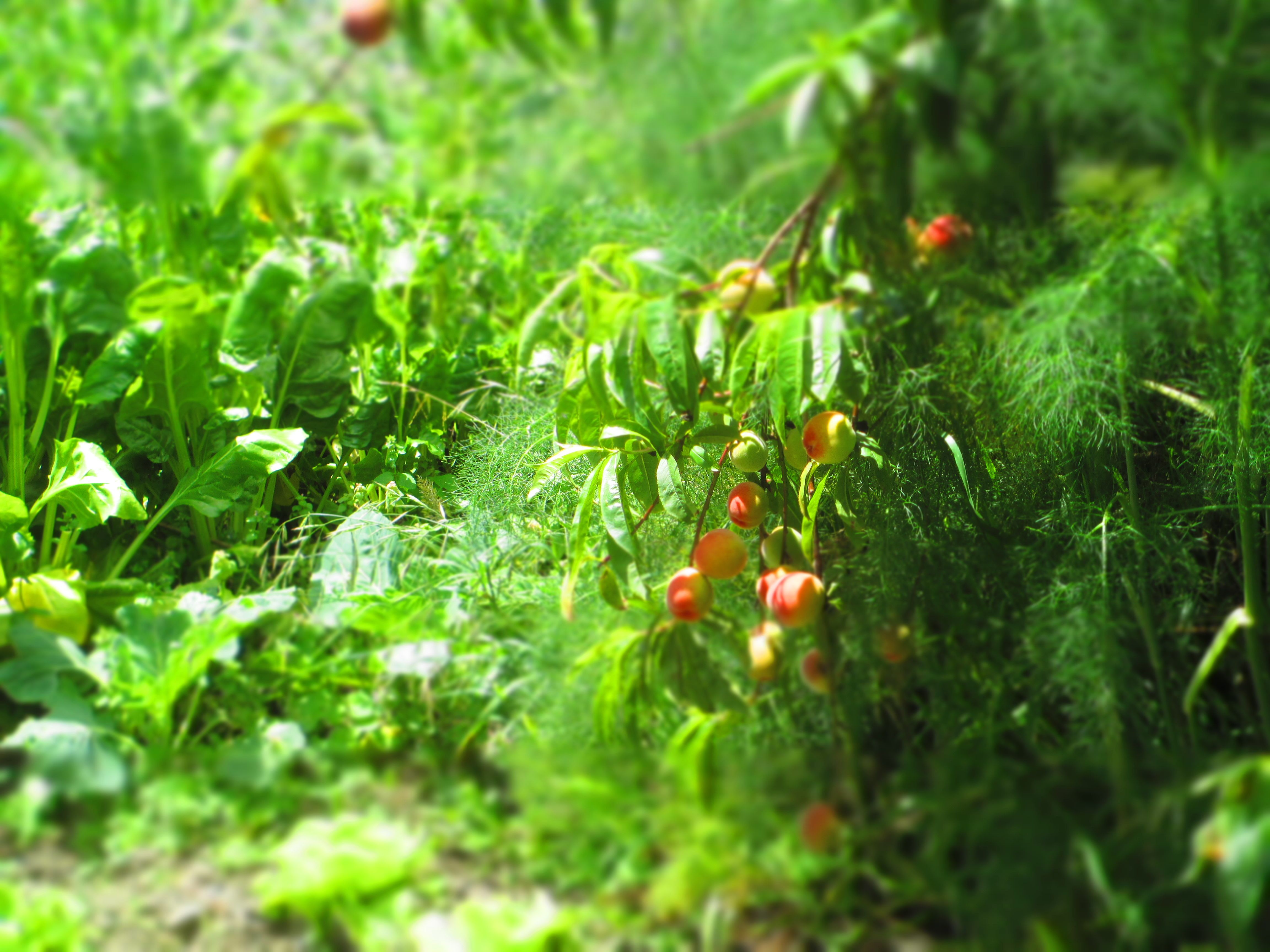
    Near the house was an absolutely beautiful peach tree sorrounded by fennel, with flawless fruit dripping off it. I sat under it for a while – it sure was a special tree – and took a bazillion photographs…but I’ll just share a couple with you here as you may not find photographs of peaches so mesmerising as I do.

    aands_8

    aands_9

    Beautiful hand-woven baskets and seedling pots made from newspaper…

    aands_4

    aands_5

    I noticed they had a ground cover of red clover, too.

    aands_10

    I have another vegetable garden visit to share with you, soon. I hope you enjoyed this one!

  • picking up what the wind drops

    I took a walk to a nearby section where an old house had recently been demolished. They are building shops there. I dug up a wormwood plant and rescued an iron gate from a skip which I’ll use as a frame for beans in the vegetable garden. 

    When I walk I am looking for stray plants and clues of what other humans are doing, their leavings, their signs.

    So many gardens are neglected and full of mistakes – odd plantings, strange schemes gone wrong. It’s a lexicon of thwarted plans, migration, human error. But I love all the gardens, all of them. I love where weeds come in and grow where no one thought there was any dirt. I love the twee tidy gardens around the brick units where the widows live – all pansies and polyanthus and tight little roses. I love the student flat gardens with the crushed comfrey and the gnarled old lemon trees. There is a place deep in my heart for the gardens inside the gates of kindergartens – old tractor tyres full of marigolds and strawberry plants, glitter and matchbox cars.

    These dahlias were planted behind a tin-shed, hard up against a damp bank…..in entirely the wrong place and where no one can see them (except me, because I creep and snoop) so I pick them and drop them at a friend’s door.

    white_dahlias

    I pick up windfall apples from the house across from the supermarket. They are a bit bruised but will do for pie. At another house someone has left ice-cream containers of passionfruit for $2 each on their fence. I take one and leave a coin in the letterbox.

    I don’t fully understand my own instinct for gleaning. It’s more than acquisition. It’s something to do with control, and side-stepping capitalism and burrowing into a universe where people trade in fruit and the urban environment is one big shared playground. I like my own company but I spend too much time in it and then I read the street and try to draw meaning from the random and the incidental.

    Occasionally a garden is stunning and special and makes perfect sense, but these gardens are rare:

    holloway_1holloway_2

    Right now, there is an American oil company doing exploratory drilling in the hills near Dannevirke. If they find enough, they have plans to frack for oil. Local farmers and  Iwi have been protesting there this week and it is getting almost no media coverage. There are similar exploratory tests going on near Whangarei, but for gold.

    I have been following the effects of fracking in Pennsylvania, USA where fracking for natural gas has been happening for some years now. None of the news is good. Profound pollution, deformities and stillbirths in animal stock, rising cancer rates and the tap water is flammable.

    Hold a lighter to your running tap and it lights up. Imagine.

    Parts of the Manawatu River are so polluted from intensive dairy farming and factory run-off IT SPONTANEOUSLY CATCHES FIRE.

    Water on fire. Water on fire.

    On the way to pick the youngest up from school I pass a house with a big walnut tree. There are walnuts all over the path, so I pick them up. I always carry a cloth bag in my hand bag for spontaneous foraging. It’s like maybe if I notice the trees enough, maybe if I honour the fruit enough, maybe if I pick up enough windfalls and rescue enough plants….maybe then…? Maybe then.

  • warm autumn

    Here is how the big vegetable bed looks right now….because it has been such a warm autumn, everything has grown quickly and lushly, which you might think is a good thing, but it isn’t really. It means that everything will be read to eat soon, and then when the really cold weather hits, the garden will be empty. Aah, well. Not much I can do about the weather!

    (Go HERE FOR A REMINDER OF HOW IT LOOKED IN MARCH.)

    I’m growing lots of Kale, green and purple, now that I’ve learned the best ways to cook it – it’s a great crop that grows throughout winter, much like silverbeet does.

    My olive tree, which was about one foot high when I bought it, is now about six feet high and after seven years, has finally fruited! Maybe moving it from from the old garden to the new garden was ‘motivating’ for it?

    There are lots of these dandelion-clocks about in the garden – I used to see them as a weed-enemy before I learned all the wonderful properties of the dandelion plant. Now I can blow them with abandon, like I used to when I was a kid.

    Make a wish!

  • the last

    I write about the seasons a lot, don’t I? I can’t help it. I grew up in a small town in the middle of farmland – my Dad was (still is) a hunter and fisherman and so we ate with the seasons and the seasons were meaningful in a way they may not be for city-folks. Most of my friends lived on farms, so the drying off of cows marked the start of winter, new lambs heralded spring. Because I do write about the seasons so much, the editor of The Comforter, Helen Rickerby, organised the book into seasonal parts. I still can’t believe it didn’t occur to me to do that – but that’s why you need a good editor, right? To show you things which are right under your nose but you can’t see because you are over-exposed to your own work.

    Anyhow, of all the seasons, autumn is my favourite. The harvest, the golden days with cold edges, the sense of melancholy. Garden fires, washing the woolens which have been in storage since September, quinces, feijoas, walnuts…picking apples – we have two apple trees at our place:

    In my book, there is a poem about the beginning of autumn, the final day of daylight saving. There is a point at the end of summer/early autumn, if you are a gardener and eat seasonally, like we do, where you know it is likely to be the ‘last’ time you taste that particular thing for some time. That final meal has autumnal melancholy all over it – it’s a farewell to summer. In the poem, ‘the last’ has a deeper resonance – because of my beliefs about the environment, I feel that anything could be our ‘last’ time, because our existence on this ailing earth is so precarious right now, and growing more so.

    Late summer this year, we ate corn for a good eight weeks, thanks to the 60 corn plants I grew – & no, I didn’t tire of it, like I do with some gluts. With the last of our fresh corn, I made a bean succotash which also contained the last of our tomatoes:

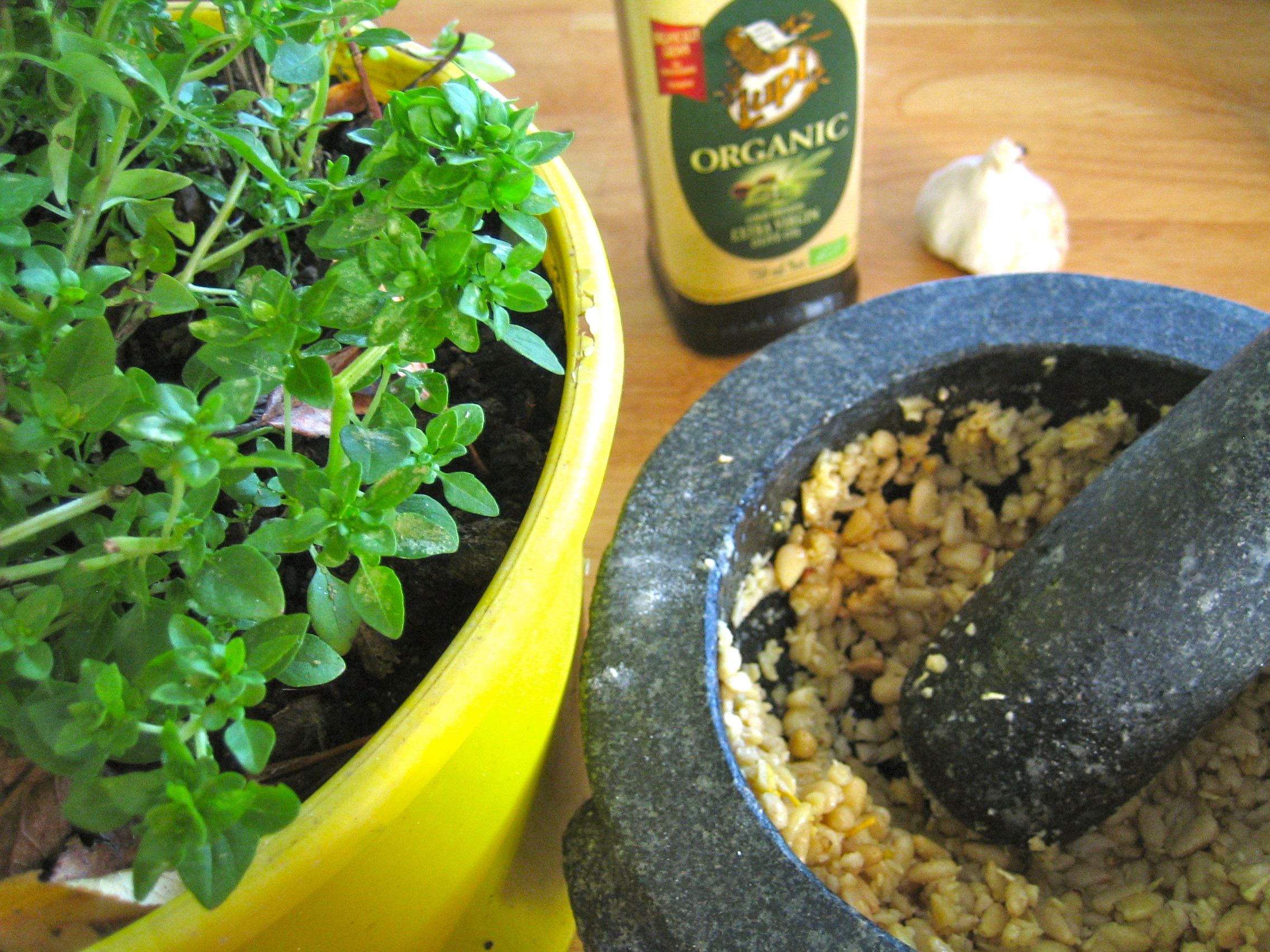
    Also, ‘last’ for the season – I made a ‘pistou’ or paste with the last of our bush basil, some pine-nuts, garlic, olive oil and salt. It’s always a sad day when the last of the basil goes. We ate it on pasta.  I like to grind such things up in my big mortar and pestle, rather than blitzing with an electronic device. It’s calming and meditative to hand-grind.

    (A Wellington friend who has never visited me at home was surprised to learn that I don’t live on a farm – he thought I did from reading my blog. I don’t know if it was just him, or if others have that impression as well – but just to be clear, I live on a very average not-quite quarter-acre section right in the heart of Palmerston North. You can take a girl out of the country, but she’ll bring her small-town/country ways to the city!)

    Anyway, here’s that poem I mentioned, from The Comforter:

    FALL BACK

    Insects everywhere – dead bees in the garden, moths

    stud the bathroom ceiling like dusty ornaments, praying

    mantises crawl out of the compost bucket. The flies.

    The last day of daylight saving. Everyone

    tired and wistful on Sunday. That feeling

    like you lost something all day.

    The last-day-of-summer pasta sauce – made with the last aubergines,

    last cherry tomatoes, the last zucchini. The garden now

    full of fledgling winter vegetables: spindles of cabbage, arrowheads of spinach.

    Manawatu gothic. Even these bright days are tinged

    with a kind of violence. There is a black velvet ribbon

    threaded through your head, collecting debris.

    The last dinner on the dehydrated lawn.

    *

  • golden sunflowers inside

    I didn’t have much luck with sunflowers last summer – I planted a whole packet in the corn bed but only three came all the way up and one of those got blown over and snapped in a storm.

    Still, the two that made it were glorious in the way that sunflowers are.

    There’s nothing like a sunflower to be a measure of spring/summer/autumn…green and growing up, up, up all through spring and most of summer….then finally the flower head opens and never fails to impress – such a heavy head, such a strong stalk…then you know autumn is here when the petals fall and the seeds start to dry on the head.

    Sunflower’s point-of-view…chasing that sun:

    A bee visits:

    I love Allen Ginsberg’s ‘Sunflower Sutra’ (I nearly chose this excerpt to go at the front of my book, but then I changed my mind at the last minute and felt the other one summed up the book more) – if you care to, you can read the whole thing HERE, there are also great clips on youtube of Allen Ginsberg reading the poem, otherwise here is my favourite part of the poem, which I repeat to myself like a mantra in challenging times:

    ‘We’re not our skin of grime, we’re not our dread

    bleak dusty imageless locomotive, we’re all

    beautiful golden sunflowers inside, we’re blessed

    by our own seed & golden hairy naked

    accomplishment.’

  • In the garden…

    The tomatoes are ripening by the bowlful every day and we are eating lovely pasta sauces and soups which taste of the sun and make me realise how insipid tinned tomatoes are! The chillies are starting to fruit – just in time for the cold of autumn, which will stunt their growth in no time. Every year I try to grow chillies – every year I get about two weeks worth of fruit before the autumn shrivel. You’d think I’d learn, right? Hope springs eternal. One day I’ll build a little glasshouse for year-round chillies.

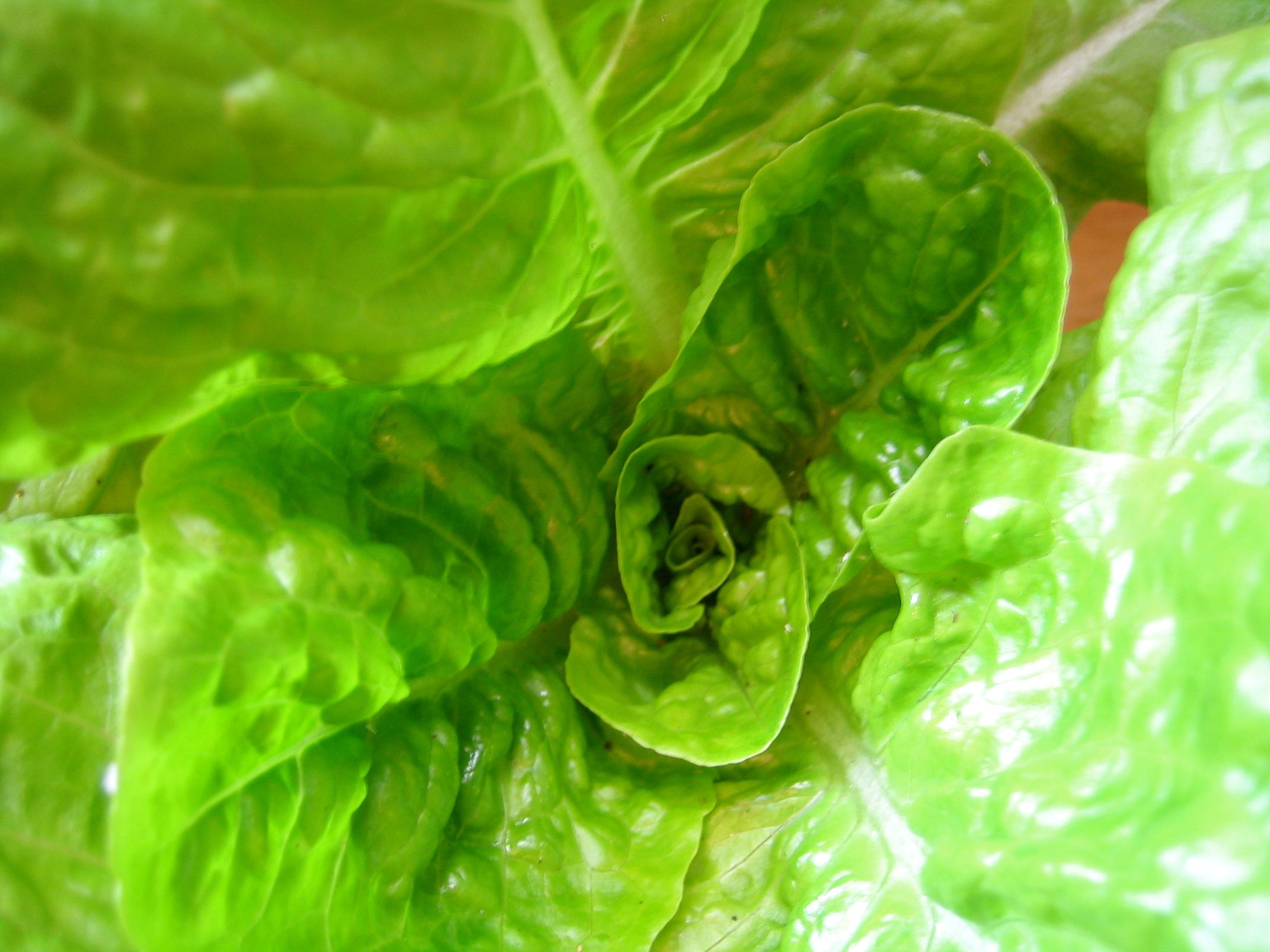
    I love these lush little gem lettuces, so much nicer than ice-berg and I eat one a day. They grow very quickly – from seedling to edible head in about three/four weeks.

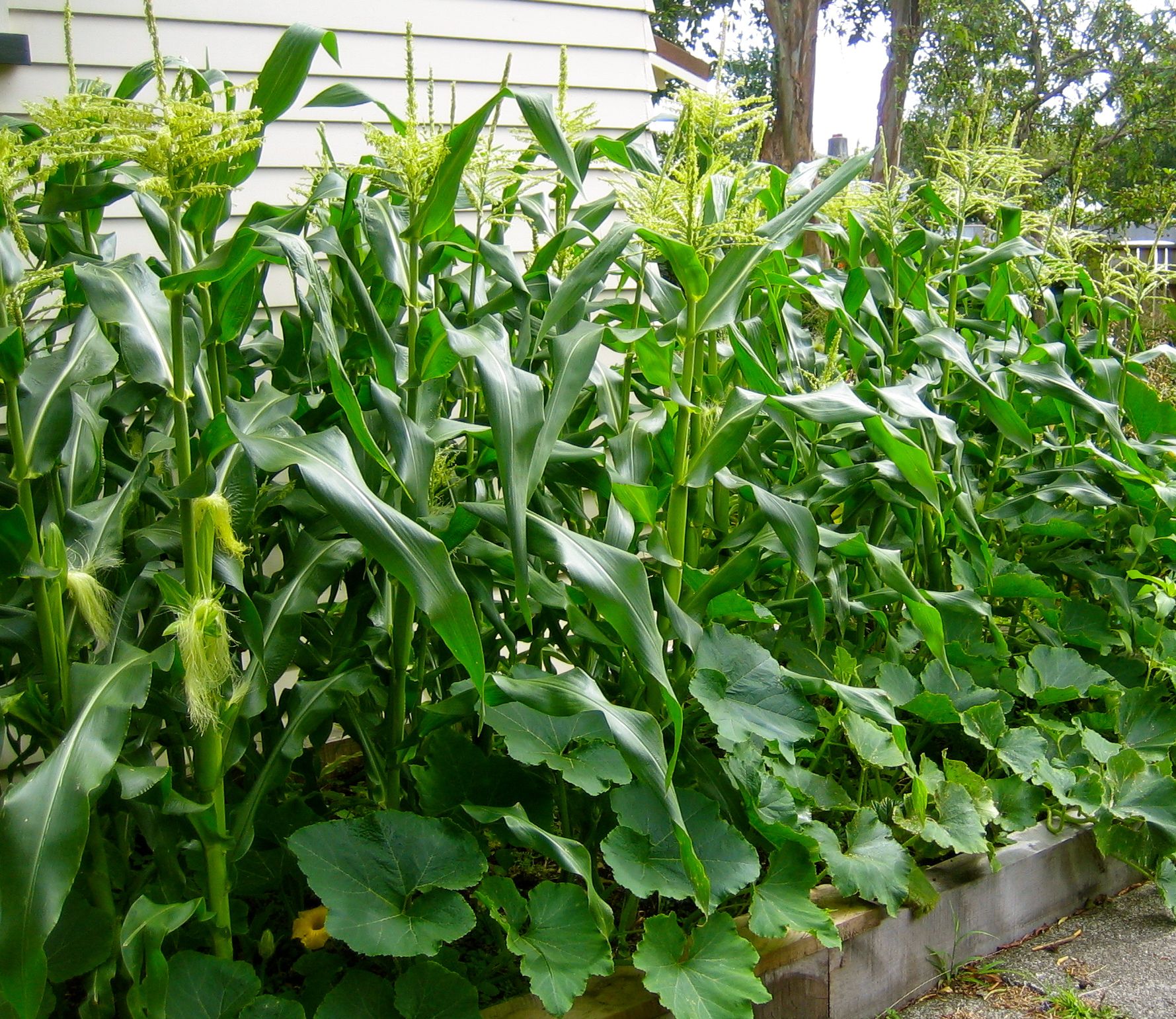
    The corn is nearly there – it seems like only yesterday I was pushing corn seeds into the warm earth…there are lots of pumpkins growing around the corn’s ‘feet’ too – we are going to have an abundant autumn!

    This is going to sound like such a cliche – but I swear, when I started growing my own vegetables, aged around 28 when I had my first baby, time seemed a lot slower and I was aware of my plants growing and can remember waiting patiently for crops to appear.

    Twelve years on, time seems to go a lot faster -I’m not sure if it is because of getting older, or because life is busier – and the seasons romp around. I feel like I turn my back for a second and the garden changes, vegetables appear, or plants die before I realised they were ailing.

  • corn bones

    I am always walking up or down the driveway – and the corn is getting bigger or it is just starting or it is gone. There is always something I am worrying about but the focus of the worry changes but the worry doesn’t change – it is tinnitus. Brain plaque. I am always wondering why my body is the way my body is because it is a curious nearly-40 body and it walked away and left my mind behind. Something happened to time that I don’t understand. How did I get so tired? When can I lay down? I don’t want to lie down. I have too much to do. I take photographs to remind me but they don’t remind me they just open windows, or maybe valves. The corn was hard seeds dropped into holes poked into the earth with my finger and now it is nearly as tall as me and I encourage it when I walk away and greet it as I come home. I’ll eat it with a bit of butter and too much salt when the time comes, if it stays standing, if it hasn’t been plagued by bugs. Will it be tough enough corn to hold a summer? Magnus calls corn cobs ‘corn bones’. The corn bones take years to break down in the compost so we are always throwing them back, and throwing them back but If I wait long enough it will all rot down.

  • manifest poetry

    Yesterday I found a bird skull in the garden while I was weeding.

    I like the way there is a little patch of feathers on the top of it’s head, like a macabre toupee.

    In one of those cases of art foreshadowing life, I wrote a poem a long while back about digging up bird skulls. It is in my book.

    I really did bury some bird bodies in the garden – however, that was at my old house, so this bird skull is not one of those that I buried.

    Since I wrote that poem, my cat died of throat cancer. I didn’t bury him in the garden, though. I had him cremated. His ashes are in a little white box on the mantlepiece, wrapped with a yellow ribbon.

    Here’s the poem:

    Latest Project

    I am curating the kills of my cat, collected

    with shovel, buried together in a yard-bird cemetery

    at the edge of the comfrey patch. Soil nourishment, for sure,

    but mostly because I want to dig up the skulls.


    A bird skull is a beautiful thing.

    Mechanics of bone, small sculpture with hinge of jaw,

    tiny teeth and spike of beak. When I dig them up

    I might make a necklace of skulls, like an urban Kali,

    goddess of change, of Your Time Is Up.


    Sparrow head, blackbird beak, thrush face,

    threaded on leather, fastened with wood.

    More likely, I would sit them in a neat row

    on a bookshelf in front of my orange Penguin classics.


    Or, more inevitably, I will forget.